All dishes / 北米
Poutine Period BOrigin theory CVerified
Some fields (dish name, region and gates) are shown from the Japanese-edition data.
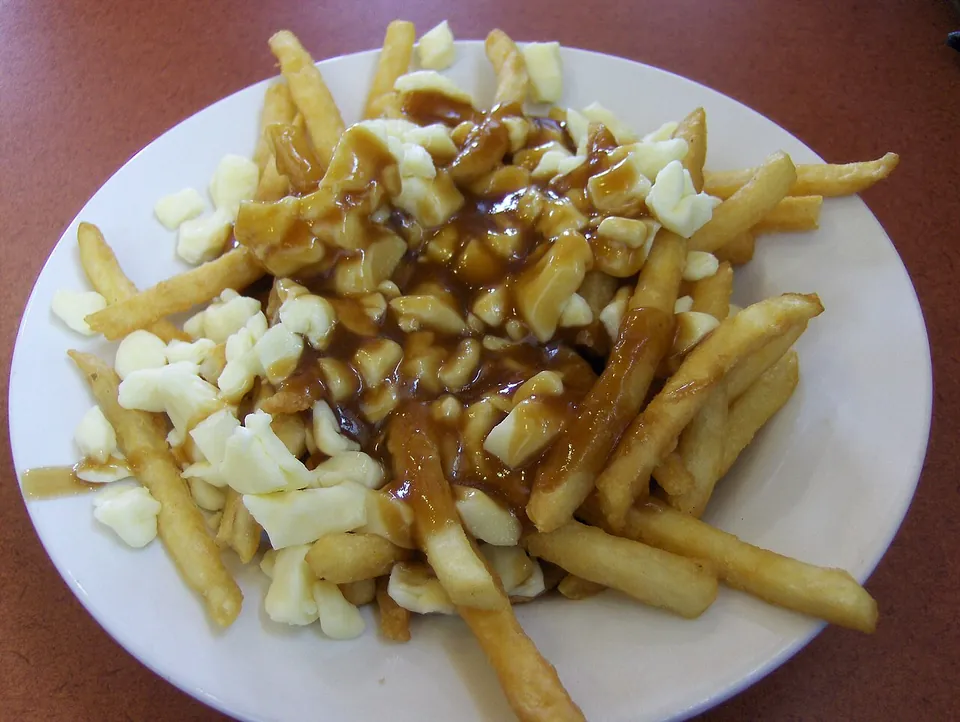
Poutine—fries under fresh cheese curds and hot gravy—is a Québécois dish whose "who made it first" question was never settled. Two towns, Warwick and Drummondville, each claim it, and food historians have come to a different conclusion altogether: that no single inventor can be named.
Verification highlight popular claim → verdict → evidence
Popular legend credits a single 1957 remark in Warwick or a 1958-64 debut in Drummondville, but no single inventor or town can be pinned down -- poutine likely emerged gradually across rural Centre-du-Quebec diners from the late 1950s to the mid 1960s. Key sources: Fabien-Ouellet, "Poutine Dynamics" (CuiZine, 2016); Oxford Companion to Cheese; Globe and Mail reporting.
The three gates
- Ingredient-supply gate
- Potato is a New World crop but was already native to the Americas. It is the limiting ingredient, but locally it arrived early -- the real lower bound is the emergence of the combination dish itself (20th century).
- Cooking-technique gate
- Deep-frying technique plus a steady supply of fresh cheese curds (regional dairy farms and cheese factories).
- Venue gate
- Rural roadside diners (casse-croute) spreading to cities and nationwide.
Overview
Poutine layers three things in one dish: French fries, fresh cheese curds, and hot gravy. It took shape in the rural interior of Québec, in the Centre-du-Québec region, between the late 1950s and the mid-1960s. The potato itself was an old crop of the Americas, long at home on Québec tables. Whether the dish could come together, then, did not turn on the supply of ingredients but on when the idea of stacking those three elements in one plate first appeared.
What gives poutine its character is the way fresh cheese curds are scattered over just-fried potatoes so that the heat half-melts them. Good curds have a squeak to them, a quality that fades quickly; they do not keep, and they must be made that day. Only in a place with dairying and a curd factory close enough to deliver fresh curds each morning can the dish become everyday food. The dairy-rich interior of Québec was exactly such a place. Add the frying equipment and the habit of ladling hot gravy over each order, and the modern form falls into place.
The stage for its spread was the rural roadside diner—the casse-croûte. As a quick, cheap plate it caught on locally, then moved to the cities and across Canada. That it began as humble everyday food is part of why the record of "who invented it" is so thin.
How we know
Poutine's birthplace has long been contested by two Québec towns. On one side is Warwick, where in 1957 Fernand Lachance, owner of Le Café Idéal, is said to have coined the name: adding cheese curds to a plate of fries, he supposedly exclaimed "ça va faire une maudite poutine!"—it'll make a damn mess. Gravy is said to have joined around 1962. On the other side is Drummondville, where Jean-Paul Roy, a trained saucier, offered the fries-curds-gravy combination from 1958 and, in 1964, renamed his restaurant Le Roy Jucep and listed it on the menu as "fromage-patate-sauce." In 1998 that restaurant even registered "Inventor of Poutine" as a trademark with Canada's intellectual-property office.
Each claim has a weak point. The Warwick story is a plausible tale about the name, but the early years were carried by word of mouth, and no contemporary record survives to support it. The Drummondville claim rests on being first to sell the three elements on one plate—yet first to sell is not the same as first to make. Food historians themselves are split, some crediting Warwick as the birthplace, others calling Roy the true inventor.
The history of the word cools the towns' claims. The word poutine, meaning a plate of fries with curds and gravy, appears in print no earlier than an article in the Sherbrooke newspaper La Tribune on 22 August 1977, reporting the dish's popularity around Drummondville, and then in the Montreal Gazette of 1980 (the OED's first citation). That is well after the 1957 and 1964 dates the restaurants claim. The year a word reaches print is not the year the dish was born. The word poutine itself is a dialect form of pouding (pudding); its older sense goes back to the early nineteenth century, and it is of a piece with the Acadian grated-potato dumplings, poutines râpées.
The scholarly view does not judge the rivalry so much as recast the question. In Fabien-Ouellet's study (2016) and in food-history surveys, several towns put out similar forms independently between the late 1950s and 1964, and because the early years were oral, the dish cannot be pinned to a single inventor or moment. The Oxford Companion to Cheese goes further: the inventors, it says, were not chefs but the customers who added curds to their fries. What can be stated with confidence reaches only this far—that in the roadside diners of Centre-du-Québec, between the late 1950s and the mid-1960s, the three elements came together—while which town gets the credit remains open. Poutine's origin dispute reads less as a mystery awaiting a verdict than as a case of a dish that had no single first hand to claim it.
The full set of origin theories and the detailed verification log — traceable all the way to their sources — are available on the Japanese edition.
See the full origin theories and verification log (Japanese) →
Related dishes
Shares the key ingredient
- Vada pavMumbai (India)C
- Proto-ajiaco (pre-chicken Muisca highland stew proto-layer)Bogotá highlands (Cundinamarca)C
- Pani puriNorth IndiaC
- Aloo kachoriIndia (Rajasthan / North India)C
- VichyssoiseFrance / USA (disputed)B
- Olivier saladMoscow (Russia)C
- Bacalhau à BrásLisbon (Portugal)C
- Caldo verdeMinho (Portugal)C
- Pav bhajiMumbai (India)C
- Abgoosht (dizi)IranC
- Jansson's temptationSwedenC
- California burritoCalifornia (USA)C
- Shepherd's pieEnglandB
- StamppotNetherlandsC
- Sindhi biryaniSindh (Pakistan)C
- Patties (Sri Lankan)Sri LankaC
- OkroshkaRussiaC
- Potato chipsUnited StatesB
- DranikiBelarusC