All dishes / 北米
Hamburger Period COrigin theory DVerified
Some fields (dish name, region and gates) are shown from the Japanese-edition data.
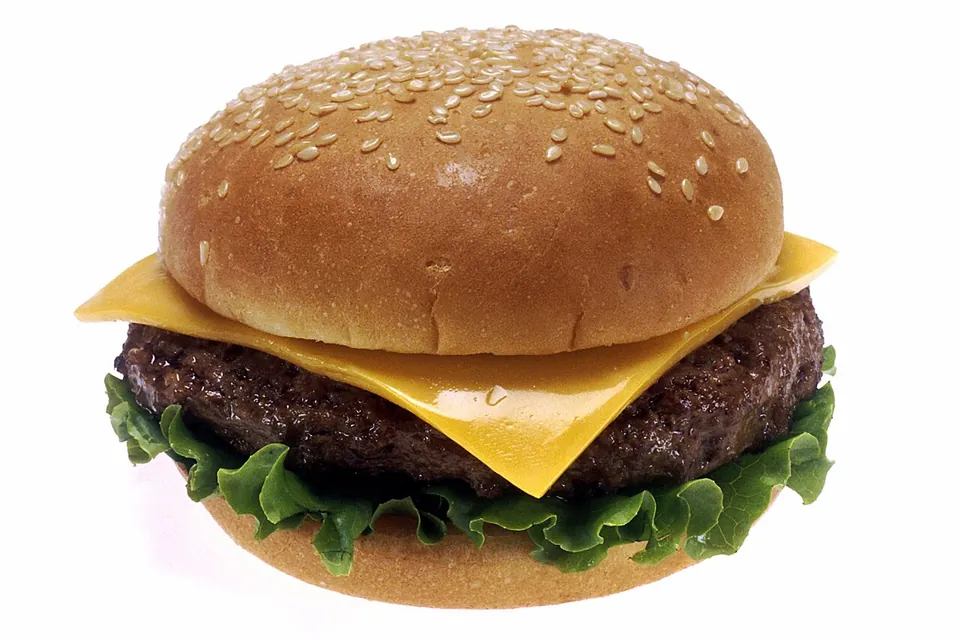
America's signature dish. Several towns step forward to claim they were the first to serve it, but which was the true birthplace cannot be verified from contemporary records. Among food historians, the settled view is that no single first can be named.
Verification highlight popular claim → verdict → evidence
Popular claim: a single inventor created the hamburger. The candidates include Louis Lassen of New Haven (1900, honored by the Library of Congress in 2000), Charlie Nagreen of Seymour, Wisconsin (1885), the Menches brothers, Fletcher Davis, and Oscar Bilby. Verdict: refuted as a single-origin story. No independent contemporary record has yet surfaced for any of these claims, and they do not converge. The earliest appearances in print, 'hamburger steak sandwiches' in a Texas newspaper of 1894 and 'hamburger sandwich' in the Chicago Daily Tribune of 1896, show the dish already on sale as street-stall, fair and saloon fare whichever legend one believes. Food historians hold that no single first inventor can be identified and that the dish emerged in parallel in several places; the 1885-1904 span is the range of the competing origin claims, not a dated window for when the dish took shape. The meat grinder had spread in America by about 1850, some thirty-five years earlier, so its arrival does not date the dish either. Key sources: Ozersky, The Hamburger: A History (Yale UP, 2008); Smithsonian Magazine; Smith, Encyclopedia of Food and Culture (Scribner, 2003).
The three gates
- Ingredient-supply gate
- Ground beef and bread were both long established in the United States. A patty could be made without any machine: an 1884 Boston cookbook (Mrs. Lincoln's broiled meat cakes) tells the cook to chop lean, raw beef quite fine. The meat grinder came into wide American use around 1850 (Smith, 2003), roughly thirty-five years before the 1885-1904 cluster of origin anecdotes, so it made cheap, uniform ground beef plentiful rather than making the dish possible. No imported ingredient was required, and nothing in the ingredients fixes an earliest possible date.
- Cooking-technique gate
- Grilling, chopping, and putting meat between bread were all long-familiar techniques in the United States and set no earliest date for the dish. The mechanical grinder replaced hand chopping; it did not make the dish possible for the first time.
- Venue gate
- Street stalls, lunch wagons, fairs, saloons, and diners. It was sold to city workers and fairgoers as portable food eaten by hand, with no knife, fork, or plate, and that is what separates it from Hamburg steak, which was served on a plate. The 1904 St. Louis World's Fair gave it national exposure and carried it further (Smith, 2003).
Overview
The hamburger we know today—ground beef, cooked and slid into a bun—took shape in the United States in the late nineteenth and early twentieth centuries. The Hamburg-style ground-beef steak, popular in nineteenth-century Germany, was carried across the Atlantic by immigrants, and in America the habit of putting it in a bun took hold.
Workers pouring into the cities wanted food that was cheap and quick to fill them. A ground-beef patty in a bun could be eaten standing, in a short break. World's fairs and other places where crowds gathered, the corner diner, the saloon and the street cart carried this food to a broad clientele and sent it across the country.
Uniform ground beef became cheap and plentiful once the meat grinder came into wide use; the hand-cranked grinder reached American butcher shops and kitchens around 1850. The patty itself, though, calls for no machine. A household cookbook published in Boston in 1884 tells the cook simply to chop lean, raw beef quite fine for its broiled meat cakes, and no grinder appears in the recipe. The anecdotes claiming to be the origin cluster between 1885 and 1904, some three decades after the grinder had spread.
How we know
Connecticut, Texas, Wisconsin, Oklahoma—town after town claims to be the birthplace of the hamburger. Each has its inventor and its tale of the first plate, and none will give ground. Charlie Nagreen of Seymour, Wisconsin (1885); Fletcher Davis of Texas (said to have won a following at the 1904 St. Louis World's Fair); Oscar Bilby of Oklahoma, who claims the first served on a bun (1891); and Louis' Lunch of Connecticut (1895–1900).
Yet for none of these tales is there any independent, contemporary record that can confirm it as the first. If anything, something recognizable as a hamburger appears in print earlier than the local claims. A Texas newspaper of 1894 carries 'hamburger steak sandwiches' (a saloon's bill of fare); the phrase 'hamburger sandwich' appears in the Chicago Daily Tribune of 1896. Whatever the truth of the origin legends, the food already existed at the turn of the century as fare of the street cart, the fair, and the saloon.
Louis' Lunch in Connecticut claims to have served the first in 1900, and it is said that in 2000 the Library of Congress recognized it as the originator. But that recognition was an honorific secured through the lobbying of a local member of Congress, not a matter of contemporary records bearing out the fact—and the earliest appearance in print, the 1894 Texas paper, is earlier still. The claim to a single 'first' remains without independent support.
Josh Ozersky, author of 'The Hamburger: A History' (Yale University Press, 2008), holds that none of the individual inventors' claims can be verified, and argues that the established view is precisely that no single first inventor can be identified. In Smithsonian magazine's reporting, the matter comes to rest on the same phrase: 'Maybe all of them.'
So the several claims stand side by side, none of them erased and none of them confirmed. In the records, the name of the first has still not been settled.
The full set of origin theories and the detailed verification log — traceable all the way to their sources — are available on the Japanese edition.
See the full origin theories and verification log (Japanese) →