All dishes / 東アジア
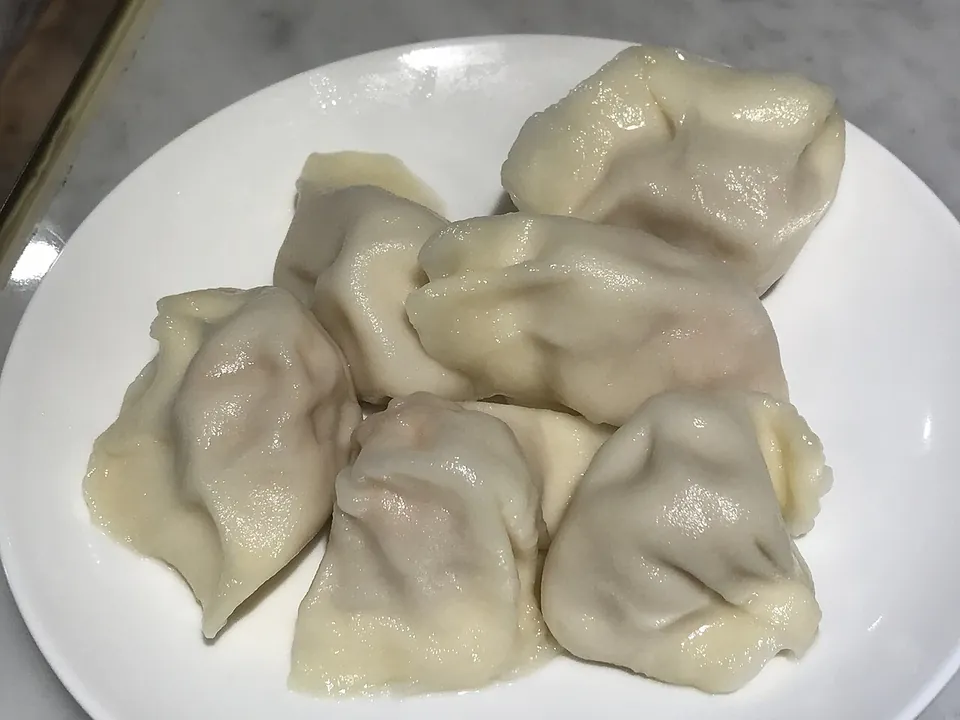
Jiaozi (gyoza) Period BOrigin theory CVerified
Some fields (dish name, region and gates) are shown from the Japanese-edition data.
The custom of eating jiaozi at the winter solstice and Lunar New Year is often traced to a single inventor: the Eastern Han physician Zhang Zhongjing, who is said to have wrapped ear-shaped parcels of medicine for people suffering from frostbite. But the recipe behind that story calls for chili peppers from the Americas, and on the question of when the dumpling was actually born, two answers still stand side by side, some 1,700 years apart.
Verification highlight popular claim → verdict → evidence
Several myths surround jiaozi. One credits physician Zhang Zhongjing with inventing it in the late Han dynasty using a chili-spiced recipe -- anachronistic, since chili peppers only reached China in the 16th-17th century, over a thousand years later. Another treats a 1978 Warring States-era tomb find in Shandong as proof the dish is 2,500 years old, but the original 1991 excavation report only tentatively called the triangular remains 'dumplings or early wonton,' a hedge often dropped in popular retellings. A Japanese legend that lord Tokugawa Mitsukuni was the first to eat jiaozi, taught by the Ming scholar Zhu Shunshui, rests on a glossary of vocabulary compiled decades after Zhu's death, not a record of any meal.
The three gates
- Ingredient-supply gate
- Wheat, though originally from West Asia, had arrived and become a local staple in ancient times; the fillings were also locally available. A milling culture was a precondition.
- Cooking-technique gate
- Wrapping fillings in wheat-flour dough and boiling, steaming, or pan-frying; this requires milling and dough-rolling skills.
- Venue gate
- A staple food and snack ranging from home kitchens to street vendors, becoming a dietary staple in northern China.
Overview
The heart of a jiaozi is wheat flour. Wheat came from far to the west, in western Asia, but it took root in China in antiquity, and with it grew a culture of milling grain and rolling the dough into thin wrappers. Filling those wrappers, then boiling, steaming, or pan-frying them, is the assembly of steps that makes a jiaozi a jiaozi.
The ancestor of that parcel first appears in writing in the Beihu Lu, an account of the customs and produce of Lingnan written by Duan Gonglu during his posting to Guangzhou in the ninth century. In a passage listing foods of the Southern Dynasties stands the name huntun bing, and the commentary of Cui Guitu quotes Yan Zhitui of the Northern Qi (c. 531–591) word for word: "the huntun of today is shaped like a crescent moon; it is eaten everywhere under heaven." An unleavened skin folded over a filling into a half-moon, in other words, was current across China by the sixth century at the latest. At this stage, though, the dumpling and the wonton had not yet parted ways.
Physical examples turn up in the Tang. From the Astana tombs at Turfan, a Silk Road waystation, dumplings and wontons survived in the dry ground. Archaeobotanical study of the excavated dumplings found they were formed from wheat and millet and dated between 499 and 640 CE — not far in time from the crescent-shaped huntun that Yan Zhitui described. These are the oldest surviving examples close to today's jiaozi.
The dumpling's own distinct names, jiaozi and jiao'er, appear in writing later still, in Dongjing Meng Hua Lu, the account of life in the Northern Song capital that carries an author's preface of 1147. Kaifeng already had all of it: jian jiaozi, fried, among the stalls of the Zhouqiao night market; shuijing jiao'er, "crystal jiao'er," on the list of a confectioner's wares; and shuangxia tuofeng jiaozi, which carries camel hump in its very name, at a palace banquet. It was in the Song that jiaozi spread widely, becoming a staple food in the north.
The same idea of wrapping filling in a skin is shared with the wonton, floated in broth, and with the leavened, puffed baozi. The wonton is a sister that branched from the same line of unleavened boiled parcels; the baozi grew from leavened dough on a different line, yet shares the same idea of wrapping filling in a wheat skin.
How we know
The best-known origin of the jiaozi is a legend of invention by Zhang Zhongjing, the revered physician of the late Eastern Han. For people whose ears had been damaged by frostbite, he is said to have made ear-shaped parcels filled with medicinal herbs, a soup called qu han jiao er tang, and this is held to be where the dumpling began. The story is also widely told as the reason people eat jiaozi at the winter solstice and Lunar New Year.
The trouble is that the legendary recipe contains chili pepper. Chili is a New World ingredient, and it did not reach China until the sixteenth and seventeenth centuries, in the late Ming. The Eastern Han belongs to the second and third centuries; in Zhang Zhongjing's lifetime, chili existed nowhere in China. The date of the story and its ingredients are out of step by more than a thousand years. On top of that, Zhang Zhongjing's only secure work is the Shanghan Zabing Lun; the jiao'er anecdote is absent from contemporary records and appears to have been passed down as a later oral tradition.
None of this denies the genuine age of the jiaozi as a kind of food. Ask when it was born, though, and two answers stand side by side. One follows the trail that texts and objects allow: from the crescent-shaped huntun Yan Zhitui described in the sixth century, through the Tang dumplings at Turfan, to the moment in Song Kaifeng when the name jiaozi settles on the thing. The other places the birth of the dumpling some 1,700 years before that, in the Spring and Autumn period.
In October 1978, at the ancient city of Xue in Zhangwang, Tengzhou, Shandong, excavators opened the tomb of a late Spring and Autumn period noble and found, inside a bronze food vessel, small white triangular foods laid out in neat rows. Each was 5 to 6 cm long and 3.5 to 4 cm across at its widest. A white powder from old mould coated their surfaces; they were carbonized, and crumbled at the touch of a bamboo skewer. Reading these as dumplings puts the birth of the jiaozi some 2,500 years ago in Shandong, the land of the ancient Dongyi.
The excavation report published in Kaogu Xuebao in 1991, however, does not call them dumplings outright. What it set down was shuijiao huo zaoqi huntun — boiled dumplings, or else early wontons — a reading offered with an explicit reservation. The triangular shape is the only handle: filling remains inside, but not enough of it to say what it was, and whether the skin was wheat flour is unknown. The find is confined to the vessels of a single tomb, and roughly a thousand years separate it from the Tang dumplings at Turfan.
What travels beyond the town, even so, is the confident version. Tengzhou celebrates itself as the birthplace of the dumpling, and Shandong regional news drops the report's reservation: the excavators, it says, recognized from the shape that this food was jiaozi, and the discovery pushes the origin of the dumpling back more than 2,500 years. Delete the "or else" that the report put there, and a hypothesis wears the face of a fact.
Is the sixth-century side any firmer? Not entirely. Huntun is often said to appear already in the Guangya, a dictionary of the Three Kingdoms period — but that attribution, too, comes by way of the same Tang commentary in the Beihu Lu, which quotes the Guangya as glossing the word. And the Qimin Yaoshu, the agricultural manual compiled in the sixth century, close to Yan Zhitui's own time, sets out wheat-flour foods in detail across its four volumes on food — bai bing, shao bing, sui bing, shui yin, bo tuo — with no entry for a parcel folded round a filling and boiled. What carries the sixth-century huntun to us is, for now, a book written nearly three hundred years later. The triangles laid in a Spring and Autumn tomb, or the slow accretion that begins with a sixth-century crescent: neither answer has settled the matter, and both remain in play.
Stories about the dumpling's beginnings are not told in China alone. In Japan, a well-worn account has it that the first person in the country ever to eat a dumpling was Tokugawa Mitsukuni, lord of Mito, the figure popular culture knows as Mito Kōmon. Zhu Shunshui, a Ming loyalist scholar who took refuge in Japan after the dynasty fell, is said to have introduced him to fukutsutsumi, a parcel filled with duck, pine nuts and goji berries. The source named is always the same book: the Shunsui Shushi Danki.
That book, though, records no meal. Compiled at Mitsukuni's order by his retainer Asaka Tanpaku out of Zhu Shunshui's answers to questions from his Japanese students, its final volume sorts Chinese vocabulary into categories — heaven and earth, human relations, food and drink — and gives each word a reading and a brief gloss. Mooncakes and jiaozi stand in the food section as Chinese words explained to Japanese pupils. A word entered in a glossary and a dish set before someone and eaten are two different things.
The printing is far from the events as well. The book carries a preface of 1707 and was published in Kyoto in 1708: twenty-six years after Zhu Shunshui died in 1682, and seven years after Mitsukuni's own death. The details in circulation wobble, too. Some retellings put the presentation of fukutsutsumi in 1689, by which time Zhu Shunshui had been dead for seven years. The widely read Japanese Wikipedia article on gyoza in Japan hangs the whole sentence on a single footnote, a web magazine piece from 2024. Nor is this the first tale of its shape. Mitsukuni was long said to have been the first in Japan to eat ramen, in 1697, until in 2017 an entry in the Inryōken Nichiroku, the diary of a Muromachi-period monk, showed noodles called keitaimen made and served to guests in 1488, carrying the record back some two centuries.
None of this rules out that Mitsukuni tasted a Chinese filled parcel; that remains perfectly possible. What is not certain is that the Shunsui Shushi Danki writes down any such moment, or that the first person in Japan to eat a dumpling can be named at all. In any case, the jiaozi that Edo-period Japan knew was known as a foreign custom — as in the Shinzoku Kibun of 1799, the survey of Chinese daily life that the Nagasaki magistrate Nakagawa Tadateru had compiled from interviews with Qing merchants — and not as anything eaten at Japanese tables. The pan-fried gyoza eaten in Japan today comes from elsewhere: from the prewar Japanese communities of the Kwantung Leased Territory and Manchuria, and from the repatriates who brought it home after 1945.
The full set of origin theories and the detailed verification log — traceable all the way to their sources — are available on the Japanese edition.
See the full origin theories and verification log (Japanese) →
Related dishes
Cross-links Sister dishes & same-name dishes (separate lineage)
- Sister dish (shared ancestor)Wonton noodlesGuangzhou (China)C
- Sister dish (shared ancestor)BaoziChinaC
Shares the key ingredient
- PierogiPolandC
- EmpanadaRío de la Plata (Argentina)C
- BliniRussiaB
- PirozhkiRussiaB
- CheburekiCrimea (Crimean Tatar)C
- BelyashiVolga-Ural (Tatar / Bashkir)C
- JalebiNorthern IndiaB
- Fortune cookieCalifornia (USA)C
- StroopwafelGouda (Netherlands)C
- LamingtonQueensland (Australia)C
- ChimichangaTucson, Arizona (USA)C
- BuuzMongoliaB
- YantıkCrimea (Crimean Tatar)C
- VarenykyUkraineC
- MandaziEast Africa (Swahili Coast)C
- LángosHungaryC
- Daoxiaomian (knife-cut noodles)Shanxi (China)C
- KhuushuurMongoliaB
- Dobos torteHungaryB
- SambusaEast Africa (Swahili Coast)B
- SarburmaCrimea (Crimean Tatars)B
- ThenthukTibet / NepalB
- ShumaiGuangzhou (China)B
- Hohhot shaomaiHohhot (China)B
- OliebollenNetherlandsC
- MarquesitaYucatán (Mexico)D
- Halwa puriLahore (Pakistan)D
- Roti prataSingaporeB
- SopaipillaNew Mexico (USA)C
- CoyotaSonora (Northern Mexico)C
- RunzaMidwestern United StatesB
- BanshMongoliaC
- Kashyk-ash (къашыкъ-аш, Crimean Tatar spoon-dumpling soup)Crimea (Crimean Tatar)C
- KulebyakaRussiaB
- Spring roll (Chinese)ChinaC
- ChuchvaraUzbekistan (Samarkand / Fergana)C
- DamperAustraliaC
- SamsaCentral AsiaC
- HalushkyUkraineC
- BanitsaBalkans (Bulgaria)C
- Har gowGuangzhou (China)C