All dishes / 東アジア
Wonton noodles Period BOrigin theory CVerified
Some fields (dish name, region and gates) are shown from the Japanese-edition data.
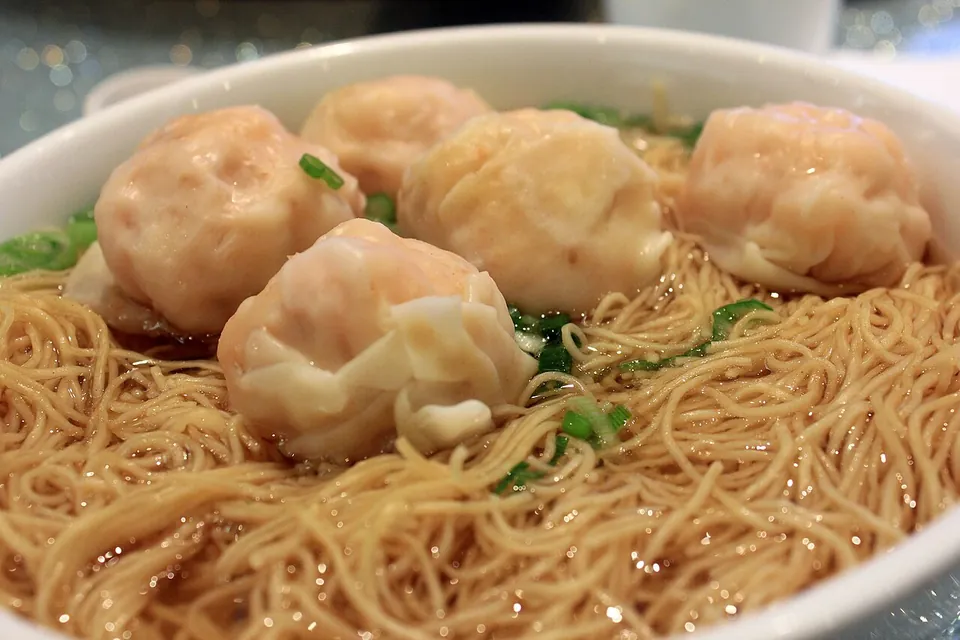
Wonton noodle soup, the pride of Guangzhou. Shrimp-filled wontons and springy thin noodles in a clear broth—a bowl that took its present shape in the Qing dynasty, when an old dumpling met the noodles of Canton.
Verification highlight popular claim → verdict → evidence
A popular claim traces Mak's Noodle back to a founding in 1856 in Guangzhou, but this doesn't appear in the shop's own official history — the earliest verified record places founder Mak Woon-chi as the 'king of wonton noodles' in 1920s Guangzhou, with the Hong Kong branch opening only in 1968. The dish itself descends from wonton (餛飩), a dumpling attested since the Han-Tang era, merged with alkaline bamboo-pressed noodles in Guangzhou during the late Qing and Republican periods (19th-20th c.).
The three gates
- Ingredient-supply gate
- Wheat, shrimp, and pork were all locally available. What the dish requires is thin alkaline noodles (bamboo-pressed noodles).
- Cooking-technique gate
- Wontons are wrapped, thin noodles are boiled, and both are served in broth.
- Venue gate
- Street food and teahouse snack in Guangzhou.
Overview
Wonton noodle soup sets wontons—filled with shrimp and pork—alongside thin wheat noodles in a clear broth. The noodles are a distinctive kind called zhusheng noodles, made with lye water (kansui). The name comes from the way the dough is pressed: a cook rides a bamboo pole, leaning body weight onto it to compress the dough, which gives the noodles their firm bite and clean snap.
The leads—wheat, shrimp and pork—were all old ingredients rooted in Canton, on the table from early on. A thin-skinned wonton wrapped around shrimp met noodles pressed with lye water, and the two came together as a single snack in a clear broth. Sold at Guangzhou's street stalls and teahouses, the bowl had also settled into Hong Kong by the first half of the twentieth century, and it continues there today.
How we know
Trace the two parts of wonton noodle soup separately and the dates spread far apart.
The wonton itself is old. Yang Xiong's Fangyan of the Former Han already records that 'a cake is called tun,' and from the late Northern and Southern dynasties into the Sui, Yan Zhitui wrote of the huntun as 'shaped like a half-moon, eaten everywhere under heaven.' By the written record alone, it was eaten across all of China by the sixth century. The wonton is a dim sum that runs back from that distant layer.
The present Cantonese bowl—shrimp added to the filling, the skin made thin, paired with lye-water thin noodles—is far younger. During the Tongzhi reign of the Qing, a man from Hunan is said to have opened the Sanchu noodle house on Beijing Road in Guangzhou, and this is remembered as the start of the current form; in the Republican era the zhusheng noodle (once called the bamboo-pole noodle) was established in Xiguan by reworking a northern technique. By around 1930 the bowl was being eaten in Hong Kong as well.
That gap between the old and the new is where founding legends fasten on. One that tourist guides and blogs often repeat holds that Mak's Noodle was founded in Guangzhou in 1856. But that year appears nowhere in the shop's own history. What the official account records is only its founder, Mak Woon-chi, remembered as the 'king of wonton noodles' in 1920s Guangzhou, and the opening of the Hong Kong shop on Gilman Street in Central in 1968; the 1856 date does not rise above hearsay.
No one person can be said to have invented wonton noodle soup. An old wonton gathered Canton's filling and noodles to itself little by little, taking form gradually within the region. The search for a single inventor at its origin stays open.
The full set of origin theories and the detailed verification log — traceable all the way to their sources — are available on the Japanese edition.
See the full origin theories and verification log (Japanese) →