All dishes / 東アジア
Daoxiaomian (knife-cut noodles) Period BOrigin theory CVerified
Some fields (dish name, region and gates) are shown from the Japanese-edition data.
A noodle from Shanxi in northern China. The famous origin tale — that under Mongol rule of the Yuan dynasty, with blades confiscated, people shaved dough into noodles with a thin sheet of iron — is widely told, but it has no backing in contemporary sources: a later invention, and just when and by whom the shaving began is still unknown.
Verification highlight popular claim → verdict → evidence
Two legends compete over knife-cut noodles, and neither has a source behind it. The better known has the Mongol rulers of the Yuan confiscating household knives for fear of Han rebellion, leaving one blade to every ten families, so that a thin sheet of iron was used to shave the dough instead. The other credits Chai Shao, son-in-law of the Tang imperial house, improvising with his sword in the field. The Yuan tale can be traced only to modern compilations of Shanxi culinary lore, not to any record from the time, and the shaving technique is thought to be older, reaching back to Song-period Taiyuan, which the legend's date cannot accommodate. What can be followed is the wheat noodle culture of Shanxi, some two thousand years deep, in which the technique took shape and was handed down: a stiff block of dough in one hand, a curved blade shaving slivers into the pot. The name of the technique has yet to be traced to a dated appearance in print, and the classical Chinese text collections that are searchable online carry almost no noodle vocabulary of any kind, so their silence settles nothing. No inventor and no date of invention can be named from the sources. The technique was listed as national intangible cultural heritage in 2008.
The three gates
- Ingredient-supply gate
- Wheat has been grown in northern China since early times. What holds the date is the shaving technique rather than the supply of wheat, and evidence for when that technique appeared has not been established.
- Cooking-technique gate
- A distinctive way of making noodles: a stiff block of dough held in one hand while a curved blade shaves slivers of it straight into boiling water.
- Venue gate
- The noodle culture of Shanxi, in the streets and the eating houses.
Overview
What kind of noodle
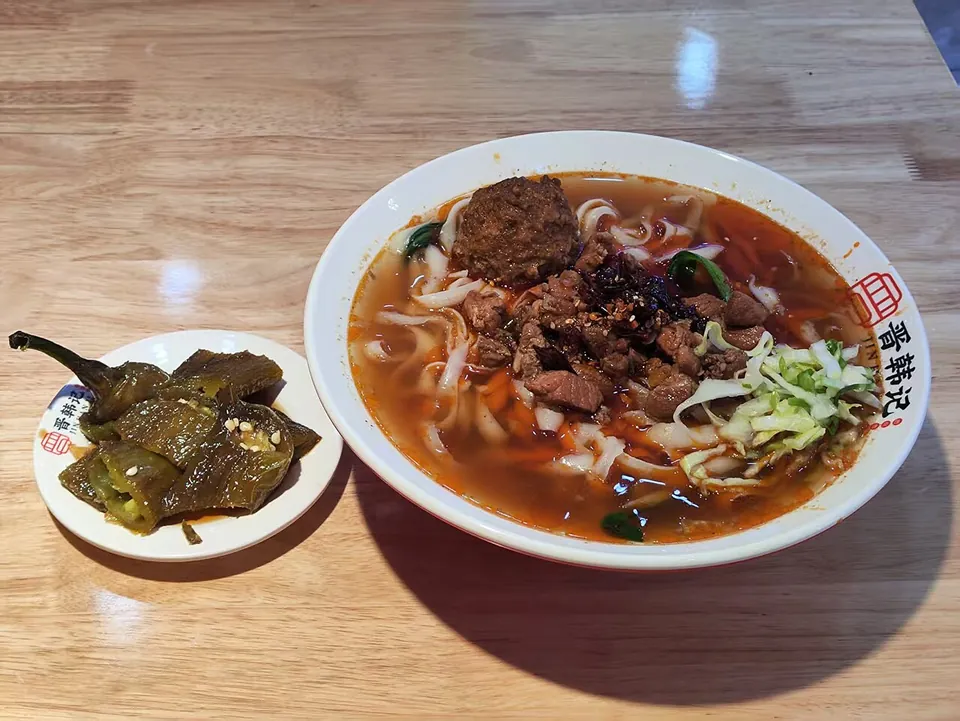
Dao xiao mian is a noodle made by holding a lump of stiffly kneaded wheat dough in one hand and shaving it, with a special curved knife, straight into a pot of boiling water. Not cutting a sheet of dough with a cleaver, nor stretching it by hand, but flicking off one sliver at a time from the block — that is its defining feature. The shaved noodle comes out thick in the middle and thin at the edges, shaped like a willow leaf, smooth on the outside and chewy at the core. It cooks the moment it hits the water and is served with soup or with stir-fried toppings.
Within the noodle culture of Shanxi
The home of this noodle is Shanxi Province in northern China. Wheat has been grown across the North China Plain since ancient times, and a long history of noodle cooking has settled into this land. Kneading, stretching, cutting, shaving, and extruding — a wide range of noodle-making techniques were honed in daily life, and dao xiao mian was handed down as one of them.
Shaving a lump of dough into the water with a knife calls for the right tool and real skill. In a land where noodle-making had taken root as an everyday craft, this shaving motion was widely passed on and settled in as a specialty served at street stalls and eateries. In 2008 it was registered as a national intangible cultural heritage as a noodle dish representing Shanxi, and by at least that point it was clearly known as a firmly established local taste. Who first began shaving, and when, is written down nowhere in the records of noodle history, and its beginning remains in the mist.
How we know
Dao xiao mian comes with two rousing tales of its origin.
One is set in the Yuan dynasty: under Mongol rule, rulers fearing rebellion by the Han Chinese confiscated even household cleavers, allowing only one blade for every ten households. So, the story goes, people shaved dough into noodles with a thin sheet of iron — and that was the beginning of dao xiao mian. The other is set in the Tang dynasty, and tells of Chai Shao, a son-in-law of the imperial house, who on the battlefield, lacking proper cooking tools, shaved dough with a knife into noodles. Both are vivid as stories and have been retold again and again at tourist sites and in travel guides.
Yet no contemporary record supports either tale. Trace the source of the story that begins with the Yuan-dynasty seizure of blades, and it leads to an anecdote in a regional food gazetteer compiled in modern times; it does not appear in the first-hand sources of that era. It is a tale attached to the noodle long after the fact. And the Yuan tale and the Tang tale disagree over the very era of the beginning.
So when was it really born? Even paging through food-history studies that trace the history of Chinese noodles, the very technique of shaving dough into noodles with a knife is written down neither in the noodle records reaching back to the Later Han, nor in the history of noodle development from the Song through the Qing. It was likely a craft passed from hand to hand among artisans, never committed to writing. So once the rousing origin legends are set aside, what remains for certain is a single point — that this shaving technique grew up within Shanxi's long culture of wheat-noodle eating — while the inventor and the exact date of its emergence are, in the sources, still blank.
The full set of origin theories and the detailed verification log — traceable all the way to their sources — are available on the Japanese edition.
See the full origin theories and verification log (Japanese) →
Related dishes
Shares the key ingredient
- PierogiPolandC
- EmpanadaRío de la Plata (Argentina)C
- BliniRussiaB
- PirozhkiRussiaB
- CheburekiCrimea (Crimean Tatar)C
- BelyashiVolga-Ural (Tatar / Bashkir)C
- JalebiNorthern IndiaB
- Fortune cookieCalifornia (USA)C
- StroopwafelGouda (Netherlands)C
- LamingtonQueensland (Australia)C
- ChimichangaTucson, Arizona (USA)C
- BuuzMongoliaB
- YantıkCrimea (Crimean Tatar)C
- VarenykyUkraineC
- MandaziEast Africa (Swahili Coast)C
- LángosHungaryC
- KhuushuurMongoliaB
- Dobos torteHungaryB
- SambusaEast Africa (Swahili Coast)B
- SarburmaCrimea (Crimean Tatars)B
- ThenthukTibet / NepalB
- ShumaiGuangzhou (China)B
- Jiaozi (gyoza)ChinaC
- Hohhot shaomaiHohhot (China)B
- OliebollenNetherlandsC
- MarquesitaYucatán (Mexico)D
- Halwa puriLahore (Pakistan)D
- Roti prataSingaporeB
- SopaipillaNew Mexico (USA)C
- CoyotaSonora (Northern Mexico)C
- RunzaMidwestern United StatesB
- BanshMongoliaC
- Kashyk-ash (къашыкъ-аш, Crimean Tatar spoon-dumpling soup)Crimea (Crimean Tatar)C
- KulebyakaRussiaB
- Spring roll (Chinese)ChinaC
- ChuchvaraUzbekistan (Samarkand / Fergana)C
- DamperAustraliaC
- SamsaCentral AsiaC
- HalushkyUkraineC
- BanitsaBalkans (Bulgaria)C
- Har gowGuangzhou (China)C