All dishes / 東アジア
Spring roll (Chinese) Period BOrigin theory CVerified
Some fields (dish name, region and gates) are shown from the Japanese-edition data.
The idea that the spring roll was invented in a particular dynasty or a particular year mistakes what its making really was. This dish is the product of a long transformation: over several centuries, an old custom of wrapping raw greens as a lucky food at the start of spring turned into something fried.
Verification highlight popular claim → verdict → evidence
A continuous documentary chain runs from a Jin-dynasty five-herb platter through a Tang-dynasty spring platter to an actual deep-fried recipe recorded in a 14th-century cookbook.
The three gates
- Ingredient-supply gate
- Wheat, pork, and vegetables were all native ingredients; no limiting ingredient.
- Cooking-technique gate
- Rolling thin wheat wrappers around a filling and deep-frying them.
- Venue gate
- From the Start of Spring custom of eating chunpan (the spring platter) to dim sum and street snacks.
Overview
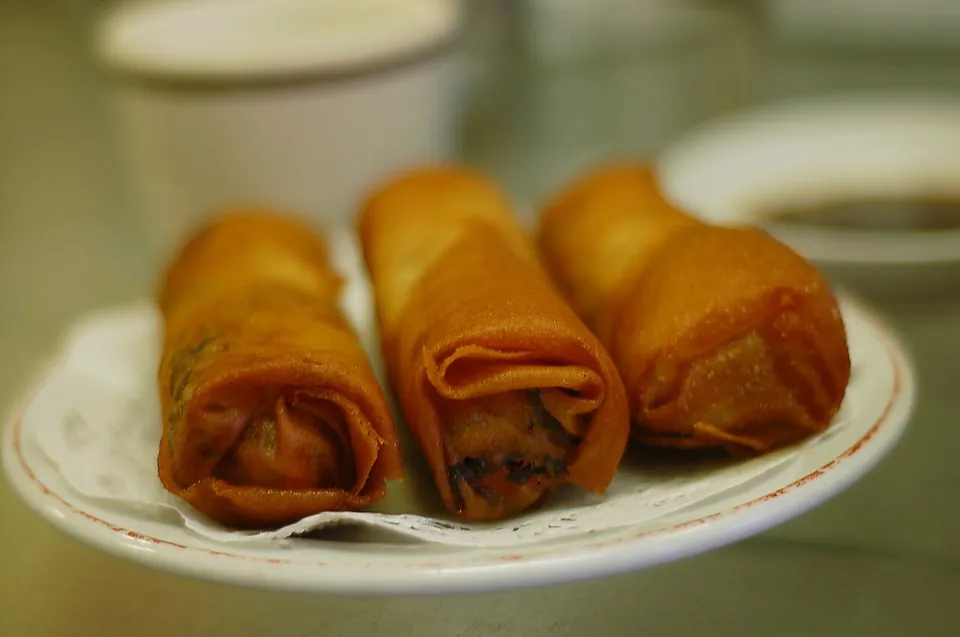
The Chinese spring roll (chunjuan) is a rolled, fried food, familiar today as a dim sum item and a street snack. It was not fried from the start, however. Trace its source and you arrive not at a dish but at a seasonal food custom.
Ancient China had a practice of eating five pungent vegetables together at the year's opening. In time, on the first day of spring, people would arrange radish, raw greens, and a thin griddled cake and eat this as a lucky dish — a way of "eating spring." This manner of wrapping raw vegetables in a thin skin and eating them is the direct ancestor of the later spring roll. Poets recorded the dish on their spring tables, a sign that it was already widely enjoyed.
What made the spring roll a spring roll was the arrival of frying. The method of frying the rolled skin in oil appears in cookbooks well after the custom of wrapping raw greens. From a raw lucky dish to a fried food with a crisp, standing skin: this turn widened a seasonal festival food into something eaten year-round. The name chunjuan ("spring roll") is said to have settled into use later still.
The main ingredients were all long present on Chinese tables. The wheat flour of the skin, the pork and bamboo shoots of the filling — each was an established local ingredient. So the spring roll's course was shaped not by whether new ingredients could be had, but by when the technique of rolling and frying appeared, and in which region it joined which fillings.
Today's spring roll does not settle into a single form. In the south it is fried with a varied filling; around Shanghai the main fillings are pork, shiitake, and napa cabbage — skin, filling, and cooking all differ by region. Much of the fried spring roll that spread to Japan and Southeast Asia takes the southern deep-fried line as its model. It is more accurate to see a many-branched family of dishes, split region by region from a common ancestor: the raw spring-greens roll of early spring.
How we know
In which dynasty, in what year, was the spring roll invented? The question has often been given a single answer: "born in the Ming," or "founded when it was named in the Qing." But this way of telling has a trap in it.
The year a spring roll first appears in an old text shows only that the dish existed by at least that year. Because it is listed in one dynasty's cookbook does not mean it was invented in that dynasty. In fact, long before the frying method is recorded, the custom of wrapping raw greens for the start of spring came first. Take the era when the name settled and call it the origin, and you overlook centuries of prehistory whole.
The spring roll's course was a line, not a point. There was an old habit of eating pungent vegetables at the year's opening; it took shape as a lucky roll of raw greens at the start of spring; it turned into a fried food; and it branched by region in filling and skin. Each stage carried forward the one before, and no single point can be cut out and called "the beginning." Assigning the origin to a particular year or dynasty is set aside because it does not fit this continuous transformation.
This lineage of rolls reached beyond China as well. The rolling-and-frying that began as a lucky food of early spring crossed to Vietnam and joined the local rice-flour skin to become chả giò. A single seasonal food custom changed shape over a thousand years and, crossing borders, put down roots inside another food culture. The real interest of the spring roll lies not in who invented it but in this long, ever-changing road itself.
The full set of origin theories and the detailed verification log — traceable all the way to their sources — are available on the Japanese edition.
See the full origin theories and verification log (Japanese) →
Related dishes
Cross-links Sister dishes & same-name dishes (separate lineage)
Shares the key ingredient
- PierogiPolandC
- EmpanadaRío de la Plata (Argentina)C
- BliniRussiaB
- PirozhkiRussiaB
- CheburekiCrimea (Crimean Tatar)C
- BelyashiVolga-Ural (Tatar / Bashkir)C
- JalebiNorthern IndiaB
- Fortune cookieCalifornia (USA)C
- StroopwafelGouda (Netherlands)C
- LamingtonQueensland (Australia)C
- ChimichangaTucson, Arizona (USA)C
- BuuzMongoliaB
- YantıkCrimea (Crimean Tatar)C
- VarenykyUkraineC
- MandaziEast Africa (Swahili Coast)C
- LángosHungaryC
- Daoxiaomian (knife-cut noodles)Shanxi (China)C
- KhuushuurMongoliaB
- Dobos torteHungaryB
- SambusaEast Africa (Swahili Coast)B
- SarburmaCrimea (Crimean Tatars)B
- ThenthukTibet / NepalB
- ShumaiGuangzhou (China)B
- Jiaozi (gyoza)ChinaC
- Hohhot shaomaiHohhot (China)B
- OliebollenNetherlandsC
- MarquesitaYucatán (Mexico)D
- Halwa puriLahore (Pakistan)D
- Roti prataSingaporeB
- SopaipillaNew Mexico (USA)C
- CoyotaSonora (Northern Mexico)C
- RunzaMidwestern United StatesB
- BanshMongoliaC
- Kashyk-ash (къашыкъ-аш, Crimean Tatar spoon-dumpling soup)Crimea (Crimean Tatar)C
- KulebyakaRussiaB
- ChuchvaraUzbekistan (Samarkand / Fergana)C
- DamperAustraliaC
- SamsaCentral AsiaC
- HalushkyUkraineC
- BanitsaBalkans (Bulgaria)C
- Har gowGuangzhou (China)C