All dishes / 東アジア
Shumai Period BOrigin theory BVerified
Some fields (dish name, region and gates) are shown from the Japanese-edition data.
The name shumai is often explained by a legend: two brothers in Hohhot, dividing the family business, named the dish for the dumplings they would "sell on the side." Yet that name already appears in fourteenth-century records, three hundred years before the legend begins.
Verification highlight popular claim → verdict → evidence
A popular legend holds that in the late Ming or early Qing dynasty, two brothers in Hohhot split their steamed-bun business, with the younger brother inventing an open-topped bun to sell 'on the side' -- but this is refuted by a 14th-century Korean Chinese-language textbook, the Bak Tongsa, which already records shaomai being sold in the Yuan-dynasty capital Dadu (modern Beijing) roughly three centuries earlier, pushing the dish's origin back to Yuan-era northern China before its later refinement as a Cantonese teahouse classic.
The three gates
- Ingredient-supply gate
- Wheat, pork, and shrimp were all locally available; the limiting factor was the thin wheat-flour wrapper, which required flour-milling and skin-making skill.
- Cooking-technique gate
- Filling is wrapped in a thin wheat skin, left open at the top, and steamed, in the dim sum style.
- Venue gate
- Originated in Cantonese teahouse dim sum culture before spreading elsewhere in China and abroad.
Overview
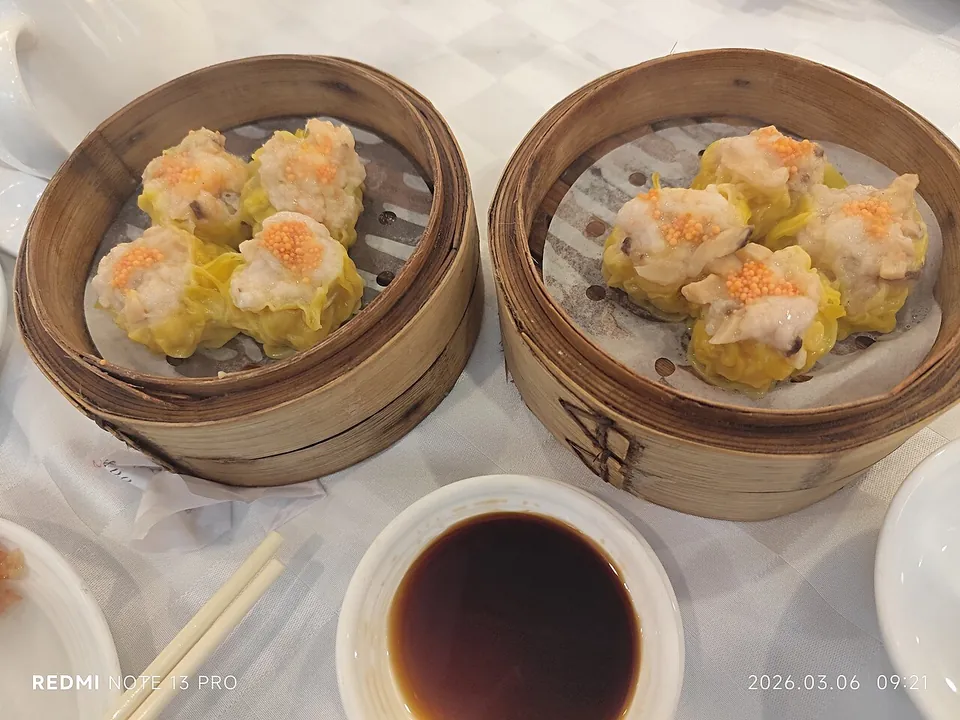
Shumai is a small dim sum: a thin wheat wrapper folded around a filling of pork and shrimp, left open at the top and steamed. The wheat of the wrapper and the pork and shrimp of the filling had all long been on Chinese tables. What makes the dish itself is the handwork, rolling the skin thin enough to show the filling through it and pleating the top open like a flower before steaming.
Its beginnings lie in northern China under the Yuan dynasty, in the fourteenth century. Shaomai (shumai), born in the region around Hohhot in Inner Mongolia, spread with the traffic of Shanxi merchants to Beijing and Tianjin, then traveled south to reach the teahouses of Guangzhou and Hong Kong. At the yum cha table it was polished into a star of the dim sum cart alongside har gow and the like, taking on the refined form we know today. Guangdong is the place that made shumai known to the world, but it is not the dish's cradle.
How we know
There is a familiar tale about how shumai got its name. In Guihua (present-day Hohhot) at the turn of the Ming and Qing, so the story goes, two brothers who sold baozi split the household; to divide the income, the younger brother steamed a separate batch of thin-skinned, open baozi to "carry along and sell" (shao dai zhe mai), and so they came to be called shaomai. Other tales of the name, that the Qianlong Emperor coined it, or that it honors Kublai Khan, were added in the same vein.
But the name shumai appears in writing far earlier than the seventeenth century of the legend. The Piao Tongshi, a Chinese-language conversation primer compiled in Korea in the mid-fourteenth century, records "su suan xian shaomai" sold in Dadu (present-day Beijing), and a note of the same period even sets down the handwork: a thin wheat skin wrapped around meat, steamed, with pleats made at the crown like flower stamens. Kim Moon-kyung's study (Geibun Kenkyu, 2013) placed the compilation of the Piao Tongshi in the late Yuan, the second half of the fourteenth century, dating it from internal evidence such as the sixth year of Zhizheng (1346) in the text. That is roughly three hundred years before the tale of the Hohhot brothers.
Since both the name and the method were already present in fourteenth-century Dadu, the seventeenth-century Hohhot legend cannot be the origin of the dish or its name. At most it explains, for that one place, where people thought the word came from, and the account in the local gazetteer Suiyuan Tongzhi Gao (1937) is likewise a later reading of the name. Where a word is said to come from is not where a dish comes from. In the same way, because yum cha is so strongly tied to Guangdong, many take Guangdong to be the birthplace of shumai. But this too mistakes the place where it settled and was refined for the place where it began. The first time the name is written down lies not in Guangzhou to the south but in Dadu to the north.
The full set of origin theories and the detailed verification log — traceable all the way to their sources — are available on the Japanese edition.
See the full origin theories and verification log (Japanese) →
Related dishes
Cross-links Sister dishes & same-name dishes (separate lineage)
Shares the key ingredient
- PierogiPolandC
- EmpanadaRío de la Plata (Argentina)C
- BliniRussiaB
- PirozhkiRussiaB
- CheburekiCrimea (Crimean Tatar)C
- BelyashiVolga-Ural (Tatar / Bashkir)C
- JalebiNorthern IndiaB
- Fortune cookieCalifornia (USA)C
- StroopwafelGouda (Netherlands)C
- LamingtonQueensland (Australia)C
- ChimichangaTucson, Arizona (USA)C
- BuuzMongoliaB
- YantıkCrimea (Crimean Tatar)C
- VarenykyUkraineC
- MandaziEast Africa (Swahili Coast)C
- LángosHungaryC
- Daoxiaomian (knife-cut noodles)Shanxi (China)C
- KhuushuurMongoliaB
- Dobos torteHungaryB
- SambusaEast Africa (Swahili Coast)B
- SarburmaCrimea (Crimean Tatars)B
- ThenthukTibet / NepalB
- Jiaozi (gyoza)ChinaC
- OliebollenNetherlandsC
- MarquesitaYucatán (Mexico)D
- Halwa puriLahore (Pakistan)D
- Roti prataSingaporeB
- SopaipillaNew Mexico (USA)C
- CoyotaSonora (Northern Mexico)C
- RunzaMidwestern United StatesB
- BanshMongoliaC
- Kashyk-ash (къашыкъ-аш, Crimean Tatar spoon-dumpling soup)Crimea (Crimean Tatar)C
- KulebyakaRussiaB
- Spring roll (Chinese)ChinaC
- ChuchvaraUzbekistan (Samarkand / Fergana)C
- DamperAustraliaC
- SamsaCentral AsiaC
- HalushkyUkraineC
- BanitsaBalkans (Bulgaria)C
- Har gowGuangzhou (China)C