All dishes / 東欧
Salo Period COrigin theory CVerified
Some fields (dish name, region and gates) are shown from the Japanese-edition data.
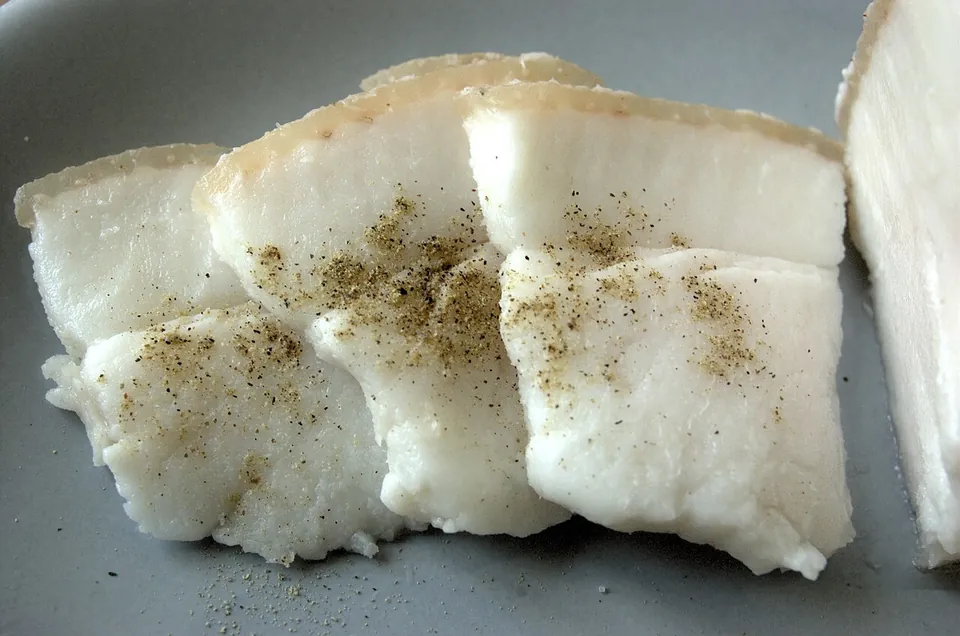
Salo is cured pork fatback, preserved with nothing but salt. It has become a national icon of Ukraine—yet trace its history and the question of when it first appeared only dissolves into fog.
Verification highlight popular claim → verdict → evidence
A claim that pig domestication on Ukrainian territory reaches back 13,000 years does not hold up; domestication happened in the Near East and reached the region only in the Neolithic. Salo turns out to combine an old Slavic preservation practice with a much broader pan-European cured-fat tradition. Main source: Columella's De re rustica (1st century Rome), alongside the Proto-Slavic root sadlo.
The three gates
- Ingredient-supply gate
- Pig husbandry and salt production were both native and long established; the limiting ingredient, pork back fat, was a native staple.
- Cooking-technique gate
- Preservation of fat through salting and smoking.
- Venue gate
- A rural preserved food that became a national icon.
Overview
Salo is pork fatback cured and kept with salt. Sliced thin onto bread or melted into a dish, it is woven deep into Ukrainian life and is now cherished as a national icon.
The ingredients are startlingly simple: pork fatback and salt, nothing more. Pigs were long established on the farms of this land, and salt, too, was at hand early. You bury the fat in salt and let it rest, sometimes smoking it over wood, and what you get is a food dense with energy that keeps for a long time. For a farming village bracing for a hard season, few stores were as dependable.
The very name speaks to a depth rooted in this land. It goes back to Proto-Slavic *sadlo, "pork belly fat," and lives on widely in neighboring Slavic tongues—Polish sadło, słonina and others. The way of life that stores fat from pig and salt has traveled a long stretch of time alongside this word.
How we know
When salo was born is not clear. That is less for want of records than because cured pork fat is so old and was so widespread that no single moment of origin stands out. Two views of its history sit side by side.
One sees it as a native Slavic village preserve. The antiquity behind that claim, though, has often been stretched much further back than it will go. Etnocook, a site introducing Ukrainian cooking, dates the domestication of pigs on the territory of modern Ukraine to 13,000 BC. Pig domestication took place in the Near East, in the second half of the ninth millennium BC. Domestic pigs from around 5500 BC at Neolithic sites in Romania carry the Near Eastern Y1 haplotype, marking Europe's domestic pigs as animals carried west with the whole Neolithic package of farming and herding (Larson et al., PNAS, 2007). What is old here is not the beginning of domestication but the husbandry that took hold afterwards: in the settlements of the Cucuteni–Trypillia culture (c. 5400–2700 BC), spread across what is now Ukraine, Moldova and Romania, pigs account for 28 percent of the domestic animal bones (Shukurov et al.).
Even so, the point at which a text can be said to name this—salo specifically—turns up surprisingly late. Even the sixteenth-century household manual the Domostroy, often cited as the first mention, reads on a second look as if it means animal fat in general. The Russian word сало, after all, covers animal fat broadly: as late as the 1816 cookbook Russkaya Povarnya, salo meant beef tallow, and pork fat went by a different name. The word may be old, but pinning down when it meant the salt-cured pork fatback we call salo today is hard to do.
The other view does not treat cured pork fat as uniquely Ukrainian at all, seeing it instead as part of a pan-European tradition of preserved fat reaching back to antiquity. Here the texts survive far earlier. Roman agricultural writers already describe salt-curing pork fat, and the first-century Columella, in Book XII, chapter 55 of his De re rustica, sets out a procedure—boning, salting, smoking to preserve the fat—almost indistinguishable from salo today. This record of cured meats from antiquity through Byzantium has been traced by recent scholarship (a study in the journal Studia Ceranea, 2014) surveying the sources. That kindred products line up across Central, Eastern, and Southeastern Europe—słonina, szalonna, slănină—shows this to be a broad tradition with no single inventor and no single birthplace.
Both views say the same thing in the end: salo is no one person's invention. From pig and salt, two everyday materials, the same knowledge grew up on its own in the ancient Mediterranean and in the Slavic countryside alike. Search for a single point of origin and you will not find it—and that absence of an answer is itself the measure of how old and how widespread this preserve is.
The full set of origin theories and the detailed verification log — traceable all the way to their sources — are available on the Japanese edition.
See the full origin theories and verification log (Japanese) →
Related dishes
Shares the key ingredient
- TonkatsuJapanC
- Tacos al pastorMexicoB
- FeijoadaBrazilB
- Barbecue ribsSouthern United StatesC
- CurrywurstBerlin (Germany)B
- Twice-cooked reheated pork (Huiguorou precursor)Sichuan, ChinaC
- ChicharrónPeru / Latin AmericaB
- ChicharrónMexicoB
- ChicharrónColombiaB
- BaoziChinaC
- Chop sueyUSA (Cantonese diaspora) / Guangdong (China)C
- Cochinita pibilYucatán (Mexico)C
- LechonCebu (Philippines)C
- Bak kut tehSingaporeC
- GolonkaPolandC
- GyrosGreeceB
- EisbeinBerlin (Germany)C
- SchweinshaxeBavaria (Germany)C
- Japanese-style twice-cooked porkJapanB
- ManchamantelesPuebla (Mexico)C
- PernilPuerto RicoC
- ChoripánRío de la Plata (Argentina)C
- Char siuGuangdong (China)C