All dishes / 西欧
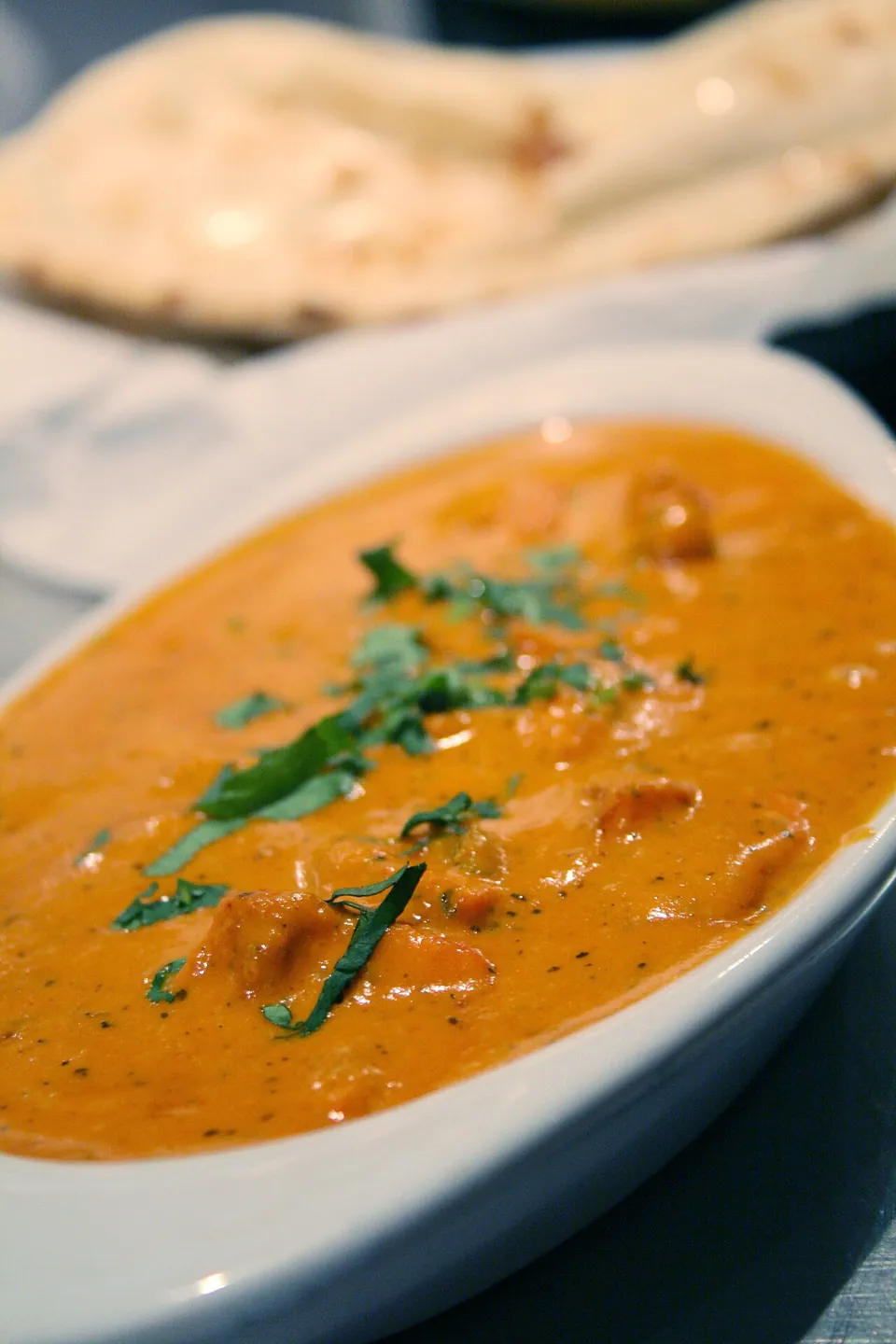
Chicken tikka masala Period BOrigin theory CVerified
Some fields (dish name, region and gates) are shown from the Japanese-edition data.
The famous origin story is that a Glasgow chef improvised chicken tikka masala one night in 1971 by stirring a can of tomato soup into a customer's curry. That tale has collapsed: even people close to the claim have called it a fabrication.
Verification highlight popular claim → verdict → evidence
Popular claim: chicken tikka masala was invented in 1971 at Glasgow's Shish Mahal by chef Ali Ahmed Aslam using tinned tomato soup. Verdict: refuted as a later-fabricated story -- the tale's own tellers (Grove and Wahhab) admitted inventing it. The dish did emerge from British Indian/Bangladeshi curry houses in the mid-to-late 20th century, but no single inventor or restaurant can be verified. Key sources: Encyclopaedia Britannica; Buettner, Journal of Modern History (2008).
The three gates
- Ingredient-supply gate
- Indian-style chicken plus a British-adapted gravy
- Cooking-technique gate
- Cooking practices of British Indian restaurants
- Venue gate
- Curry houses
Overview
Chicken tikka masala looks like a dish of India, yet it was born in Britain. It took shape over the second half of the twentieth century, broadly from the 1960s into the 1970s, in the Indian- and Bangladeshi-run curry houses of the United Kingdom. This British origin is firm ground, backed by reference works, by the press, and more recently by academic scholarship.
The dish is a product of the accumulated craft of British curry houses. At its base is chicken tikka, pieces of chicken cooked in a tandoor oven, a technique carried over from India. Around this Indian roast chicken the cooks wrapped a mild, creamy tomato sauce, toned down to suit the British palate. It helps to picture it as a gentler, British-facing cousin of North Indian butter chicken, and indeed the two stand in exactly that sister-dish relationship, one softened for local tastes. Immigrant cooks kept nudging the spiced flavours of home toward what their regular customers liked, and out of that meeting halfway the dish emerged.
The earliest trace of it in writing goes back to 1975, when the words 'tikka masala' appeared in the New York Times, the first citation dictionaries can follow. But that is the first time the name reached print, not the first time the dish was cooked. The food itself was almost certainly being served in British curry houses before then.
That it was born in Britain is solid; naming the one shop or one cook who made it first is another matter entirely. Around the same period, a number of restaurants were reportedly serving much the same thing side by side, and there is no way to pin down who was first. Chicken tikka masala is a dish whose place and era are visible while its very first plate stays hidden in the mist.
How we know
Whenever the origin of chicken tikka masala comes up, one anecdote is sure to follow. In 1971, at a restaurant called Shish Mahal in Glasgow, a cook is said to have reached for a can of Campbell's tomato soup to finish a customer's curry, and to have invented the dish on the spot: a single-inventor story with a single hero.
That story has already been set aside. It cannot be firmly corroborated, and even those around the restaurant have treated it as a fabrication, so as history it does not hold up. What settled the matter came in 2009. The city of Glasgow tried to register the dish as a local speciality under the European Union's protected-origin scheme. The bid failed, because far too many establishments claimed to have invented it. A 1998 curry restaurant guide recorded as many as forty-eight different ways of making it. That is hardly the picture you would expect if one cook had dreamed it up on a single day.
So what remains once the Glasgow story is set aside? Only the firm outline: that the dish was born in British curry houses in the later twentieth century, with no identifiable first plate. This is the shared view of reference works and scholarship. The historian Elizabeth Buettner, writing in a scholarly journal, supports the same picture, of a dish that Britain's South Asian restaurants shaped by reworking Indian cooking for British tastes.
A few competing readings sit alongside this outline. Some trace the dish to North Indian butter chicken; others point to a similar recipe in Mrs Balbir Singh's 'Indian Cookery' of 1961 as a forerunner. Each lacks a decisive proof and simply stands next to the others. There has even been a claim that the dish reaches back five thousand years to ancient India, but that merely dresses it in a false, invented antiquity and rests on nothing.
The real interest of chicken tikka masala is not the answer to who made it first, but the conclusion that the question cannot be settled. Even after the glamorous single-inventor myth is dismissed, the origin stays open, and telling that honestly is what it means to do the dish justice.
The full set of origin theories and the detailed verification log — traceable all the way to their sources — are available on the Japanese edition.
See the full origin theories and verification log (Japanese) →
Related dishes
Cross-links Sister dishes & same-name dishes (separate lineage)
Shares the key ingredient
- Wat (pre-chili Ethiopian stew, earlier layer)Ethiopian HighlandsC
- AjiacoBogotá, ColombiaB
- Jerk chickenJamaicaC
- Soto ayamJava (Indonesia)C
- ShkmeruliGeorgiaB
- Khao man gaiThailandB
- Hainanese chicken riceHainan (China) → SingaporeC
- MoambeCongo (Central Africa)C
- Nyembwe chicken (Poulet nyembwe)Gabon (Central Africa)C
- Chicken yassaSenegalC
- Chicken KievKyiv (Ukraine)C
- Circassian chicken (Çerkez tavuğu)Turkey (Ottoman court) / CaucasusB
- Sopa de limaYucatán (Mexico)C
- White cut chickenGuangdong (China)C
- Ohn no khao swèMyanmarC
- Kedjenou layer (canari steam-braise)Côte d'IvoireC
- WaterzooiFlanders (Belgium)C
- Soup currySapporo (Japan)B