All dishes / 南アジア
Upma Period BOrigin theory CVerified
Some fields (dish name, region and gates) are shown from the Japanese-edition data.
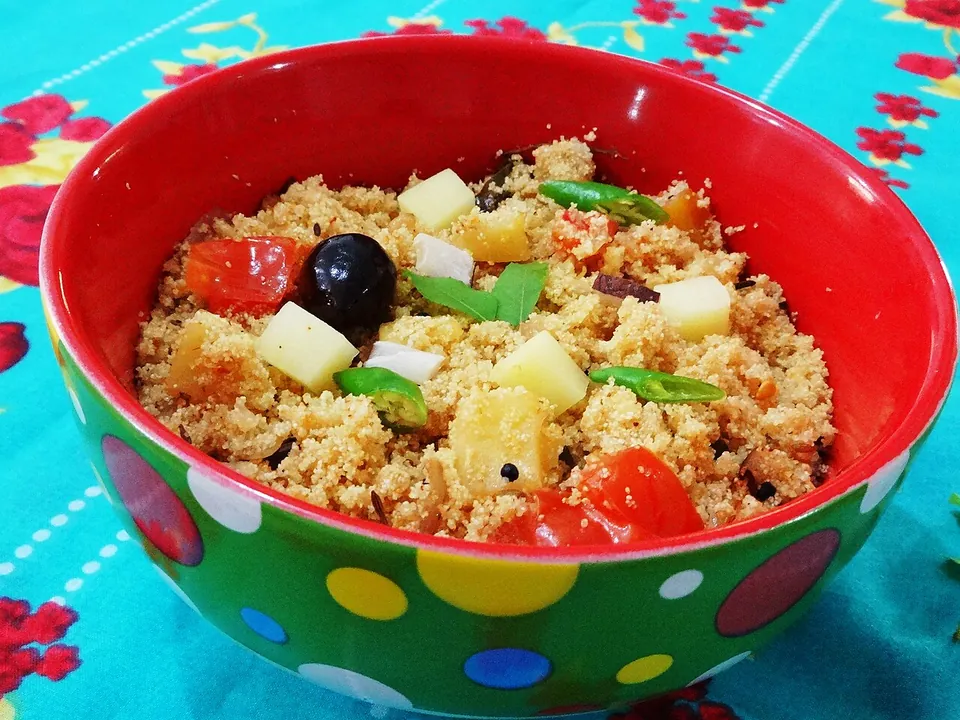
Upma is a South Indian breakfast staple. Its now-standard semolina form is a relatively recent one: it spread in the twentieth century when, amid wartime rice shortages, wheat was urged on households as a substitute for rice.
Verification highlight popular claim → verdict → evidence
The now-dominant semolina (rava) upma is often assumed to be the 'original' form. Verdict: it is instead a 20th-century development, promoted by British colonial authorities as a rice substitute during WWII grain shortages (wartime rice diversion); an older layer of upma made from rice and other native grains is attested in an 1891 Tamil cookbook, Hindu Pakasastra (T.K. Ramachandra Rau), predating the semolina form.
The three gates
- Ingredient-supply gate
- Wheat is native to South Asia; the limiting factor is provisionally the cheap, roller-milled distribution of semolina (rava) in the modern era.
- Cooking-technique gate
- Tempering (tarka) of grains, followed by roasting and simmering.
- Venue gate
- South Indian home cooking and the tiffin (light-meal) tradition.
Overview
Upma is a South Indian dish in which grain is toasted and simmered in oil that has first been tempered—the tarka technique—with mustard seeds and urad dal for aroma. It sits deep in the culture of home breakfasts and tiffin, the light meals of the day. Its name comes from uppu, meaning salt, and mavu, meaning grain flour; it was never, in origin, tied to any one grain.
The version most common today uses wheat semolina, known as rava. Wheat is a long-established crop in South Asia, but this form spread through households only once roller milling put cheap semolina within reach in the markets. The tempering that gives the dish its aroma is an established local technique; combined with the semolina that circulated widely in the modern period, it produced the upma of the present day.
How we know
Upma as a category is older than semolina. A Tamil-language cookbook printed in Madras in 1891, the Hindu Pākaśāstra of T.K. Ramachandra Rau, includes a "sada (plain) upma," and in its original form the dish was a toasted-and-simmered preparation of local grains such as rice. A separate book of the same title—the English Pakasastra of C.V. Ramasawmy, printed in Madras in 1836—belongs to a different line and is not the source of this 1891 sada upma. The name uppu plus mavu likewise points to grain flour in general, not to wheat semolina in particular. The older layer of upma was made from local grains.
The ground for the semolina version to become dominant was already being laid in the colonial period. McCay's 1912 nutritional research ranked wheat above rice as a grain, and the British promotion of wheat had been accumulating as a discourse since around that time. On that groundwork, the rice shortage of the Second World War became the occasion that pushed the substitute into general use. When Rangoon fell in 1942, imports of rice from Burma—then roughly fifteen percent of India's rice supply—were cut off, and in June of that year the Madras Presidency banned the export of rice. The squeeze on rice in South India thus became real, leading on to the Bengal famine of 1943. Wheat semolina was urged as a replacement for rice, and through free cookery classes and nutritional advocacy, semolina upma became widely established in the first half of the twentieth century. The same wheat-substitution can be seen in rava idli, which MTR in Bangalore created in the early 1940s.
Two layers thus overlie one another in upma: an old layer of toasted local grain, and the semolina version that spread through the colonial-to-wartime promotion of wheat. The age of the dish category itself is real; and yet the spread of the rava upma now taken as standard has a comparatively recent starting point in the modern circulation of semolina.
The full set of origin theories and the detailed verification log — traceable all the way to their sources — are available on the Japanese edition.
See the full origin theories and verification log (Japanese) →