All dishes / 北米
Caesar (Bloody Caesar) Period BOrigin theory BVerified
Some fields (dish name, region and gates) are shown from the Japanese-edition data.
The Caesar is a Canadian cocktail of tomato juice, vodka, and clam broth. A Calgary restaurant manager did assemble the drink in 1969, but the telling that "he invented a one-of-a-kind drink out of nothing" overlooks a line of clam-based cocktails that had been running for some years before.
Verification highlight popular claim → verdict → evidence
Walter Chell is credited with inventing the Caesar in 1969 at Calgary's Marco's restaurant, mixing crushed clams, tomato juice, vodka, and spices -- the account The Canadian Encyclopedia records as standard. However, combining clam, tomato, and vodka was not original to Chell: similar cocktails (such as the 1968 Clamdigger) already existed, and Mott's had independently commercialized Clamato in 1966. Chell's real contribution was establishing the specific 'Caesar' as Canada's signature cocktail, not inventing the underlying concept.
The three gates
- Ingredient-supply gate
- What held the dish back was the commercialization of Clamato juice (tomato plus clam broth) in the 1960s; tomato itself is a New World native, but the packaged juice's availability sets the lower bound.
- Cooking-technique gate
- Cocktail mixing.
- Venue gate
- Restaurants and bars in Calgary.
Overview
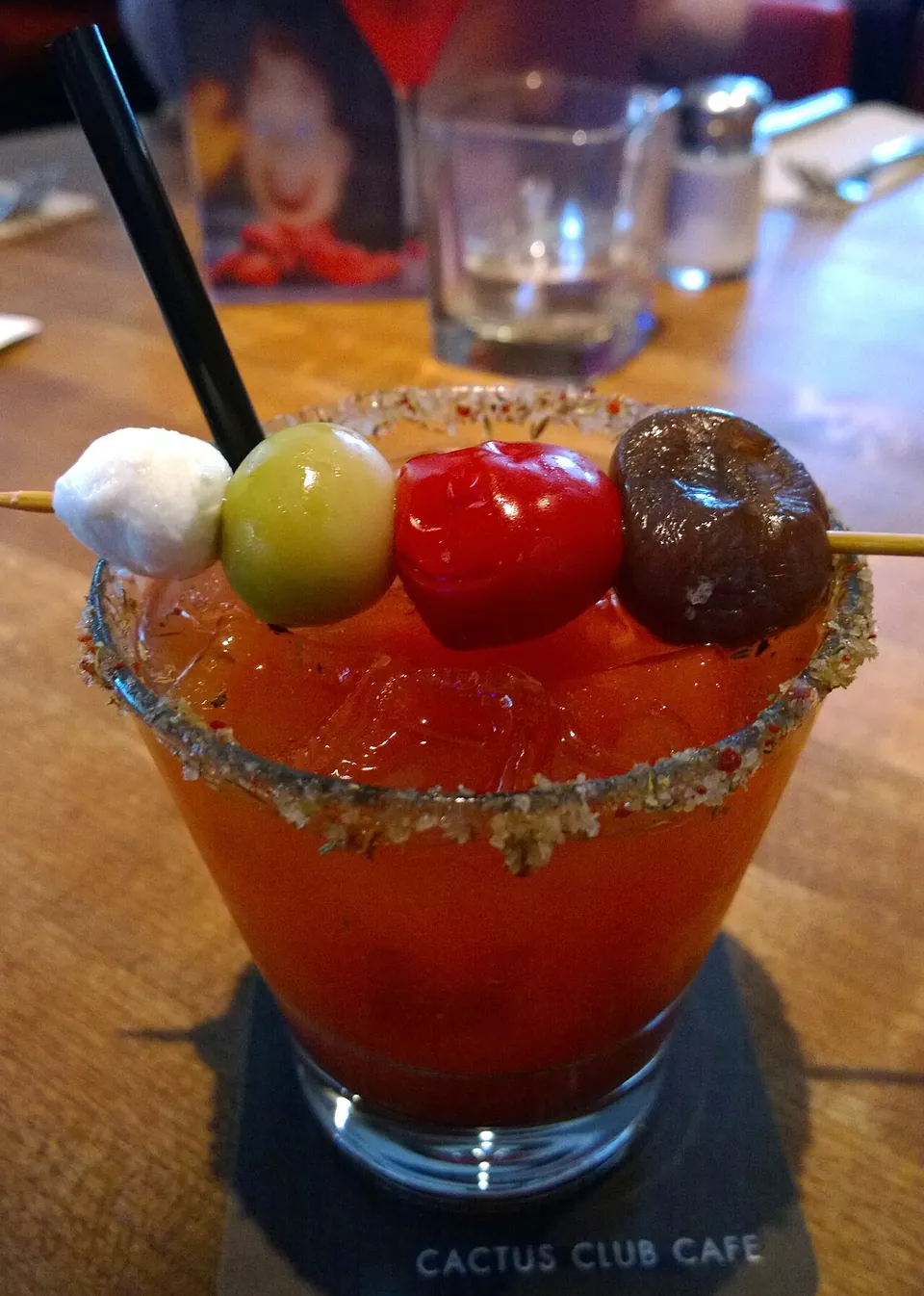
The Caesar (Bloody Caesar) is built on Clamato juice—tomato juice with clam broth dissolved into it—combined with vodka, spices, and lime. Beloved in Canada as a national drink, its color and briny flavor give it a distinctive place among the red cocktails.
The key to this drink is a beverage that melds clam broth and tomato. Combining the two by the glass takes effort, but once a pre-mixed Clamato appeared as a bottled product, a bartender could put a glass together quickly at the counter. Clamato reached store shelves as an industrial product when Mott's (Duffy-Mott) commercialized it in 1966. Tomatoes had long been a New World ingredient, but a processed drink pairing them with clam did not become available by the bottle until that year.
Three years after that beverage arrived in stores, in 1969, the drink took shape at the Calgary Inn in Calgary, Alberta. For the opening of the Italian restaurant Marco's, the manager Walter Chell is said to have prepared a drink of crushed-clam broth with tomato juice, vodka, and spices. A British regular's remark—"that's a damn good bloody Caesar"—is said to be the source of the name. The drink could only have existed after 1966, when Clamato appeared as a product.
How we know
The Caesar carries a telling that ties its origin to a single person: that Walter Chell invented, from nothing, a drink the world had never seen. That a glass was assembled in Calgary in 1969 is itself recorded as settled fact by The Canadian Encyclopedia and is not in dispute. What is at issue is whether that glass was an "invention out of nothing."
Cocktails combining clam broth, tomato, and vodka existed before the Caesar. The Bloody Mary a La Milo (1951), the Imperial Clam Digger (1962), and the Clamdigger (1968) were among the earlier clam-based drinks, and Clamato itself had been commercialized by Mott's in 1966 along a separate current from Chell's. In other words, Chell was not the originator of the "clam plus tomato plus vodka" idea.
This does not diminish what Chell did. What he established was a particular Canadian standard called the Caesar. Mott's Clamato sales surged after the Caesar caught on—by 1994, seven-tenths of Canadian sales were for Caesars—and that fact tells of the firm place this drink built within the family of cocktails. Not the inventor of the idea itself, but the one who rooted a standard: seen that way, he sits comfortably with both the line of earlier clam-based cocktails and the clear 1969 record of the drink's creation.
The full set of origin theories and the detailed verification log — traceable all the way to their sources — are available on the Japanese edition.
See the full origin theories and verification log (Japanese) →