All dishes / ラテンアメリカ
Gallo pinto Period BOrigin theory CVerified
Some fields (dish name, region and gates) are shown from the Japanese-edition data.
Gallo pinto, the beloved Costa Rican breakfast, comes with a fond origin tale: a farmer who invented it on a whim in 1930. Scholars read that story as a tradition made up long after the fact, stitched together to give an everyday food a birthday.
Verification highlight popular claim → verdict → evidence
Costa Rican tradition dates gallo pinto to the feast of Saint Sebastian in 1930, when a farmer in the San Sebastián district of San José is said to have joked that he would serve his guests a spotted rooster and set down fried rice and beans instead. Preston-Werner (Journal of American Folklore 122, 2009) reads that tale as an invented tradition, a story that fastens a food eaten everywhere to one date and one place. The dish came with the Afro-Caribbean workers who arrived on the Caribbean coast in the nineteenth century for the Atlantic railway and the banana plantations (Rivera, Food, Culture & Society 15:2), and Carlos Luis Fallas's novel Mamita Yunai (1941), the earliest appearance of the name in print so far found, already shows pinto as ordinary fare among plantation labourers, which one farmer's joke in 1930 cannot account for. Which country it belongs to is a separate quarrel and remains open: Nicaragua claims it was eaten on its Caribbean coast in the seventeenth or eighteenth century, and rice was certainly available there, since enslaved Africans on the Mosquito Coast were growing it in 1774-76, but no source showing gallo pinto on those tables has yet been found.
The three gates
- Ingredient-supply gate
- Neither rice nor beans holds the dish back. Rice is recorded as a locally grown crop in Spanish Central America in the early seventeenth century: Vázquez de Espinoza, travelling between 1612 and 1621, describes Sonsonate as a place that harvests a considerable quantity of rice, and by about 1620 rice was grown and eaten across Spanish America. In Costa Rica it was one of the staple grains of the central valley by the eighteenth century at the latest. Common beans are native to Mesoamerica. Both were therefore within reach from the seventeenth century, which leaves a nineteenth-century date unexplained.
- Cooking-technique gate
- The previous day's cooked rice and beans fried together.
- Venue gate
- A home breakfast in Costa Rica and Nicaragua. The dish waited on the settling of Afro-Caribbean communities along the Caribbean coast, who cooked rice and beans together as everyday food. On the Mosquito Coast (Honduras to Nicaragua) enslaved Africans on British settlements are recorded in 1774-76 growing maize, rice and other crops; on the Costa Rican side it took hold with migrant labour for the Atlantic railway and the banana plantations in the later nineteenth century.
Overview
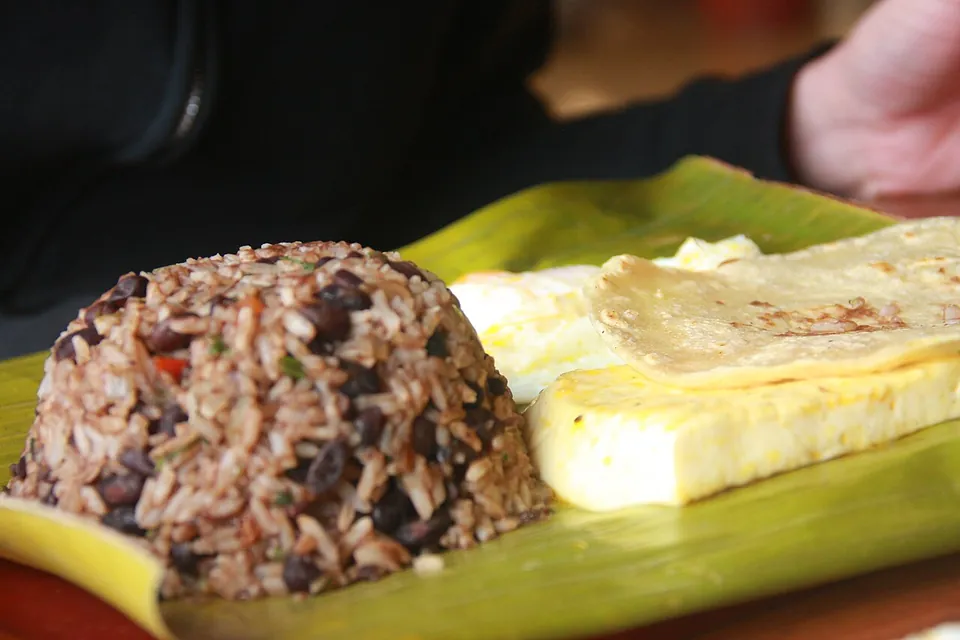
Gallo pinto is a home breakfast of Costa Rica and Nicaragua, made by frying yesterday's rice together with beans and seasoning the mix with onion and sweet pepper. Its speckled look gave it its name, which means "spotted rooster." Costa Rican cooks usually reach for red beans, Nicaraguan cooks for black.
Beans were a long-established crop here, on everyday tables from early on, and the sweet pepper (chile dulce) that flavors the dish is native ground too. Rice, it turns out, did not reach Central America nearly as late as once thought. Spanish Central America already had recorded rice cultivation by the early seventeenth century (around 1620, with a range of 1612–1629), and in Costa Rica rice was one of the central valley's staple grains by at latest the eighteenth century. It was West African rice-growers, not Europeans, who are credited with establishing rice cultivation in the Americas in the first place. English settlements on the Mosquito Coast (Honduras to Nicaragua) have a documented record, from 1774–76, of African-descended residents growing maize and rice there. The habit of frying up last night's rice the next morning could settle into household routine only once such a community had taken root.
The cooking itself is plain, built on the thrift of using up leftover rice. The stage on which the dish spread was the Caribbean coast, where the Atlantic railway works and the banana plantations drew in labor. Across the later nineteenth and early twentieth centuries, it took shape there as the everyday food of the people who worked those lines and fields.
How we know
Costa Rica tells a cherished story about how gallo pinto was born. On the feast day of Saint Sebastian in 1930, a farmer in the San Sebastián district on the edge of San José joked to his guests that he would serve them a "spotted rooster" (gallo pinto); with no rooster to spare, he fried up rice and beans instead, and so the dish began.
No contemporary record backs this anecdote as fact. The anthropologist T. Preston-Werner (Journal of American Folklore, 2009) reads the tale as a cultural device that pins an already-common food to a particular time (a saint's day in the early twentieth century) and place (the San Sebastián district)—in other words, a tradition made up after the fact.
The dish itself already existed on the Caribbean coast well before that date. In the novel Mamita Yunai (1941) by Carlos Luis Fallas, gallo pinto appears as an everyday food of the banana-plantation workers. This earliest written record tells of a dish—rice and beans fried together—brought by Afro-Caribbean migrant laborers who came to the Caribbean coast in the nineteenth century, and already widespread by the early twentieth. It does not square with the idea of a single farmer inventing it in 1930. That the origin lies with the Afro-Caribbean is, in fact, something Costa Rica and Nicaragua largely agree on.
What remains is the quarrel over which country the national dish truly comes from. Costa Rica holds to the San Sebastián origin; Nicaragua points to its own Caribbean coast, where people are said to have eaten the dish since Afro-Latin arrivals of the seventeenth and eighteenth centuries. By that time rice was already established in Spanish Central America, so ingredient availability is no reason to dismiss Nicaragua's claim. What is missing, on both countries' Caribbean coasts, is direct evidence that gallo pinto itself was being eaten there in the seventeenth or eighteenth century. The historians Cabezas and Espinoza state plainly that documentary evidence for rice reaching that coast simply "no existe" (does not exist), and the earliest firsthand testimony from the coast is the Talamanca oral history, recorded around 1900 by Paula Palmer. What the two countries are really contesting is less who invented the dish than whose national dish it is. The dispute, dubbed the "gallo pinto war," is a political and symbolic sore point that remains unsettled to this day.
The full set of origin theories and the detailed verification log — traceable all the way to their sources — are available on the Japanese edition.
See the full origin theories and verification log (Japanese) →
Related dishes
Shares the key ingredient
- BiryaniSouth Asia (Deccan / Mughal)C
- DosaSouth India (Tamil Nadu / Karnataka)C
- PaellaValencia, SpainC
- Risotto alla milaneseMilan (Lombardy, Italy)C
- Nasi gorengIndonesia (Java)C
- JambalayaNew Orleans (Louisiana, USA)C
- MujaddaraLevant (Syria, Lebanon, Palestine)B
- DoriaYokohama, JapanB
- IdliSouth IndiaC
- MaqlubaPalestine / LevantC
- White mixed rice (hondonban / goldongban — Bibimbap precursor)Korean PeninsulaC
- MandiHadhramaut (Yemen)C
- Rice and native-grain upma layer (sada upma, pre-semolina)South IndiaC
- KiribathSri LankaD
- KabsaSaudi ArabiaC
- PlovUzbekistan (Samarkand / Fergana)C
- MachboosPersian Gulf (Bahrain / Kuwait)B
- Dal bhatNepalB
- KoshariEgyptC
- PilauEast Africa (Swahili Coast)C
- Rice-and-lentil koshari base layer (pre-pasta, pre-tomato)EgyptC
- Bánh cuốnVietnamB
- MahshiEgyptB
- PolowIranC
- PulaoNorth IndiaC
- PilavAnatoliaC
- Kabuli palawAfghanistanC
- Pilaf (French)FranceC
- Pilaf (Japanese-style)JapanC
- TahdigIranC
- Arroz de mariscoAlgarve (Portugal)C
- CasadoCosta RicaC
- Nan gyi thokeMyanmarC
- Mont diMyanmarC
- AranciniSicily (Italy)C
- Mazbi (madhbi)Yemen (Hadhramaut)C