All dishes / 西欧
Tiropita Period BOrigin theory CVerified
Some fields (dish name, region and gates) are shown from the Japanese-edition data.
A Greek savory pie of paper-thin dough folded again and again around sheep's-milk cheese. It sits at the tip of a very long line of cheese pies reaching back to antiquity, yet the name "tiropita" and the dish we know today only settled into their present shape in modern times.
Verification highlight popular claim → verdict → evidence
Two accounts of tiropita stand side by side and neither has won. One takes the pie back to the ancient layered cheese cake, the plakous of the Greeks and the placenta of the Romans: Cato builds one in De agri cultura (76, 160 BC) from sheets of tracta with sheep's cheese and honey, the plakous of Antiphanes, of goat's milk, honey and flour, survives through Athenaeus, and Andrew Dalby (Siren Feasts, Routledge, 1996) follows the line into the Byzantine cheese pies. The other holds that what makes a tiropita a tiropita, sheets of phyllo thin enough to see through, came west with Turkish yufka during the Ottoman centuries; Bertrandon de la Brocquière, travelling in 1432-33, watched Turkoman nomads bake such sheets on a portable iron plate. Cheese pie is genuinely old. The paper-thin pastry need not be as old, and the word tiropita settles into use only after Greek independence in the 19th century.
The three gates
- Ingredient-supply gate
- Both the wheat used for the phyllo and the sheep's-milk cheese (feta) are native.
- Cooking-technique gate
- Very thin sheets of phyllo dough are layered and baked.
- Venue gate
- A savory pie made at home or sold in bakeries.
Overview
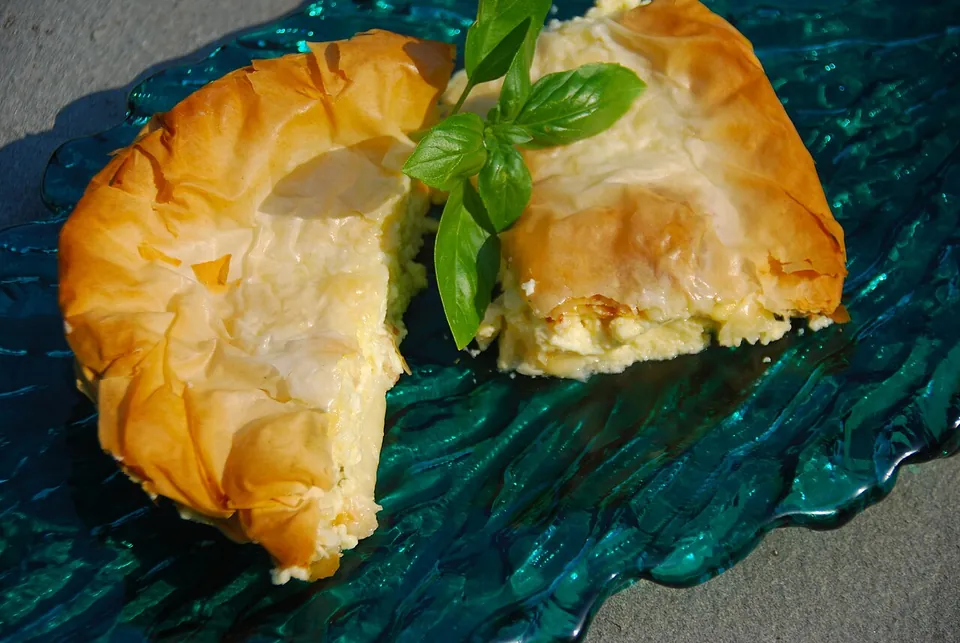
Tiropita is a Greek savory pie of feta and other sheep's-milk cheeses bound with egg, wrapped in many layers of the wafer-thin wheat pastry called phyllo and baked. It is home cooking and bakery fare alike, eaten for breakfast or as a light bite, and long a fixture on the everyday table.
Both wheat and sheep's-milk cheese have deep roots in the Greek landscape. On rugged, hilly ground people kept sheep and cured their milk in brine, and cheesemaking of this kind had been part of daily life since antiquity. These were long-established local staples, always within reach.
Rolling the phyllo out until it is nearly translucent, then stacking it sheet by sheet with a brushing of oil and baking it crisp, is the defining craft of the pies of Greece and its neighbors. The technique of layered dough has its source in Central Asia, and it spread across the Ottoman world as the thin pastry the Turks called yufka, giving rise to the wide family of savory pies known as börek. Tiropita took its present form as this thin-dough culture worked its way across the eastern Mediterranean.
Spanakopita, filled with spinach, is often spoken of as a sister pie born of the same phyllo. Only the filling differs; the method of stacking thin sheets and baking them binds the two inseparably.
How we know
Two different spans of time are folded into a single tiropita.
The idea of wrapping cheese in dough and baking it is very old. The Roman statesman Cato, writing around 160 BC in his treatise on farming, set down a cake called placenta made of dough stacked in layers with sheep's-milk cheese and honey pressed between them. Reaching back further, the fourth-century-BC comic poet Antiphanes sang of plakous, made of goat's milk, honey and flour; his words survive because Athenaeus quoted them in his third-century Deipnosophistae. Layered cheese cakes of this sort carried on into the Byzantine period, whose texts name pies stuffed with cheese. The food historian Andrew Dalby places this line within Greek tradition and traces its passage down to the Byzantine cheese pie. As a genre, the cheese pie carries more than a thousand years of history in the Mediterranean world.
The way we now picture the dish, though, with its paper-thin phyllo stacked in many layers, arrived later. The culinary historian Charles Perry traces this layered-dough technique to the layered breads of the nomadic Turks of Central Asia. In 1433 Bertrandon de la Brocquière, traveling through Turkic nomad country, wrote of watching wafer-thin dough baked on a portable iron griddle. When this thin pastry spread across the Ottoman world as yufka, together with the family of savory pies called börek, tiropita settled into the form we know. The feta at its heart was standardized into today's cheese, and the name tiropita fastened onto the dish, in the nineteenth century, as an independent Greece shaped a national cuisine.
So the pie holds a double nature: the cheese-pie stratum beneath it is genuinely ancient, while the tiropita of thin phyllo and standardized feta is a modern product. To exaggerate its age and claim it has continued unchanged from antiquity would be wrong; so too would insisting only on its novelty and cutting away the old lineage. How far back the older stratum reaches, and whether the present form was an Ottoman-era creation or the extension of a long continuity, scholars have not settled on a single answer. Later craft and a later name were laid over an old foundation, and that stacking of layers is what a single sheet of tiropita quietly shows.
The full set of origin theories and the detailed verification log — traceable all the way to their sources — are available on the Japanese edition.
See the full origin theories and verification log (Japanese) →