All dishes / 西欧
Souvlaki Period BOrigin theory CVerified
Some fields (dish name, region and gates) are shown from the Japanese-edition data.
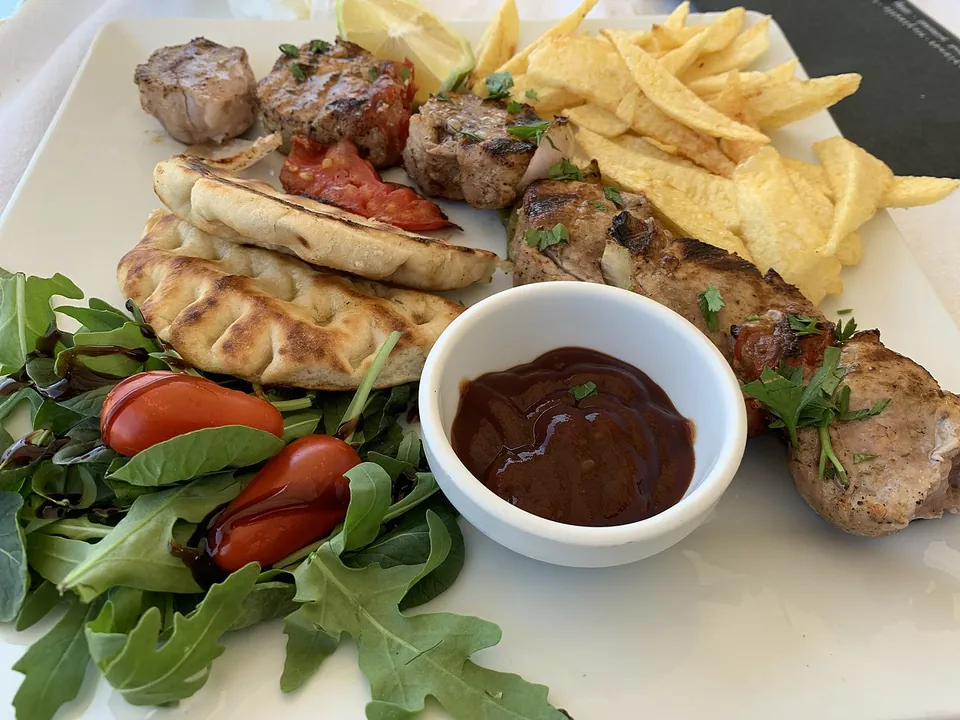
Bite-sized pork, skewered and grilled over charcoal. The skewer-grilling itself reaches back to the Bronze Age Aegean, but the souvlaki you buy on the street is a young food that spread across Greece after the Second World War.
Verification highlight popular claim → verdict → evidence
Myth: souvlaki as a single, continuous dish since antiquity. Verdict: the skewer-grilling technique itself does trace to the Bronze Age (Homer's Iliad; stone skewer-rests at Akrotiri), but the modern street-food souvlaki is a 20th-century, post-WWII creation—first attestation is not the same as origin. Key sources: Homer's Iliad; OED/Etymonline (English attestation 1942-1959).
The three gates
- Ingredient-supply gate
- Pork and mutton are locally available; the dish rides the spread of street-side skewer grilling.
- Cooking-technique gate
- Small pieces of meat are threaded on skewers and grilled over charcoal.
- Venue gate
- Street stalls and tavernas.
Overview
Souvlaki is a Greek dish of small pieces of meat threaded onto a skewer and grilled over an open flame. Pork and lamb, its usual meats, were long-established local staples. Threading small cuts of meat on a skewer and cooking them over direct heat is likewise an old Aegean way of grilling.
The souvlaki now sold at street stalls took shape in the early twentieth century. Skewered meat that had been grilled at home and at festivals became a ready-to-buy product at stalls and tavernas, and with that shift the souvlaki we picture today came into being. By the 1950s Livadeia, a town in central Greece on the route travelers took between Athens and the north, had become known for its pork-skewer takeaway. In the 1960s, street vendors from Boeotia carried the food across the country.
The 'antiquity' of souvlaki has two layers. Follow the lineage of the grilling method and you reach the Bronze Age; the souvlaki sold everywhere as a street product is far more recent. Under one name, an old technique and a new marketplace overlap.
How we know
Two ways of telling souvlaki's age stand side by side.
One looks to deep continuity. At the site of Akrotiri on Santorini, archaeologists have found stone skewer-rests (krateutai) dated to before the volcanic eruption of the seventeenth century BC. Mycenae and Pylos have yielded what are called 'souvlaki trays,' portable grilling devices; reconstruction experiments by Julie Hruby of Dartmouth showed that these were meant to hold the coals inside (reported to the Archaeological Institute of America in 2014). Homer's Iliad, in its first book, describes meat threaded onto a spit (obelos) and grilled over charcoal. The word itself traces from classical Greek obeliskos, 'little spit,' through medieval Greek souvla to souvlaki. The craft of skewer-grilling and its culinary lineage are genuinely old.
The other looks to the modern product. The word 'souvlaki' appears in English writing only recently: the Oxford English Dictionary gives a first date of 1958 (R. Liddell), Merriam-Webster gives 1942, and the earliest attestations fall roughly within the 1940s and 1950s. Postwar urbanization and demand for cheap eating out were what drove it.
These two are not a contest in which one must be false. That skewer-grilling reaches into the Aegean past is certain, but that is the antiquity of a technique and a food category, not the year the street-sold product came together. The line in Homer and the skewer-rests at Akrotiri speak only to the earliest evidence written or made; they do not close off the possibility that meat was grilled this way still earlier. An old way of grilling was poured into the new vessel of the twentieth-century stall, and became today's souvlaki.
The full set of origin theories and the detailed verification log — traceable all the way to their sources — are available on the Japanese edition.
See the full origin theories and verification log (Japanese) →