All dishes / 中東・北アフリカ
Maqluba Period COrigin theory CVerified
Some fields (dish name, region and gates) are shown from the Japanese-edition data.
A dish of Palestine and the wider Levant, brought to the table by flipping the whole pot upside down; "maqluba" itself means "upside-down." Because a dish of the same name appears in a thirteenth-century cookbook, that entry was long taken as its origin. But that older maqluba was not an upside-down pilaf at all; it was a patty of ground meat turned in the pan to brown both sides. The shared name was a coincidence, and the true ancestor of today's dish lies further back, in a ninth-century poem.
Verification highlight popular claim → verdict → evidence
Myth: the 13th-century maqluba recorded in al-Baghdadi's Kitab al-Tabikh (1226) is the direct ancestor of today's dish. Verdict: rejected — recent scholarship (Nasrallah 2007) shows al-Baghdadi's maqluba was a pan-fried meat patty flipped in the pan, not an inverted rice pilaf; the shared name is a coincidental homonym from the Arabic root q-l-b ('to flip'). The true structural ancestor is instead the 9th-century maghmūma described in a poem by Ibrahim ibn al-Mahdi (preserved in al-Warraq's 10th-century cookbook, translated by Nasrallah): layers of meat, fat, onion, rice, and eggplant, covered, cooked, and inverted onto a platter — matching the modern dish's essential composition three centuries before al-Baghdadi. The earliest clear description of the current rice-eggplant-meat form is Elihu Grant's The People of Palestine (1921); an earlier example has not yet been found.
The three gates
- Ingredient-supply gate
- Rice (the limiting element, arriving in the Levant with early Islamic-era/10th-century rice cultivation), eggplant (introduced to the Arab world c. 8th century), and meat are all Old World staples long available in the region — ingredients place little constraint on the dish's origin.
- Cooking-technique gate
- Pilaf-style cooking in a pot, then inverted onto a platter — a basic medieval Arab technique, not a limiting factor.
- Venue gate
- the home kitchen; common people; everyday; local community.
Overview
When and where it took shape
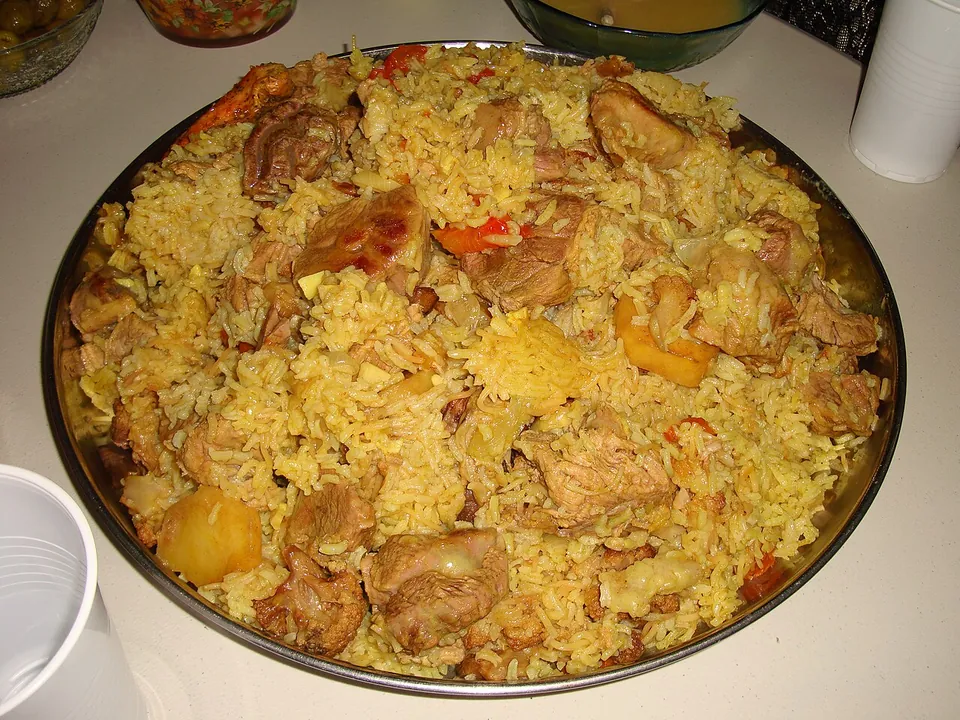
Maqluba belongs to the Levant, the eastern shore of the Mediterranean, and above all to Palestine. In the pot, rice, fried eggplant, and chicken or lamb are layered and cooked together; once done, a dish is set over the mouth of the pot and the whole thing is flipped in one motion. The meat and the browned eggplant that sat at the bottom come to the top, and a steaming mound rises onto the table. The name, "upside-down," describes that very gesture.
This is not a dish that came down from a high courtly table. Its home has always been the household, and the shared table of the community, where a large pot is turned out and divided at feasts and gatherings. The murmur at the moment of the flip, and the dish standing up without collapsing, become the center of the occasion.
The ingredients are all long rooted in this land. Rice was grown in the Levant from the early Islamic period, and eggplant had spread widely across the Arab world even earlier; together with the meat, all of these were materials at home here. Cooking in the pot and then turning it out upside down was likewise a method that medieval Arab cookery already held. The parts that make up today's maqluba had, in other words, been gathered close at hand for a very long time.
And yet the form we know today, rice and fried eggplant and meat layered and flipped, shows up clearly in the written record only at the start of the twentieth century. The parts are old, but the assembled dish is described with certainty only late. That gap in time is the key to reading how maqluba came to be.
How we know
An old name over a newer dish
When maqluba's origin is told, the thirteenth-century cookbook has long been brought forward. Muhammad al-Baghdadi, of the Abbasid era, compiled a cookbook in the thirteenth century in which a dish called maqluba, "upside-down," appears, and this was spoken of, almost as settled fact, as the direct ancestor of today's rice-eggplant-and-meat maqluba. Both the idea of turning the pot out and the name itself, the argument ran, were already present in that age.
Read against the sources, though, the entry tells a different story. As Nawal Nasrallah's edited English translation of the medieval Arab cookbooks shows, al-Baghdadi's maqluba was not rice and fried eggplant turned out together but a patty of ground meat turned in the pan to brown both sides. The Arabic root meaning "to overturn" can attach itself to any dish that involves flipping. The shared name was no more than a coincidence around that root, not a link between the dishes themselves. That two dishes carry the same name, and that two dishes are the same dish, are separate matters.
Where, then, is the true ancestor of today's maqluba? It lies three centuries earlier still, in a ninth-century poem. Ibrahim ibn al-Mahdi, an Abbasid nobleman, sang of a covered dish, maghmuma, and described it thus: a layer of meat, its fat, onion, rice, and thin slices of peeled eggplant, laid up and covered with a round lid, set over the fire, and, once cooked, turned out onto a large platter. Meat and eggplant and rice layered, then flipped upside down at the end: the skeleton of today's maqluba is all here. This poem was gathered into the tenth-century cookbook compiled by Ibn Sayyar al-Warraq, and can be read today through Nasrallah's translation.
An early clear record of the present form, rice and fried eggplant and meat layered and flipped, is found in Elihu Grant's account of Palestinian life at the start of the twentieth century. Rice had long been grown in the Levant, but its spread as an everyday staple came only in the modern era. The skeleton appears in a ninth-century poem, and the present form is recorded at the opening of the twentieth; how to bridge that long span is a question that remains, its sources not yet found.
So two spans of time lie folded together in maqluba. The gesture of turning the pot out and calling it "upside-down," name and act alike, reaches back to medieval Arab cookery. The present form, rice and fried eggplant and meat layered and cooked, was assembled far later, on the tables of this land. An old name that had first belonged to another dish: only when that mix-up is undone does the true lineage, hidden beneath the overturned pot, come into view.
The full set of origin theories and the detailed verification log — traceable all the way to their sources — are available on the Japanese edition.
See the full origin theories and verification log (Japanese) →
Related dishes
Shares the key ingredient
- BiryaniSouth Asia (Deccan / Mughal)C
- DosaSouth India (Tamil Nadu / Karnataka)C
- PaellaValencia, SpainC
- Risotto alla milaneseMilan (Lombardy, Italy)C
- Nasi gorengIndonesia (Java)C
- JambalayaNew Orleans (Louisiana, USA)C
- MujaddaraLevant (Syria, Lebanon, Palestine)B
- DoriaYokohama, JapanB
- IdliSouth IndiaC
- White mixed rice (hondonban / goldongban — Bibimbap precursor)Korean PeninsulaC
- MandiHadhramaut (Yemen)C
- Rice and native-grain upma layer (sada upma, pre-semolina)South IndiaC
- KiribathSri LankaD
- KabsaSaudi ArabiaC
- PlovUzbekistan (Samarkand / Fergana)C
- MachboosPersian Gulf (Bahrain / Kuwait)B
- Gallo pintoCosta Rica / NicaraguaC
- Dal bhatNepalB
- KoshariEgyptC
- PilauEast Africa (Swahili Coast)C
- Rice-and-lentil koshari base layer (pre-pasta, pre-tomato)EgyptC
- Bánh cuốnVietnamB
- MahshiEgyptB
- PolowIranC
- PulaoNorth IndiaC
- PilavAnatoliaC
- Kabuli palawAfghanistanC
- Pilaf (French)FranceC
- Pilaf (Japanese-style)JapanC
- TahdigIranC
- Arroz de mariscoAlgarve (Portugal)C
- CasadoCosta RicaC
- Nan gyi thokeMyanmarC
- Mont diMyanmarC
- AranciniSicily (Italy)C
- Mazbi (madhbi)Yemen (Hadhramaut)C