All dishes / ラテンアメリカ
Ropa vieja Period BOrigin theory CVerified
Some fields (dish name, region and gates) are shown from the Japanese-edition data.
"An old shirt boiled down into meat": a tender folk tale clings to ropa vieja, whose name means "old clothes" in Spanish. But that story explains the name, not the dish. The real ancestry lies in a stew that crossed the Atlantic.
Verification highlight popular claim → verdict → evidence
Myth: a poor man tore up his old clothes (ropa vieja means old clothes) in prayer and they turned into a meat stew. Verdict: refuted as folk etymology rather than history — Sebastián de Covarrubias's 1611 dictionary Tesoro de la lengua castellana already lists ropavejero (secondhand-clothes dealer), showing the name derives from the ragged look of shredded meat, not from a literal tale. Key source: Juan Cabrisas's 1858 cookbook Nuevo Manual de la Cocinera Catalana y Cubana, the earliest confirmed appearance of the dish in Cuban print.
The three gates
- Ingredient-supply gate
- Cattle arrived in the Caribbean only after the Spanish arrival, the bottleneck; other ingredients such as tomatoes are native.
- Cooking-technique gate
- Beef is simmered until tender and shredded, in a sofrito-based stew.
- Venue gate
- Cuban home cooking, later moving into eateries.
Overview
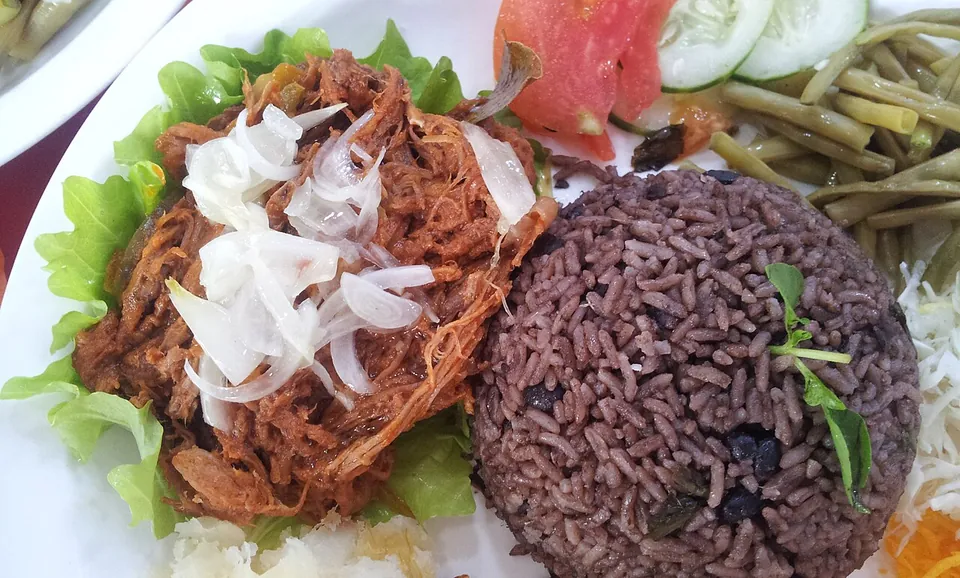
Ropa vieja is a Cuban home dish of beef simmered slowly until it falls into shreds, then folded into a sofrito of tomato, bell pepper, and onion. The strands of beef drink up the sauce and reach the table alongside rice and beans. The name says "old clothes," but what you eat is unmistakably braised beef.
Cattle were not native to the Caribbean. There were no cows on the island until Spanish ships carried livestock across the ocean and put them ashore; the beef of this dish arrived with them, around 1512, and the braise could not have existed before that. Tomatoes and peppers, the color and body of the sauce, were already here, and met the newcomer to become the dish as we know it.
The method traveled the same route. Simmering beef for a long time until it pulls apart, and building a base from sauteed aromatics, came across the water with settlers and took root, drawing in local produce. Ropa vieja first appears in a Cuban cookbook in Juan Cabrisas's Nuevo Manual de la Cocinera Catalana y Cubana (1858), where "ropa vieja cubana," "habanera," and "andaluza" sit side by side on the page. That is a firmer footing than the long-repeated claim that 1857 marks the earliest record.
How we know
The first thing most people tell you about ropa vieja is the sad little folk tale. A poor man with nothing to feed his family shredded his own old clothes and boiled them with love and prayer, and they turned into a meat stew.
But this is not where the dish comes from. It is a story invented afterward to explain why a beef braise carries the name "old clothes." The Spanish lexicographer Sebastian de Covarrubias, in his Tesoro de la lengua castellana o espanola (1611), already lists ropavejero and ropavejeria, the old-clothes dealer and his trade. The words behind ropa vieja point to worn cloth and rags, the look of meat cooked until it frays, not to a miracle in which garments became dinner. The other common explanation, that it is a dish of scraps gathered together, points the same way.
So where does it actually come from? The most repeated account traces it to Sephardic Jews in medieval Iberia, who simmered a stew overnight for the Sabbath, and says it spread through North Africa and the Canary Islands before Canarian migrants carried it to the New World. But this single-origin story rests on likenesses of technique and sound, the kind of tale that circulates widely without the support of primary sources. That modern Spanish ropa vieja often uses pork chorizo, which cannot square with Jewish dietary law, weakens the case for pinning it on one people. A competing view holds that thrift stews reusing leftover meat arose broadly across Iberia, and the two accounts have not been reconciled. Neither a miracle of old clothes nor a single ethnic lineage: a stew that crossed the sea and drew in the produce of its new home is where this dish truly lies.
The full set of origin theories and the detailed verification log — traceable all the way to their sources — are available on the Japanese edition.
See the full origin theories and verification log (Japanese) →
Related dishes
Cross-links Sister dishes & same-name dishes (separate lineage)
Shares the key ingredient
- PhoVietnamC
- Beef StroganoffRussiaC
- Chicago Italian beefChicago (USA)C
- Salt beef (the layer before canning)Ireland (Cork / Dublin)C
- AsadoRío de la Plata (Argentina / Uruguay)C
- Lomo saltadoLima (Peru)C
- BulgogiKorean Peninsula (South Korea)B
- ĆevapčićiBalkans (Serbia, etc.)C
- Proto-bulgogi (native grilled-meat proto-layer)Korean PeninsulaC
- Proto-goulash (pre-paprika herdsmen's meat stew proto-layer)HungaryC
- KharchoGeorgia (Caucasus)B
- Proto-rendang (pre-chili merendang proto-layer)West Sumatra (Minangkabau), IndonesiaC
- Nyama chomaEast Africa (Kenya, Tanzania)C
- Philly cheesesteakPhiladelphia (USA)B
- Pastel de chocloChileC
- NihariNorth India (Delhi / Awadh)C
- NikujagaJapanC
- Australian meat pieAustraliaC
- FajitasRio Grande Valley, Texas (USA)B
- Loco mocoHilo, Hawaii (USA)B
- KitfoGurage (Ethiopia)C
- MachacaNorthern Mexico (Sonora / Sinaloa)C
- TibsEthiopian HighlandsB
- BiltongSouth AfricaC
- Lok lakPhnom Penh (Cambodia)C
- Carne asadaNorthern Mexico (Sonora)C
- Hamburg steakHamburg (Germany)B
- Bò lúc lắc (Vietnamese shaking beef)Southern VietnamC
- Montreal-style smoked meatQuebec (Canada)D
- Kare-karePhilippinesC
- PastramiNew York (USA)D
- BraaiSouth AfricaC
- French dip sandwichLos Angeles, California (USA)C