All dishes / ラテンアメリカ
Mole poblano Period BOrigin theory CVerified
Some fields (dish name, region and gates) are shown from the Japanese-edition data.
A nun is said to have improvised it in a rush before an archbishop's visit, a lovely birth story. But this convent-origin tale leaves no trace in the records of its own time; it was tidied into shape by later generations.
Verification highlight popular claim → verdict → evidence
The popular legend that nuns at Puebla's Santa Rosa convent improvised the dish for a visiting archbishop is rejected as an unsupported later invention -- documentary sources are thin before the 19th century, and the dish's earliest print appearances (El Cocinero Mexicano and Novisimo Arte de Cocina, both 1831) don't even include chocolate, showing today's familiar version is a later addition. The better-supported account holds that mole poblano developed gradually by grafting Old World spices -- brought in after the 1521 conquest -- onto an indigenous chili-and-seed sauce base (molli/chilmolli, described by Sahagun in the 16th century), with no single inventor or founding event (Laudan; Ruiz de la Peña Posada, 2021).
The three gates
- Ingredient-supply gate
- Chili pepper, cacao, and turkey are indigenous; the Old World spices essential to the composite dish -- cinnamon, pepper, almonds, sesame, and the like -- arrived only after the conquest (1521 onward), setting the physical lower bound.
- Cooking-technique gate
- Rehydrating dried chilies and grinding them on a metate into a thick sauce, then long simmering.
- Venue gate
- Convent kitchens; religious/semi-privileged stratum; festive and ceremonial occasions.
Overview
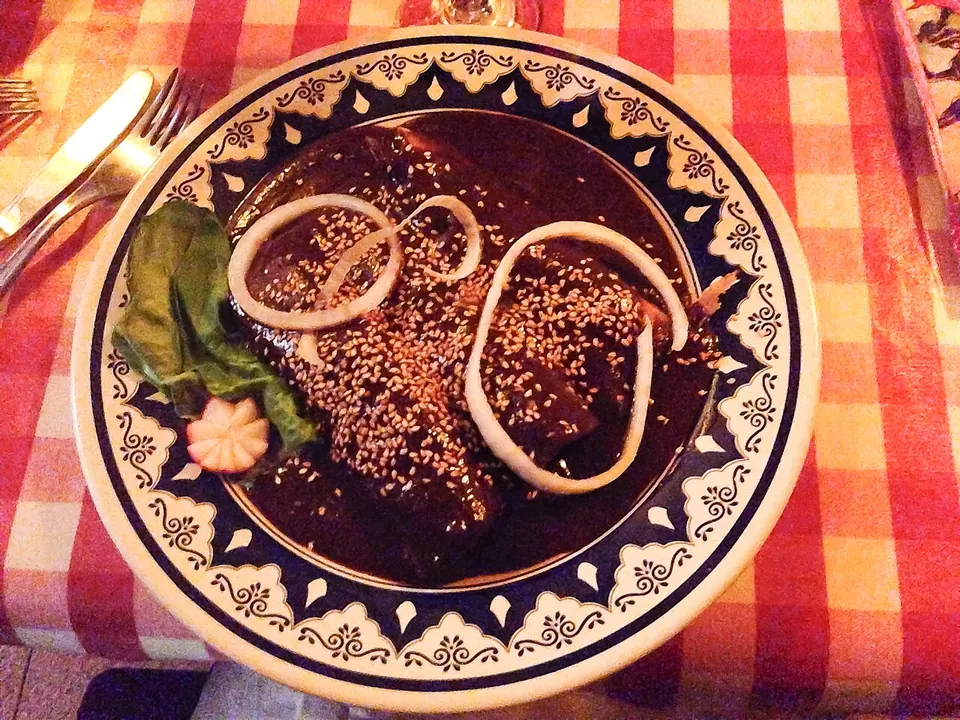
Mole poblano is a festive dish of Puebla, Mexico. It is a turkey generously bathed in a thick sauce (mole) worked through with chiles and an array of spices, and it took shape in the colonial period (17th to 18th century).
The lead ingredient, turkey, is a long-established fowl of Mesoamerica. The chiles paired with it, and the craft of grinding seeds into a thick sauce, were deeply rooted in the land as well. Indigenous people called such thick sauces molli and already set them on everyday tables and at feasts; the dish takes its name from that word.
The land's flavor changed markedly after the Spanish conquest (1521). As Old World spices such as cinnamon, pepper, almond, sesame, and clove arrived across the ocean, they were laid, little by little, over the indigenous thick sauce, and the complex mole handed down today began to appear. The handwork of rehydrating dried chiles, grinding them long on the stone metate, and simmering the mixture into a deep flavor drew the blend together into one dish. The convent kitchens of Puebla were among the places that raised this flavor as a festive dish.
Mole poblano, then, was not the work of a single genius in a single night. It is the product of a long blending, in which the spices carried by the conquest were layered, over many generations, upon an old indigenous sauce.
How we know
Mole poblano comes with a birth story passed down over the years: a nun of the Santa Rosa convent in Puebla, caught off guard by an archbishop's sudden visit, is said to have improvised the dish from whatever was on hand. It is dramatic and easy to remember. But no record from its own time supports the tale.
The food historian Rachel Laudan pointed out early on that this convent tradition has no documentary basis. The culinary-history holdings of the University of Texas at San Antonio (UTSA) Special Collections add to Laudan's reading from the scholarly side, noting that the documentary trail for mole poblano is very thin before the 19th century. The more finely detailed the anecdote, down to a nun named Sor Andrea improvising for a viceroy's visit around 1680, the less old documentation exists to support it. The tale that someone invented it in a single night was shaped by later generations, not by anyone who was there.
Where, then, are the real traces? The earliest lie in Sahagun's 16th-century General History of the Things of New Spain (the Florentine Codex), which depicts the indigenous chile- and seed-based thick sauces (molli, chilmolli). The mole in its current form appears in writing much later: the clemole of the 1791 manuscript Recetario Novohispano (chiles combined with Old World spices such as sesame, cumin, clove, pepper, and cinnamon), and in print in the 1831 El Cocinero Mexicano and Novisimo Arte de Cocina. The first time a dish is written down is not the moment it was born, but it marks when the mole in its current form began to be set down on paper.
Tellingly, the mole poblano printed in that year, 1831, contains no chocolate. Today a 'sauce with cacao dissolved in' is spoken of almost as the emblem of mole, but that face was added still later; it was never the lead from the start.
What remains, then, is not a nun's overnight improvisation. Old World spices dissolved, over generations, into an old indigenous sauce, and even a touch of color like chocolate was added afterward. Puebla's dish could only appear later than the 16th-century indigenous flavor, over a long stretch of time.
The full set of origin theories and the detailed verification log — traceable all the way to their sources — are available on the Japanese edition.
See the full origin theories and verification log (Japanese) →