All dishes / ラテンアメリカ
Pastel de choclo Period BOrigin theory CVerified
Some fields (dish name, region and gates) are shown from the Japanese-edition data.
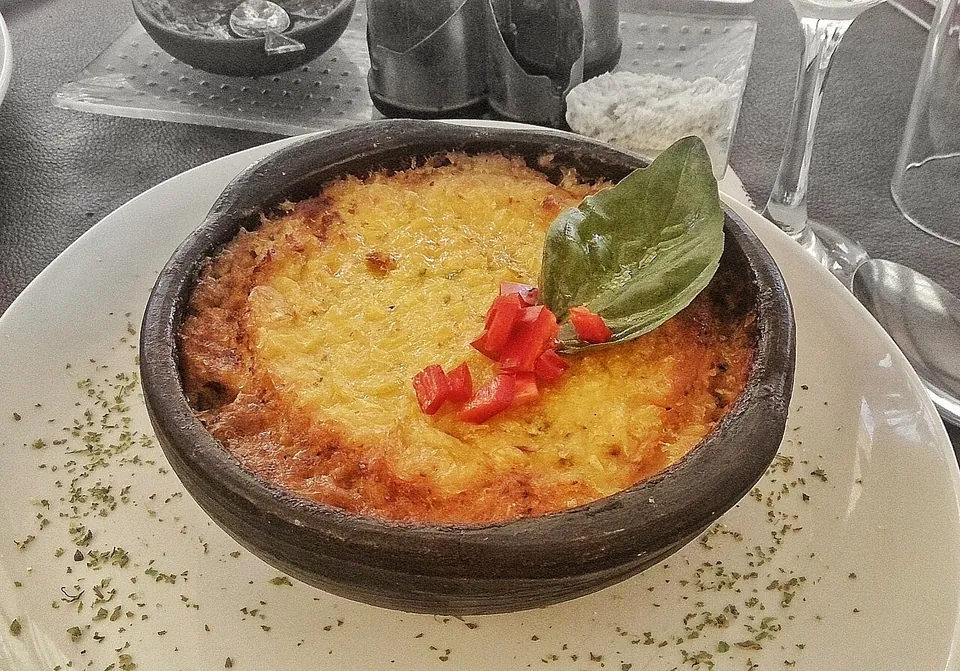
One of Chile's signature dishes: a savory filling capped with a sweet lid of ground fresh corn and baked until golden. The famous anecdote that it was already served at a banquet in Cuzco in 1608 comes from a work of literature written more than two hundred years later, not from a contemporary record, and it lacks documentary support.
Verification highlight popular claim → verdict → evidence
Myth: a 1608 Cusco origin, based on Ricardo Palma's literary tradición placing the dish at a monastic banquet in colonial Peru. Verdict: rejected — Palma was born in 1833 and wrote over two centuries later; his tradición mixes history with literary embellishment and is not a primary source, and the term may be a retroactive (anachronistic) application of a later name; the dish never appears in Chilean colonial-era sources. The earliest confirmed record is Claudio Gay's Historia física y política de Chile: Agricultura (based on 1830s observation, published 1862-65), describing a peasant festival dish of mutton (sometimes chicken) pino with sweetened corn dough. What is solid: the dough is native (from the humita tradition), while the current form combining it with beef pino is limited by the arrival of Spanish cattle in Chile (1540).
The three gates
- Ingredient-supply gate
- Limiting factor: ground beef (pino filling) — Spanish-introduced cattle arrived in Chile in 1540, setting the physical floor for the current form. The corn dough itself is native to South America (Chile, from c. 1000 CE) and is not limiting.
- Cooking-technique gate
- Native corn dough (from the humita tradition), sieved/kneaded, filled with pino, and baked in an oven or clay pot — a fusion of Spanish empanada technique with indigenous corn processing.
- Venue gate
- Colonial kitchens where Mapuche cooks working in Spanish settler households incorporated Old World fillings (beef, onion, olives, raisins, egg) into native corn preparations — a home/colonial-household setting.
Overview
When and where it took shape
Pastel de choclo is a dish that stands at the heart of the Chilean table. A sweet batter of ground fresh corn (choclo), sweetened with sugar, is spread over a meat filling and baked in an oven or an earthenware dish until the surface browns. Break through the lid and the warm filling appears beneath.
It helps to see the dish in two layers.
The outer corn batter belongs to an old South American food. Corn is a crop the indigenous Mapuche have grown for more than a thousand years, and the batter dishes made by grinding and kneading the fresh kernels and then wrapping or baking them (humita) were on this land long before the Spanish arrived. Choclo, the fresh corn at the heart of the lid, was a long-established native crop, on everyday tables here from early on. Analysis of organic residues left in pre-Columbian pottery confirms that corn was eaten in this region far back in time.
The change came in what the batter enclosed. The Spanish settlers brought cattle, along with onions, raisins, olives, and other foods and livestock the land had not known. Ground beef browned with onion and combined with raisins, olives, and hard-boiled egg makes the filling known as pino, born in the settlers' kitchens; it is a New World flavor akin to the Spanish baked pastry, the empanada. Until cattle crossed the ocean and took root on this land, the present form, with its filling of meat pino, had no way of coming into being.
The old sweet corn batter now enclosed this beef pino and was baked in the oven. When the indigenous batter and the settlers' filling came together on a single plate, today's pastel de choclo took shape. The distinctive pairing of a sweet baked lid over salty meat below, two worlds sharing one dish, is what gives it its appeal.
How we know
Today's pastel de choclo comes clearly into the documentary record in the nineteenth century. The French naturalist Claude Gay walked through central Chile in the 1830s, recording rural life, and set down a peasant festival dish in which a filling of mutton (sometimes chicken) was capped with a sweetened corn batter and baked. This is the earliest reliable record of the dish in Chile, and it shows that the present form, with its meat filling, was certainly there by then.
There is, however, a famous anecdote that claims a far older origin. Among the Peruvian tradiciones written by Ricardo Palma is a piece in which pastel de choclo is served at a monastic banquet in Cuzco around 1608. On this basis it is sometimes said that the dish had already taken shape in colonial Peru, earlier than in Chile.
But the anecdote cannot be read as a contemporary record. Palma was born in 1833, and he wrote more than two hundred years after the events he describes. His tradiciones are, by their very genre, history laced with literary embellishment, not primary sources. There is a strong suspicion that the dish name "pastel de choclo" was projected back onto an age in which it is far from clear the dish was yet called that. And in the Chilean colonial records concerning that same Cuzco of 1608, the dish never appears.
What emerges instead is a more grounded account of its making. The anthropologist Sonia Montecino, in her book "La olla deleitosa: Cocinas mestizas de Chile" (The Delectable Pot: The Mixed Cuisines of Chile), describes pastel de choclo as a dish of fusion (mestizaje) in which the indigenous corn batter and the Spanish pino melt together. Mapuche cooks stood in the settlers' kitchens and worked old-world fillings into the native batter, and that meeting is where the dish was born. The antiquity of the corn batter is genuine, and so is the newness of the beef pino. That an old indigenous food and the ingredients the settlers brought were joined on a single plate, that fusion itself, is what pastel de choclo truly is.
The full set of origin theories and the detailed verification log — traceable all the way to their sources — are available on the Japanese edition.
See the full origin theories and verification log (Japanese) →
Related dishes
Lineage Family, predecessor, variants
Shares the key ingredient
- PhoVietnamC
- Beef StroganoffRussiaC
- Chicago Italian beefChicago (USA)C
- Salt beef (the layer before canning)Ireland (Cork / Dublin)C
- AsadoRío de la Plata (Argentina / Uruguay)C
- Lomo saltadoLima (Peru)C
- BulgogiKorean Peninsula (South Korea)B
- ĆevapčićiBalkans (Serbia, etc.)C
- Proto-bulgogi (native grilled-meat proto-layer)Korean PeninsulaC
- Proto-goulash (pre-paprika herdsmen's meat stew proto-layer)HungaryC
- KharchoGeorgia (Caucasus)B
- Proto-rendang (pre-chili merendang proto-layer)West Sumatra (Minangkabau), IndonesiaC
- Nyama chomaEast Africa (Kenya, Tanzania)C
- Philly cheesesteakPhiladelphia (USA)B
- NihariNorth India (Delhi / Awadh)C
- NikujagaJapanC
- Australian meat pieAustraliaC
- FajitasRio Grande Valley, Texas (USA)B
- Loco mocoHilo, Hawaii (USA)B
- KitfoGurage (Ethiopia)C
- Ropa viejaCubaC
- MachacaNorthern Mexico (Sonora / Sinaloa)C
- Ropa vieja (Iberian prototype)Canary Islands, SpainB
- TibsEthiopian HighlandsB
- BiltongSouth AfricaC
- Lok lakPhnom Penh (Cambodia)C
- Carne asadaNorthern Mexico (Sonora)C
- Hamburg steakHamburg (Germany)B
- Bò lúc lắc (Vietnamese shaking beef)Southern VietnamC
- Montreal-style smoked meatQuebec (Canada)D
- Kare-karePhilippinesC
- PastramiNew York (USA)D
- BraaiSouth AfricaC
- French dip sandwichLos Angeles, California (USA)C