All dishes / 中東・北アフリカ
Fattoush Period COrigin theory BVerified
Some fields (dish name, region and gates) are shown from the Japanese-edition data.
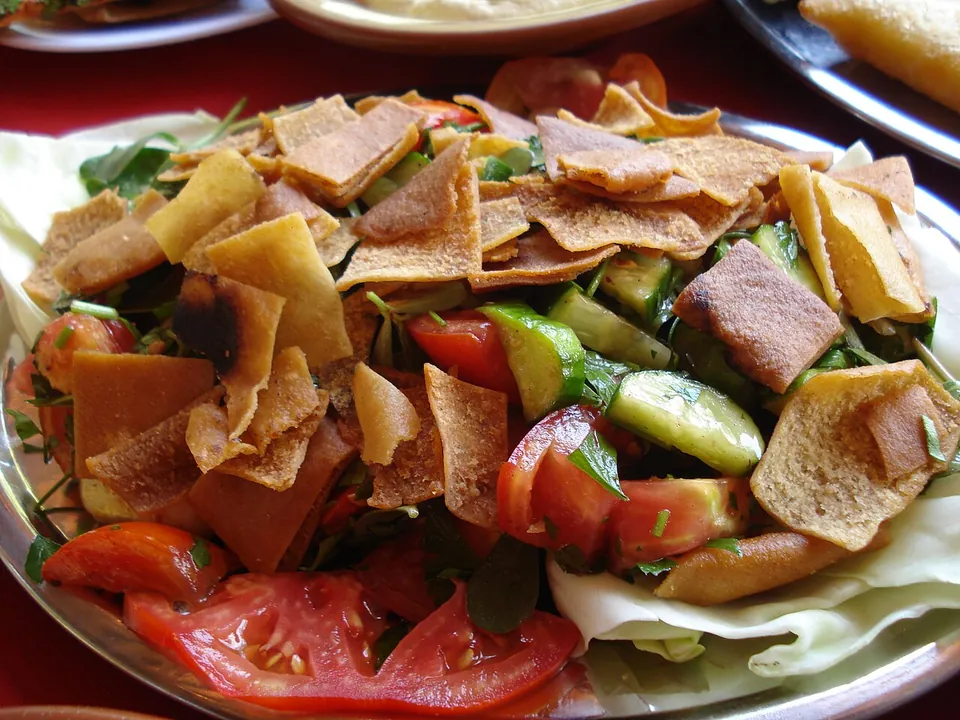
Fattoush is a Levantine dish of thrift, built to use up flatbread that has gone stale. Tomatoes are indispensable to the version most people expect today, but Levantines only took to eating them as an everyday vegetable in the nineteenth century, while the dish itself belongs to a much older lineage of bread salads.
Verification highlight popular claim → verdict → evidence
Fattoush is a dish of two ages, and the two common errors both come of blurring them. The older layer, stale flatbread crumbled with seasonal vegetables, herbs and sumac, is a thrift dish of the Levantine countryside belonging to the fatta family of bread-based preparations. Nawal Nasrallah points to a close relative, a vegetable tharid of dried bread, cucumber, herbs and oil, in Ibn Sayyar al-Warraq's tenth-century Baghdad cookbook, and R. Dozy set down in 1889 a fettouch of bread soaked in water with cucumber, onion, mint, purslane, olives, vinegar and oil, with no tomato in it. The tomato belongs to the second age: a New World crop, recorded in the Levant by 1756, when Alexander Russell noted love apples growing in the little gardens of Aleppo and hardly eaten by the local people except the Jews, and field-grown and sold in the bazaar by his second edition of 1794. So a tomato-bearing fattoush can be no older than that, while the tomato-free layer is not bound by it, and calling the whole dish a post-Columbian invention is as wrong as reading the modern plate back into the tenth century. The English word is first recorded only in 1953 (Oxford English Dictionary), which marks when English took the dish up, not when it was made.
The three gates
- Ingredient-supply gate
- The ingredient that governs the date is stale flatbread (khubz), baked from locally grown wheat, so no New World crop bears on the older form of the dish. The tomato in today's standard version is another matter. It is a New World crop, and for the version that contains it the earliest possible date is set by the tomato's arrival in the Levant in 1756 (range 1694 to 1756; Alexander Russell, The Natural History of Aleppo, first edition, 1756, a primary record). In the Aleppo of 1756 tomatoes grew in the little gardens, but, as Russell notes, were hardly eaten by any of the local people except the Jews; by the second edition of 1794 they were grown in the fields and carried to the bazaar as a market vegetable. Being present in the land and being taken up as everyday local food are two different things, the latter belonging to the nineteenth century, and it is the former that fixes the lower bound.
- Cooking-technique gate
- Frying or toasting the stale bread, and souring it with sumac or lemon. An ordinary hearth and ordinary kitchen work suffice; no special equipment is called for.
- Venue gate
- Village home cooking in the Levant, within the practice of mouneh (household stores and thrift); ordinary rural people, eating at home.
Overview
Fattoush comes from the villages of the eastern Mediterranean, including present-day Lebanon. Stale flatbread is fried or toasted and broken up, then tossed with seasonal vegetables, herbs, and the tart red spice sumac. The name joins the Arabic fatt, 'to crush', with a Turkic suffix, and the dish belongs to a whole family of preparations built on leftover bread.
Its main ingredient is the stale flatbread itself. Levantine flatbread is baked from local wheat and has long been a staple of daily life; when a batch was not finished fresh, village kitchens turned the remainder into the next meal rather than throwing it away. Frying the bread and sharpening it with sumac or lemon called for nothing more than an ordinary hearth and hand work. That is why this bread-salad form can be traced back well before the modern era. The food historian Nawal Nasrallah has pointed to a close relative in the work of the tenth-century writer Ibn Sayyar al-Warraq, who recorded a dish of dried bread with cucumber, herbs, and oil. A late nineteenth-century account likewise describes a tomato-free version: bread soaked in water and combined with cucumber, onion, mint, purslane, vinegar, and oil.
The setting for this dish is the Levantine village household and the ethic of the mouneh, the practice of stores and thrift. It grew from an everyday habit of wasting no bread, not from any court kitchen. This was food that ordinary people worked out for themselves, in the course of their own lives.
How we know
The reward in reading Fattoush's history is separating two layers that are easily blurred.
The older layer, the tomato-free bread dish, is now firmly the accepted account of its origin. Al-Warraq's tenth-century record of dried bread with cucumber, herbs, and oil survives in Nawal Nasrallah's annotated study Annals of the Caliphs' Kitchens (Brill, 2007). The tomato-free form appears again in the late nineteenth century, when Dozy set it down in the proceedings of an orientalist congress (1889-1891): dried bread soaked in water and dressed with cucumber, onion, mint, purslane, olive, salt, vinegar, and oil, a plate distinct from the modern one. A primary record, an academic study, and a specialist dictionary point to this origin by separate routes.
The tomato version common today has to be read as a different branch, and what makes it interesting is how far apart two moments lie: when the red fruit first appeared in this soil, and when the people here began to eat it. The first edition of the natural history written by the English factory physician at Aleppo (1756) records tomatoes raised in the little gardens of the town, next to the chilli peppers that were put up as pickles. The same sentence goes on to say that the natives, apart from the Jews, hardly ate them. By the second edition of 1794 the entry has been rewritten: tomatoes, formerly raised in pots like any other flower, were lately being grown in the fields and brought to the bazaars, and the local name for them is set down as Frank badinjan, the Franks' eggplant, meaning the eggplant of the resident Europeans. Present in the garden, then, but not yet a vegetable of one's own. Levantine households took the tomato up as an everyday vegetable, in their salads and stews, in the nineteenth century, and fattoush with tomato in it follows from there.
That interval makes the older records read heavier rather than lighter. Dozy's late nineteenth-century description carries no tomato, and not because there were none to be had in the Levant by then. Red fruit was on the market stalls, and this dish was still being written down without it.
Two mistakes are worth avoiding. One is to see only the familiar tomato version and conclude that all Fattoush is a post-tomato dish. The other is the reverse, to fold the older layer straight into the modern plate. The tomato's late entry into daily cooking bears on when a tomato-bearing form could appear; it says nothing against the antiquity of the bread-salad form itself.
One more thing muddies the picture: when the name first surfaces in English. The Oxford English Dictionary places the earliest English use in 1953, in a record from Brooklyn, New York. But that marks when English speakers took up the dish, not when the dish was born. Reading the old prehistory, the modern version, and the spread of the name as separate threads is the key to telling this dish straight.
The full set of origin theories and the detailed verification log — traceable all the way to their sources — are available on the Japanese edition.
See the full origin theories and verification log (Japanese) →