All dishes / 中東・北アフリカ
Kibbeh Period BOrigin theory CVerified
Some fields (dish name, region and gates) are shown from the Japanese-edition data.
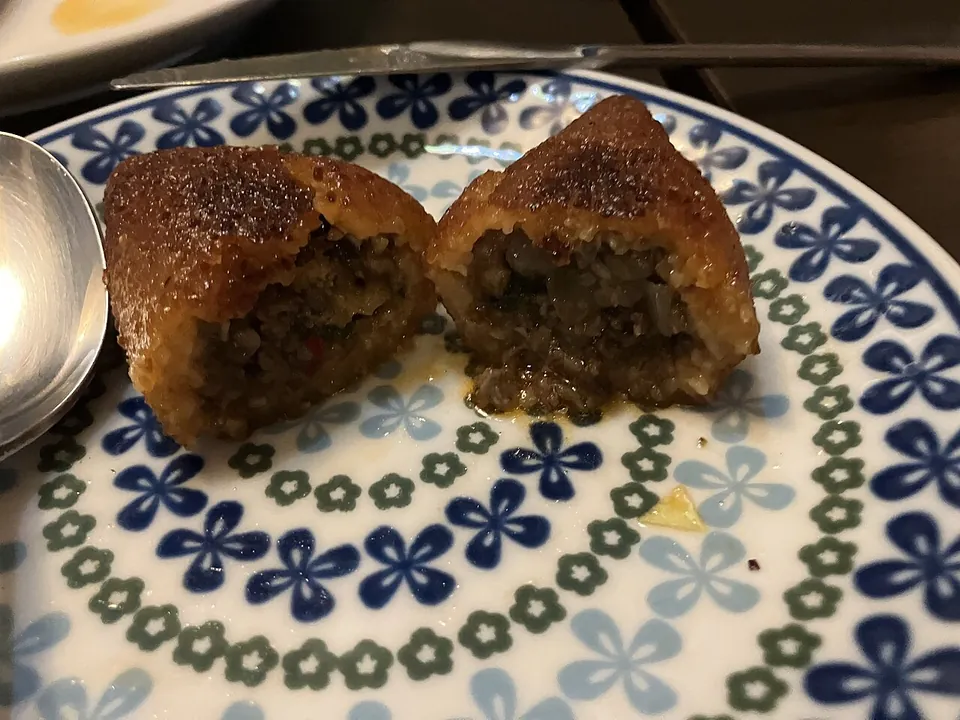
Kibbeh is a Levantine dish in which bulgur (cracked wheat) and lamb are pounded together in a mortar and shaped by hand. The pounded-meat prototype reaches back to a tenth-century cookbook, but the stuffed form we know today, a shell of bulgur filled with minced meat, took shape only in the eighteenth and nineteenth centuries. It is neither an ancient dish passed down unchanged nor the invention of any single country.
Verification highlight popular claim → verdict → evidence
Popular claim: online sources often describe kibbeh as an unchanged ancient Mesopotamian dish, or credit a single country or city (e.g. Aleppo) as its birthplace. Verdict: refuted -- Charles Perry's review of medieval Arabic cookbooks shows the ancient kubba was only a cooked meatball, distinct from today's raw/stuffed kibbeh; Manal Mourad notes Aleppo was a culinary crossroads rather than a birthplace; and Pitts & Kabalan (2021) show kibbeh was first proclaimed "Lebanon's national dish" only in 1951 (George al-Rayyis's cookbook) -- a 20th-century social construction, not ancient continuity. Key sources: Charles Perry, Medieval Arab Cookery; Pitts & Kabalan, "When Did Kibbe Become Lebanese?" (Making Levantine Cuisine, University of Texas Press, 2021).
The three gates
- Ingredient-supply gate
- Both bulgur and lamb were native staples, always available, so nothing held the dish back on the ingredient side.
- Cooking-technique gate
- Pounding bulgur and meat together in a mortar to form a paste, then frying, baking, or serving it raw.
- Venue gate
- Home and festive cooking of the Levant, later spreading to banquets and street stalls.
Overview
Kibbeh is made from bulgur and lamb. Both the cracked wheat and the lamb were long-established in the Levant, on everyday tables from early on. Pounded and worked together in a mortar, they become a smooth paste. It is handled in many ways: rolled into balls and fried, pressed flat and baked, or served raw.
The best-known form is the spindle-shaped kibbeh, a shell of bulgur packed around seasoned minced meat. The earliest written record of this stuffed style is in the eighteenth-century dictionary Taj al-'Arus, which describes it as "discs of minced meat and rice flour made by the people of al-Sham (the Levant)." By the nineteenth century it was well established: a cookbook published in Beirut in 1885 by Khalil Khattar Sarkis gathered fifteen kinds of kibbeh, and Aleppo in northern Syria became a stronghold of the dish, with more than seventeen.
How we know
Kibbeh's lineage runs longer than one might guess. The name descends from the Akkadian kubbu (a round or pounded lump), and the tenth-century Kitab al-Tabikh of Ibn Sayyar al-Warraq records kubba, a pounded-meat ball. In Medieval Arab Cookery, the food historian Charles Perry's translation and commentary, the kubba that appears is cooked meat throughout, with no raw kibbeh to be found. A prototype of pounded meat and grain shaped into a ball did indeed exist across the Levant and Mesopotamia in the Abbasid period.
Two folk claims grow easily from this. One is that kibbeh is an ancient Mesopotamian dish handed down unchanged; the other is that a particular country or city, Aleppo among them, is its birthplace. But nearly a thousand years separate the cooked-meat prototype from the present stuffed form of a bulgur shell packed with minced meat. The food historian Manal Mourad adds that Aleppo is not a place of origin but a culinary crossroads standing on the trade routes.
When the stuffed kibbeh became the face of the Levant has also been retraced. The American missionary William McClure Thomson, writing from observations made in 1847 in The Land and the Book (published 1859), noted kibbeh of mortar-pounded wheat as an "Arab national dish." By the mid-nineteenth century, then, the dish was already rooted in the land. And according to the study When Did Kibbe Become Lebanese? by Pitts and Kabalan (2021), kibbeh was first named a "Lebanese national dish" in the 1951 cookbook of Georges al-Rayyis; its standing as a national dish was built, rather, in the later twentieth century. The depth of the old prototype is genuine, but there is no support in the record for equating it with today's kibbeh, for fixing on a single birthplace, or for calling it a national dish handed down from antiquity.
The full set of origin theories and the detailed verification log — traceable all the way to their sources — are available on the Japanese edition.
See the full origin theories and verification log (Japanese) →