All dishes / 東南アジア
Khao piak sen Period BOrigin theory CVerified
Some fields (dish name, region and gates) are shown from the Japanese-edition data.
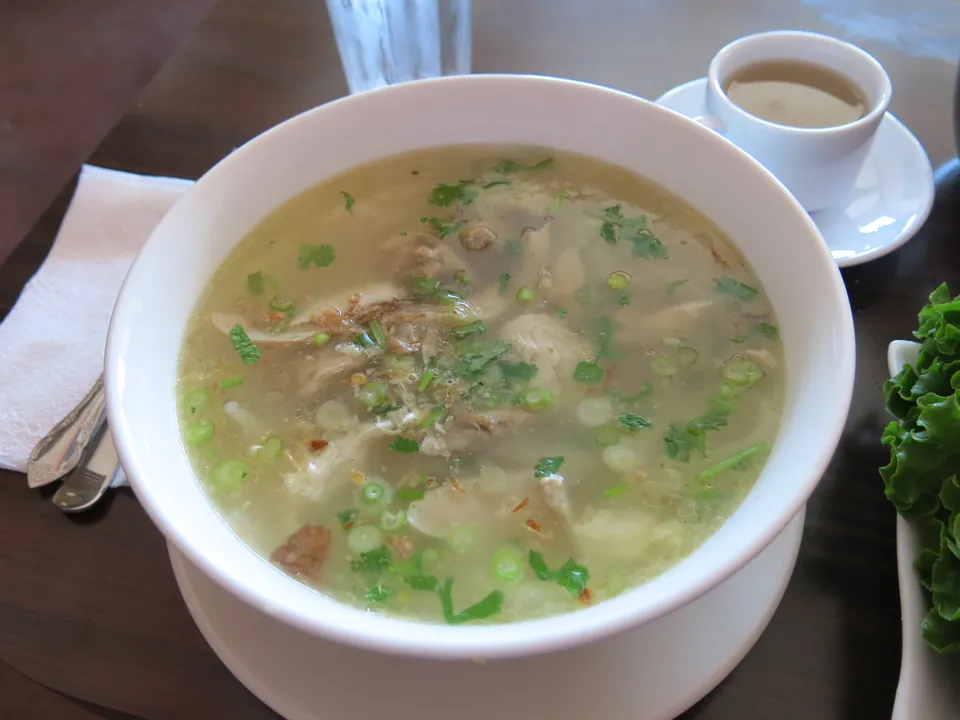
A breakfast noodle from the Laotian capital of Vientiane: chewy fresh noodles of rice flour worked with tapioca, simmered in chicken broth. It is often said to "go back thousands of years," but that antiquity belongs to a different, rice-only dish; the tapioca noodle in its present form is modern, born after South American cassava had spread through Southeast Asia.
Verification highlight popular claim → verdict → evidence
The dish's chewy noodle, made from rice flour mixed with tapioca starch, could not take its current form until tapioca (from cassava, a New World crop) reached Laos in the 18th-19th century; the dish is believed to have formed in the modern era, centered on Vientiane. A claim that the dish's history goes back thousands of years is considered a confusion with a separate, older rice-porridge dish of a similar name, khao piak khao. The rice-and-tapioca noodle-soup style is shared more broadly across the Mekong region, seen for example in Vietnam's bánh canh.
The three gates
- Ingredient-supply gate
- Rice was locally available; the arrival of tapioca starch (from cassava, a New World crop) limits when the distinctively chewy noodle could form.
- Cooking-technique gate
- Fresh noodles made from a mix of rice flour and tapioca flour, simmered in soup.
- Venue gate
- A breakfast and street-food noodle dish.
Overview
Where and when it was born
Khao piak sen is a Laotian noodle dish of fresh noodles kneaded from rice flour and tapioca starch, simmered in a broth drawn from chicken bones and served with chicken or pork. It is an everyday bowl of the morning stalls and eateries, spread above all through the capital, Vientiane. "Piak" describes something wet and soft and "sen" means noodle; the dish rests on freshly made noodles boiled straight away, slippery and chewy at once.
The chew comes from tapioca starch, drawn from cassava, a crop native to South America. Cassava was carried out of the New World in the age of ocean voyages, reached Southeast Asia in the sixteenth and seventeenth centuries, and had taken firm hold by the nineteenth. It was around then that the starch became something a Laotian kitchen could reach for day to day. Rice had long been the staple, but the springiness that rice flour alone cannot give was supplied by the newly arrived tapioca.
The fresh noodle of rice and tapioca as we know it took shape in the modern period, from the late nineteenth into the twentieth century, in and around Vientiane, once the New World crop had settled in. The stall, a place for something quick to eat, joined with the handwork of boiling freshly made noodles, and the dish settled into the land as a breakfast standard.
How we know
"The history of khao piak goes back thousands of years" is a line one hears often. But it rests on a mix-up. Laos has khao piak khao, a porridge of rice itself simmered soft, and it is this rice dish that carries the great age. The fresh noodle kneaded with tapioca starch, khao piak sen (sen meaning noodle, or strand), is a separate and newer thing. The name, "wet rice strands," points to the shape of a noodle, not a porridge.
Here the source of the tapioca becomes decisive. The cassava behind it is South American, and it reached Southeast Asia in the sixteenth and seventeenth centuries and came into wide use in Laos only in the nineteenth (a survey of the history of cassava for the FAO sets out these dates of introduction and spread). Until the South American crop crossed the sea and arrived, the chewy tapioca noodle had no way of existing in Laos. A "khao piak sen from thousands of years ago" simply does not fit the dates. The old layer lives instead in khao piak khao, the porridge that can be made from rice alone.
Even then, trying to pin the bowl to one place and one first cook in Laos runs into a wall. Thick, chewy noodles of rice and tapioca eaten in soup are found widely along the Mekong, and Vietnam's bánh canh, among others, closely resembles it in texture and in the way it is eaten. Records naming a distinct birthplace or year are thin, and khao piak sen is best seen as this shared Mekong tradition of thick noodle soup finding one of its forms in the stalls of Vientiane.
The full set of origin theories and the detailed verification log — traceable all the way to their sources — are available on the Japanese edition.
See the full origin theories and verification log (Japanese) →
Related dishes
Shares the key ingredient
- FufuWest / Central AfricaC
- Mhogo wa naziEast Africa (Swahili Coast)B
- KwangaCongo (Central Africa)B
- AttiékéIvory CoastB