All dishes / サブサハラ・アフリカ
Piri piri chicken Period COrigin theory CVerified
Some fields (dish name, region and gates) are shown from the Japanese-edition data.
A small village in the Algarve calls itself the "capital of piri piri chicken" and has claimed the dish was born there in 1964. But the small, fierce chili at its heart had crossed the sea and taken root in Africa long before that.
Verification highlight popular claim → verdict → evidence
The chili that defines piri piri chicken reached Portuguese-held Mozambique and Angola from the New World in the 1500s, but the dish's now-familiar form was largely shaped later, after 1974, when Portuguese settlers returning from the collapsing African colonies popularized it back home -- a restaurant in the Algarve's claim to have invented it in 1964 doesn't hold up against that timeline.
The three gates
- Ingredient-supply gate
- The chili pepper (African bird's-eye/piri piri) arrived via colonial trade, reaching Mozambique c. 1500-1600 (lower bound). Native to the New World, it became naturalized in Southeast Africa through early-16th-century Portuguese trade. Chicken is indigenous. Limiting factor: the chili pepper.
- Cooking-technique gate
- Open-fire or charcoal grilling with a chili marinade. An indigenous cooking technique that imposes no limiting bottleneck.
- Venue gate
- colonial commercial/public settings / Social popular/common / commercial / colonial trade sphere
Overview
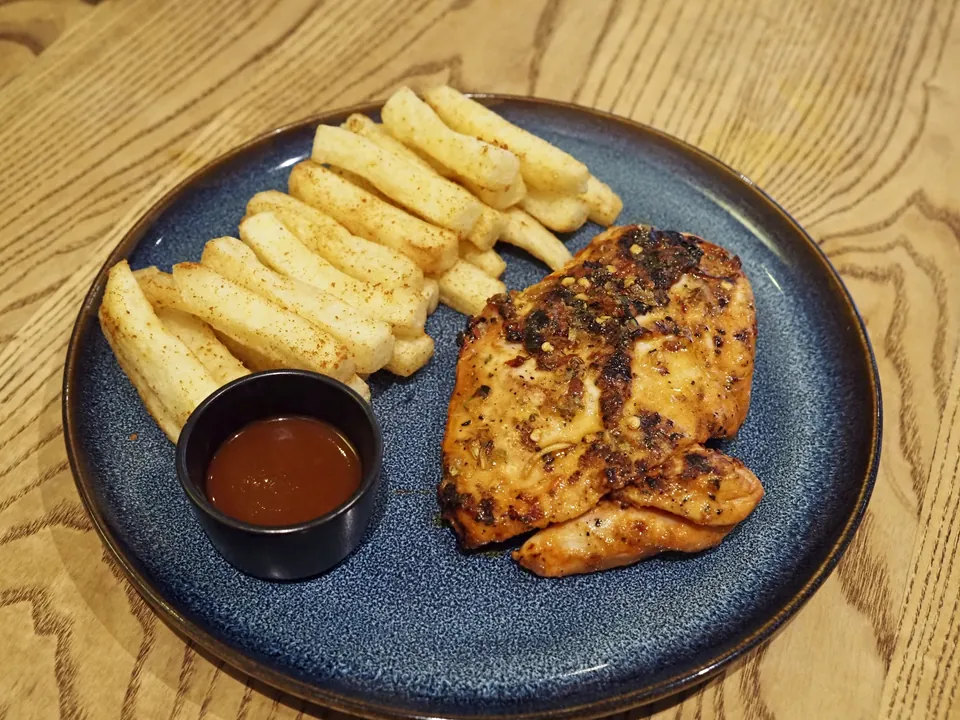
Piri piri chicken is made by marinating chicken in a sauce sharp with garlic, vinegar, and lemon and hot with chili, then grilling it over charcoal. "Piri piri" is the African bird's-eye chili that makes the dish; small but strongly pungent, it sets the character of the whole plate. The name comes from pili pili, "pepper-pepper" in the languages of southeastern Africa, and the word itself tells you the dish's roots lie on Africa's eastern coast.
The chili, surprisingly, is not an African plant to begin with. It is native to the New World, one of the crops the Portuguese carried around the globe in the age of exploration. In the sixteenth century, as Portuguese trade networks reached from the Indian Ocean to the African coast, the chili was brought to southeastern Africa, where it settled into the warm land and spread as if it were a native crop. Chicken had long been raised here. Once that fiery seed from across the sea had struck root in African soil, the makings of the dish, the local chicken and the chili to bind it, were finally all in place.
In Portuguese Africa, above all in the port towns and markets of Mozambique and Angola, the chili now at hand met the local chicken. In the everyday commerce of colonial life the pairing grew into a dish of chicken robed in chili sauce and grilled over charcoal. In time it would spread far beyond the colonies, out into the world.
How we know
Piri piri chicken has a famous origin legend. A restaurant in the village of Guia, in the southern Portuguese Algarve, styles itself the birthplace of modern piri piri chicken and dates that beginning to its opening in 1964. In 1999 the Portuguese government named Guia the "capital of piri piri chicken," and the story that this village is where the dish was born spread alongside the language of tourism.
Yet this founding tale does not square with the record. First, its source is the restaurant's own claim and a government's promotional "capital" designation, not evidence of the dish's origin. Second, the piri piri chicken style now known worldwide was worked out in metropolitan Portugal only after 1974, which makes 1964 too early. Third, the chili that is the source of the heat took root in colonial Africa in the sixteenth century, so the groundwork of the dish reaches far back before 1964. Guia was indeed a hub of the dish's spread and its rise to fame, but mistaking that role for "invention" is what the 1964 origin story really amounts to.
So how did it actually come about? Trace its history and two lands appear. One is colonial Africa. The chili, brought from the New World and naturalized there, joined the local chicken across Portuguese Africa, in Mozambique and Angola, and the core of the dish took form. Some once narrowed the origin to Mozambique alone, but the food historian Iona McCleery (University of Leeds) takes the origin broadly, across Angola, Mozambique, and possibly Brazil, and holds that pinning it to a single country is too narrow for the sources.
The other land is metropolitan Portugal. When the dictatorship fell in 1974 and the colonies gained independence one after another, many Portuguese who had lived in Africa returned home. The taste they brought back was shaped in the Algarve into a style of charcoal grilling, spatchcocking, and chili, and in time it spread worldwide through restaurant chains. McCleery notes that heavy chili eating was historically rare in metropolitan Portugal and that the vogue for piri piri chicken coincides closely with the end of the colonial wars and the return from Africa. This homecoming route is backed by scholarship together with the independently agreeing testimony of cooks and farmers, and is now accepted as a firm thread.
The source of the heat sprouted in colonial Africa, and the style known around the world was shaped in the home country after decolonization. This two-part path is the road the dish traveled. The light kindled by one restaurant in Guia is only a single lamp lit late in that long story.
The full set of origin theories and the detailed verification log — traceable all the way to their sources — are available on the Japanese edition.
See the full origin theories and verification log (Japanese) →
Related dishes
Shares the key ingredient
- KimchiSouth KoreaC
- Mapo tofuSichuan (China)C
- Doro watEthiopian HighlandsB
- Indigenous molli (chilmolli, pre-Old-World-spice chili sauce proto-layer)MexicoC
- RendangMinangkabau, West Sumatra (Indonesia)C
- Tom yum goongThailandC
- SambalMalay Archipelago (Indonesia)C
- TteokbokkiKorean PeninsulaC
- Tandoori chickenNorth India (Punjab / Delhi)C
- LaksaPenang (Straits Settlements)C
- MuhammaraAleppo, SyriaC
- VindalooGoa (India)C
- HarissaTunisiaC
- BibimbapSouth KoreaC
- Twice-cooked pork (huiguorou)Sichuan (China)C
- LarbLaos / Isan (Thailand)C
- Chili con carneTexas, USA (San Antonio)C
- Dan dan noodlesChengdu, Sichuan (China)C
- General Tso's chickenNew York (USA)C
- Pol sambolSri LankaB
- Chapli kebabPeshawar (Pakistan)C
- ShiroEthiopian HighlandsB
- Hiroshima soupless dandan noodlesHiroshima (Japan)B
- Kung pao chickenSichuan (China)C
- Fuqi feipianSichuan (China)D
- Nasi lemakMalaysiaC
- LampraisSri LankaC
- Nigerian pepper soupNigeria (West Africa)C
- MerguezMoroccoB