All dishes / 北米
Gumbo Period BOrigin theory CVerified
Some fields (dish name, region and gates) are shown from the Japanese-edition data.
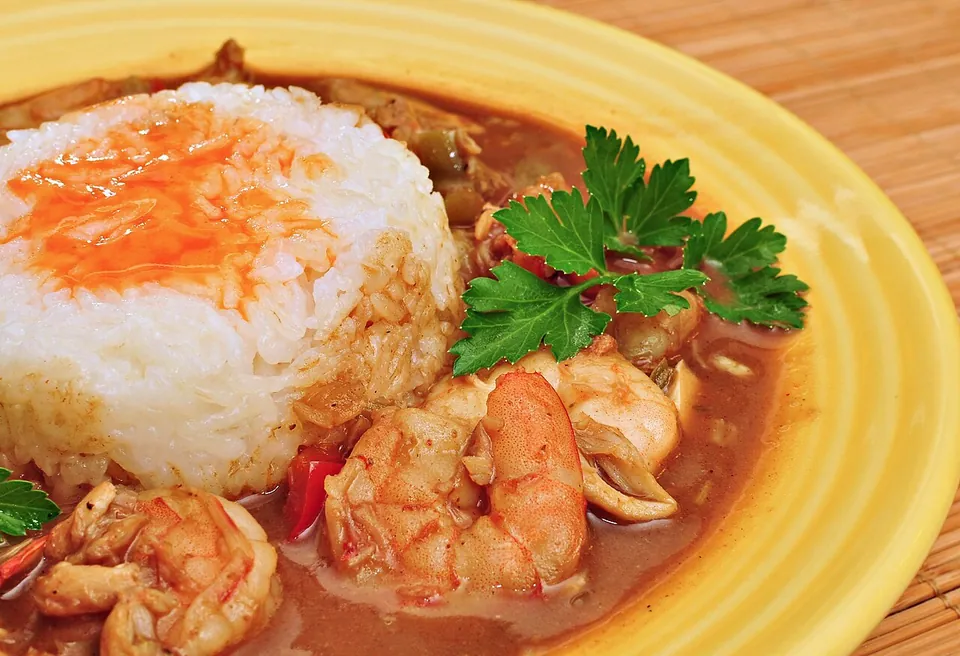
Gumbo is sometimes told as a dish French elites created in imitation of bouillabaisse. But its name points to the African okra, and the oldest surviving record shows a Mandingo woman cooking okra and rice into a gumbo in 1764. It is a creole dish born where French, West African, and Native American cooking met in Louisiana.
Verification highlight popular claim → verdict → evidence
Okra reached North America from West Africa via the Atlantic slave trade (Louisiana cultivation recorded from 1804). The earliest documented mentions of gumbo are from 1803-1804 in New Orleans, with an even earlier 1764 record. The word derives from the Bantu ki ngombo ('okra'). Three distinct thickening traditions are recognized: okra (West African), file powder (Choctaw-derived sassafras, native North American), and roux (French). Scholarship treats gumbo as a blend of French, West African, Native American, and Spanish influences, with no single origin story dominant.
The three gates
- Ingredient-supply gate
- Okra originates in West Africa and reached the New World via the Atlantic slave trade (North American cultivation from around the colonial-era 1700s); the file-powder version uses native North American sassafras.
- Cooking-technique gate
- A blend developed in colonial Louisiana: French roux, West African thickening techniques, and native sassafras, shaped by port trade.
- Venue gate
- Louisiana home cooking, later part of Creole urban culture in New Orleans.
Overview
Gumbo is a thickened stew and one of the defining dishes of the Creole cooking of Louisiana (New Orleans). Its lead ingredient, okra, is a West African crop. It was carried to the New World through the Atlantic slave trade, cultivated in North America from the colonial period around 1700, with a Louisiana planting record in 1804. From the late 18th into the 19th century, as this land of mixed peoples and ingredients came together, gumbo appears again and again in the record as a Creole dish.
The setting for its emergence was colonial Louisiana, a crossroads. The French roux, West African thickening techniques, and the sassafras of North America's native peoples met here, where port trade converged. On older Creole tables, a version built on okra and tomato without any roux was also widely made.
Gumbo enters the written record early. In 1764, an interrogation record of the French Superior Council notes a woman named Comba (Louison), of Mandingo origin, cooking a gumbo of file powder and okra together with rice, a primary source unearthed by the historian Gwendolyn Midlo Hall. It is one of the earliest scenes we have of gumbo being simmered in a colonial Louisiana kitchen, by the hands of people of African descent.
As a setting, gumbo began in Louisiana home cooking and took hold within the Creole urban culture of New Orleans.
How we know
Gumbo has long been trailed by the claim that French elites cooked it up in imitation of the bouillabaisse of southern France. The sources turn that account aside. First, the name gumbo derives from words for okra in Bantu and Bambara, with no French equivalent. Second, gumbo does not use the white fish that anchors bouillabaisse; versions made only with sausage or chicken, with no seafood at all, are common. Third, the oldest surviving record (the 1764 French Superior Council interrogation) shows a Mandingo woman, Comba, cooking a gumbo of file powder and okra together with rice, and the hands behind it were of African descent. The French-elite origin story has been criticized by scholars (Hall, Elie) as a 'whitewashing' that erases African and Haitian contributions from the story.
Gumbo is not the invention of a single person; it is where three lineages of thickening cross. The first is okra, the source of the name itself and a principal thickener in the age before refrigeration. West Africans carried okra across the slave trade, and its mucilaginous stew is held to be gumbo's matrix (Brasseaux, 64 Parishes, Hall). The second is the file powder of the Choctaw, ground from dried sassafras leaves and used as a thickener when okra was out of season, a lineage rooted in North America. The third is the French roux, browned dark in Louisiana.
The common account often puts this roux at the center of gumbo's origin, but The Picayune's Creole Cook Book of 1900 records that older Creole versions were built on okra and tomato without roux. The roux is only one of the three lineages, and not an indispensable one. The 1764 record already shows the file thickener standing alongside okra.
Not the invention of any one hand, but the crossing of several lineages: the picture of a dish formed where French, West African, and Native American cooking mingled is one that multiple accounts still support.
The full set of origin theories and the detailed verification log — traceable all the way to their sources — are available on the Japanese edition.
See the full origin theories and verification log (Japanese) →