All dishes / 西欧
Arroz de marisco Period COrigin theory CVerified
Some fields (dish name, region and gates) are shown from the Japanese-edition data.
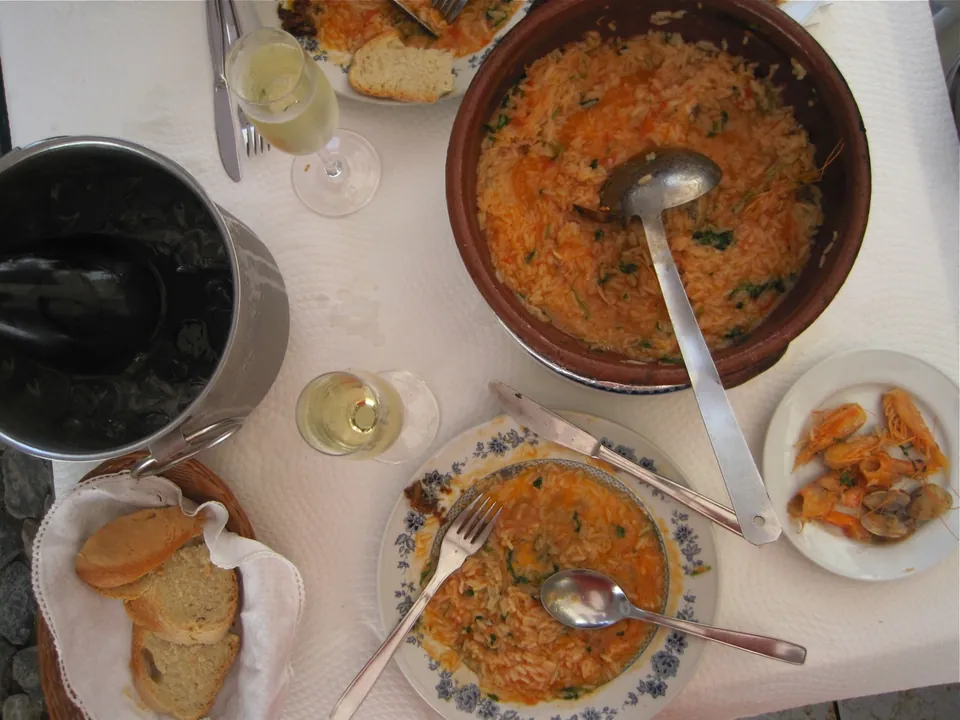
A Portuguese seafood-and-rice dish in which Atlantic shellfish are cooked into rice that stays wet and soupy. Several coastal towns have proudly claimed to be its birthplace, yet no source has ever settled which town can truly claim it.
Verification highlight popular claim → verdict → evidence
Local tourism boards claim the dish originated specifically in the fishing village of Praia da Vieira. This civic claim lacks independent documentation going back that far; the dish as known today is a 20th-century national dish whose true birthplace cannot be pinned down. The oldest dated printed use of the name 'arroz de marisco' found so far is a 1965 photo-book on the Algarve, decades later than the village origin story implies. Main sources: Marinha Grande tourism board's official account and Artur Pastor's Algarve, Portugal (1965).
The three gates
- Ingredient-supply gate
- Seafood was already available locally; the limiting factor was an ample rice supply and rice becoming an everyday staple.
- Cooking-technique gate
- Rice is simmered in seafood stock until it turns into a loose, soupy, porridge-like dish.
- Venue gate
- Home kitchens and modest eateries along the Algarve coast.
Overview
Arroz de marisco takes Atlantic seafood—prawns, clams—and lets the rice drink up their broth, cooking it deliberately loose and soupy. Where some dishes finish the rice dry in the same kind of pan, this one keeps it moist. Portuguese calls that state malandrinho—loose and glistening with liquid—and that wetness is the whole point of the dish.
The raw materials had long been at hand. Rice reached the Iberian Peninsula in the Moorish period (from the eighth century) and took root; in Portugal it has been grown ever since as the sticky Carolino rice, an old crop of the land. The seafood was, of course, the bounty of the Atlantic coast, familiar in every household along it. Cooking rice in seafood broth was thus something done on these shores for a very long time.
Why, then, place the dish's making in the modern era? The deciding factor is not whether the ingredients existed but when the dish took shape as a bounded thing bearing the name arroz de marisco. Its present form, which includes a tomato-tinged sauce, could only come together after edible tomatoes spread through Iberia from the mid-eighteenth century onward. More decisively, the dish under this name was not widely shared as a national staple until the twentieth century: it was written down in Maria de Lourdes Modesto's Cozinha Tradicional Portuguesa (1980s) and given prestige by its selection as one of the Sete Maravilhas da Gastronomia (Seven Wonders of Portuguese Gastronomy) in 2011. The genre of coastal rice dishes is old, but the dish we now name is a modern one.
How we know
The question that stirs the most heat around this dish is where it was born. The tale most often told makes Praia da Vieira, on the coast of Leiria in central Portugal, the birthplace. People settled these dunes in the late eighteenth century and fished with the beach-seine net called xávega; the fishing families, it is said, cooked the day's catch with rice and shared it out—and from this the dish grew. The local Marinha Grande tourism office presents this officially, and the 2011 honor made it more widely known.
It is a fine story, but no independent record reaching back to the eighteenth century supports it. Even if the settlement itself dates to the late eighteenth century, no contemporary source shows that a dish named arroz de marisco was born there. This is a town's cherished story of pride, not evidence of origin.
What the sources will allow is this: the exact birthplace cannot be pinned to a single town, and the dish is best seen as having grown somewhere along Portugal's seafood-rich coast, with its true origin still unresolved and unlikely to be settled without new sources. What is certain are three things: the old Iberian tradition of eating rice, the Atlantic seafood, and the twentieth-century codification of this dish as a national plate. The year a name appears in print is a separate matter from the year a dish was born.
Its resemblance to neighboring Spain's paella is no accident. The two grew apart from a shared Iberian ground of seafood-and-rice cooking—sister dishes, neither the parent of the other. Where paella drives off the liquid to build a crust of toasted rice (socarrat), this one keeps the liquid and finishes loose. Two dishes from one root that walked toward opposite textures.
The full set of origin theories and the detailed verification log — traceable all the way to their sources — are available on the Japanese edition.
See the full origin theories and verification log (Japanese) →
Related dishes
Cross-links Sister dishes & same-name dishes (separate lineage)
Shares the key ingredient
- BiryaniSouth Asia (Deccan / Mughal)C
- DosaSouth India (Tamil Nadu / Karnataka)C
- Risotto alla milaneseMilan (Lombardy, Italy)C
- Nasi gorengIndonesia (Java)C
- JambalayaNew Orleans (Louisiana, USA)C
- MujaddaraLevant (Syria, Lebanon, Palestine)B
- DoriaYokohama, JapanB
- IdliSouth IndiaC
- MaqlubaPalestine / LevantC
- White mixed rice (hondonban / goldongban — Bibimbap precursor)Korean PeninsulaC
- MandiHadhramaut (Yemen)C
- Rice and native-grain upma layer (sada upma, pre-semolina)South IndiaC
- KiribathSri LankaD
- KabsaSaudi ArabiaC
- PlovUzbekistan (Samarkand / Fergana)C
- MachboosPersian Gulf (Bahrain / Kuwait)B
- Gallo pintoCosta Rica / NicaraguaC
- Dal bhatNepalB
- KoshariEgyptC
- PilauEast Africa (Swahili Coast)C
- Rice-and-lentil koshari base layer (pre-pasta, pre-tomato)EgyptC
- Bánh cuốnVietnamB
- MahshiEgyptB
- PolowIranC
- PulaoNorth IndiaC
- PilavAnatoliaC
- Kabuli palawAfghanistanC
- Pilaf (French)FranceC
- Pilaf (Japanese-style)JapanC
- TahdigIranC
- CasadoCosta RicaC
- Nan gyi thokeMyanmarC
- Mont diMyanmarC
- AranciniSicily (Italy)C
- Mazbi (madhbi)Yemen (Hadhramaut)C