All dishes / 南アジア
Shami kebab Period COrigin theory CVerified
Some fields (dish name, region and gates) are shown from the Japanese-edition data.
A court cook devising a soft patty for an aged nawab who had lost his teeth: the famous birth story of the shami kebab is an anecdote borrowed from a different kebab altogether. And the dish's name was already written down in 1832, in a record made far from Awadh in the Deccan, when Wajid Ali Shah, the prince the story most often credits, was a boy of ten.
Verification highlight popular claim → verdict → evidence
A popular story says shami kebab was created for a toothless Nawab of Awadh who could no longer chew regular kebabs. The story does not hold up: the name 'Shamee Kubab' already appears as an independent entry in an 1832 London-published glossary of Muslim customs in India, years before the Nawab most often named in the legend (Wajid Ali Shah, born 1822) could have commissioned it. Main sources: Jaffur Shurreef and G. A. Herklots, Qanoon-e-Islam (1832), and a matching printed recipe in Riddell's cookbook (1877).
The three gates
- Ingredient-supply gate
- Split chickpeas (chana dal) and minced meat were both already available locally; the ingredient side is not the limiting factor.
- Cooking-technique gate
- The technique of pounding minced meat together with roasted chickpea flour (besan) in a mortar, then shaping and shallow-frying it into patties or balls, is the likely limiting factor. Both the 19th-century printed recipes (Riddell 1849/1877) and Veerasawmy (1936) list roasted chickpea flour as the binder; the modern practice of grinding boiled chana dal together with the meat does not appear in this body of sources.
- Venue gate
- Served at Awadh/Delhi court banquets and among urban Muslim communities as a festive dish and light meal.
Overview
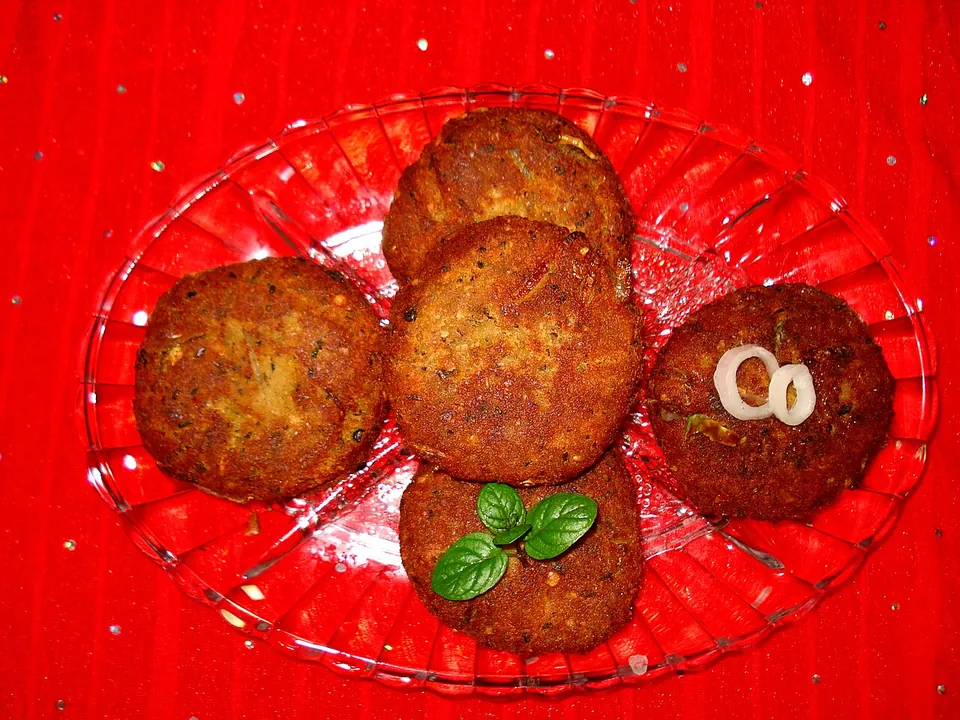
The shami kebab is a minced-meat dish made by simmering lamb together with chana dal (split chickpeas), grinding and kneading the mixture fine, shaping it into flat discs and shallow-frying them. It is eaten in Lahore and Karachi and across the towns of North India, at banquets and as a light bite alike.
Lamb and chana dal were long-established foods in South Asia, on everyday tables from early on. Meat and pulse to hand are simmered, then ground fine enough to be almost a paste, and worked firmly by hand with spice into a smooth body that holds together right up to the edge of falling apart. That kneading is what makes a shami kebab a shami kebab. It sets the dish apart from the seekh kebab, where chunks of meat are grilled on a skewer over open fire, and from the chapli kebab, where coarse mince is patted flat and fried: three dishes that share the word kebab and are built by wholly different hands.
The oldest record of the name stands in the Qanoon-e-Islam, published in London in 1832, an account of Muslim life in India written from the inside by Jaffur Shurreef and translated by G. A. Herklots. In its appendix, among the food terms, 'Shamee Kubab' has an entry of its own, alongside Seekh Kubab and Luddoo Kubab. The description is brief: chopped meat mixed with aromatics, green ginger and lime juice, shaped a finger thick and fried in ghee. No pulse appears in it yet.
The skeleton we would recognise today, pulse and all, is in print by 1877, in the eighth edition of Riddell's Indian Domestic Economy and Receipt Book. Mince is worked with roasted chana flour (besan), suet and spice, pounded in a mortar, shaped into cakes or balls and fried in ghee: pulse flour as the binder, pounding, kneading, shaping, frying, much as the kebab is made now. In the printed records that run from the nineteenth century into the early twentieth, though, the pulse named is roasted chana flour, and when the boiled chana dal of today's kitchens came to be ground together with the meat has yet to be pinned down. On a base of mince and pulse that reaches back to Mughal cooking, the dish settled into its present shape over the course of the nineteenth century.
The stage the legend gives it is the court of Awadh (Oudh), yet the English printed records all fall on the Deccan and Bombay Presidency side. The 1832 account describes the customs of Muslims in the Madras Presidency, and Riddell was a physician who served for many years in the Nizam's government at Hyderabad. Since books in English were printed in the presidency towns, this weighting does not rule out an Awadhi origin. Still, the shami was not a dish confined to one court's kitchen. In the banquets and light meals of the Muslim towns, where the smoothness of kneaded meat was something to compete over, the kebab was refined.
How we know
This dish comes with a story people like to tell. For a nawab of Awadh who had grown old and lost his teeth, a court cook is said to have devised a patty soft enough to eat without chewing.
It is an appealing tale, but nothing supports it for the shami kebab. The 'toothless nawab' anecdote belongs in the first place to a different kebab: the galouti, where the enzyme in raw papaya tenderises meat to melting softness. The story of that dish's birth was at some point loosely transferred onto the shami, and accounts that untangle the muddled origin legends, setting the 'insulted' nawab beside the 'toothless' one, point out the confusion. Which nawab is even meant will not settle: some tellings say Wajid Ali Shah, others his predecessor Asaf-ud-Daula. No contemporary record has yet surfaced to bear the anecdote out.
The dates do not fit either. In the food glossary of the Qanoon-e-Islam, printed in London in 1832, 'Shamee Kubab' already has its own entry. Wajid Ali Shah was born in 1822 and came to the throne in 1847; in 1832 he was a boy of ten, so any invention in his kitchens would come after that entry was written. And what the glossary records is not Awadh but the Deccan, the customs of Indian Muslims in the Madras Presidency. Attributing the dish to Asaf-ud-Daula (r. 1775-97) at least sits early enough in time, but on that side too a contemporary record has yet to turn up.
Shami, in any case, looks less like the name of one cook's invention than the name of a way of working. The first edition of Riddell's book (Bombay, 1849) carries 'Kooftha Mahee Shamy', a shami of fish: ground pulse flour as the binder, the mixture pounded firm, rolled and fried, the same method applied to fish instead of meat. A name for a technique travels across ingredients in a way a name for one man's anecdote does not.
So where does the word come from? The strongest reading takes shami as an Arabic and Persian relational adjective meaning 'of Sham', that is, of Bilad al-Sham, Greater Syria, the Levant. Platts's Dictionary of Urdu, Classical Hindi, and English (1884), the standard historical dictionary, defines shāmī on page 719 as 'of or belonging to Syria, Syrian', and places under it the compound shāmī ṭikiyoṅ-ke kabāb, a kebab made of flat cakes of meat. The lexicographers agree on 'Syrian'; the readings that trace the name instead to Persian shaam ('supper', 'evening') or to the perfume shamama have yet to surface in a dictionary of that standing, and are best taken as folk etymologies carried along in the telling.
A word's origin, though, is not a dish's origin. That Levantine cooks moved into South Asia between the medieval and Mughal centuries, bringing with them the minced-meat patties of the kibbeh and kofta family, would fit the etymology neatly, but the records of such a passage are not yet in hand. Carrying an echo of the Levant in its name, the shami kebab stands before us as a dish kneaded into shape in the courts and town kitchens of South Asia.
The full set of origin theories and the detailed verification log — traceable all the way to their sources — are available on the Japanese edition.
See the full origin theories and verification log (Japanese) →