All dishes / 東アジア
Cheung fun (rice noodle roll) Period BOrigin theory CVerified
Some fields (dish name, region and gates) are shown from the Japanese-edition data.
Cheung fun is a Cantonese dim sum of rice batter steamed into a thin sheet and rolled around shrimp, beef or char siu. A widely told tale has it invented by a Tang-dynasty monk and named by the Qianlong Emperor, who thought it resembled pig's intestine—but that story has no firm source in the local gazetteers and does not fit the documentary record. It is a later fabrication.
Verification highlight popular claim → verdict → evidence
A folk legend claims the dish originated in Tang-dynasty Luoding and was named by the Qianlong Emperor, but a Yangcheng Evening News investigation explicitly debunks this as an unsupported 'invented tradition.' The dish actually took shape in Guangzhou's Xiguan district during the Republican era, settling into its current form through 1930s street vendors and the wartime-era Pantang Hexian teahouse; rice itself was long available, but the decisive factor was the bu la chang steaming technique.
The three gates
- Ingredient-supply gate
- Rice has been native to southern China since ancient times; the limiting ingredient is rice slurry (water-milled rice flour).
- Cooking-technique gate
- The technique of pouring a thin batter onto cloth and steaming it (bu la chang / drawer-style steaming).
- Venue gate
- Established in Guangzhou's teahouse dim sum culture and as a street breakfast.
Overview
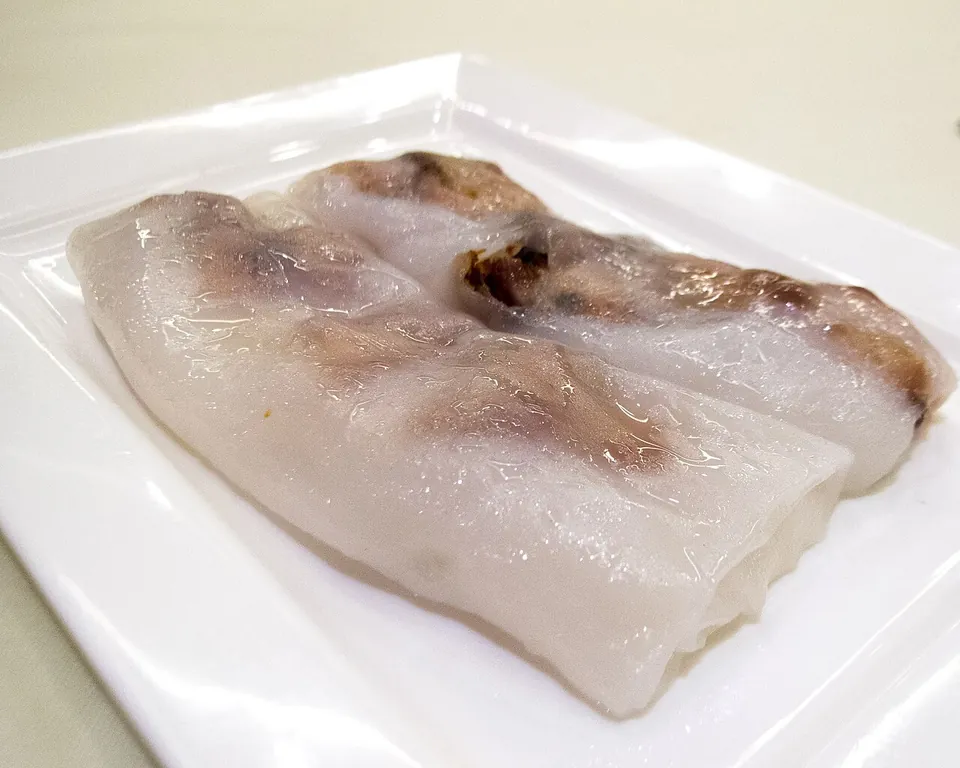
Cheung fun (cheungfan) is a dim sum of southern China's Guangdong region: a thin sheet of rice-flour batter steamed until set, then rolled around shrimp, beef, char siu and the like. Just off the steam, the sheet is translucent and soft, and it is served under a sweet-savoury soy-based sauce. In the teahouses of Guangzhou and Hong Kong it is a standard dish of yum cha, and at street stalls it has long been eaten as breakfast.
The wrapper is made from rice, a grain long established in southern China. Rice was a familiar crop that had ripened across the southern land from far back, and a smooth milk of soaked, ground rice could always be kept ready in the kitchen. That rice milk is spread in the thinnest layer over a cloth-lined frame and steamed through in one go by the steam alone. Peeling it from the cloth while rolling it up is a handwork known as bou laai cheung; steamed through the cloth, the sheet comes out glossy and smooth, and it slips apart softly in the mouth. The cook draws the hot frame out swiftly and rolls the steaming sheet up in a single motion. Later a drawer-style steamer came into use, stacked so that sheets could be steamed one after another, and stalls too could serve freshly rolled cheung fun in a steady stream. Only once this run of handwork—pour thin, steam, peel and roll—was in place did cheung fun take shape as a dish.
The stage on which that handwork was refined was the dim sum culture of Guangzhou in the first half of the twentieth century, across the late Qing and Republican periods. In the city's teahouses, yum cha—savouring small plates of dim sum alongside tea—was deeply woven into daily life. The idea of a thinly steamed sheet of rice was refined among these dim sum offerings and came together as a dish in the form of a roll. Cheung fun took hold precisely because that yum cha culture and the street breakfast trade were there to hold it.
How we know
The origin that folk tradition long handed down for cheung fun reaches all the way back to the Tang dynasty. At the Longkan Cave in Luoding, Guangdong, the Sixth Chan Patriarch Huineng and his disciple Huiji are said to have made a rice cake, the "Huiji ci" (Longkan ci); later the Qianlong Emperor, touring the south, is said to have eaten it and named it "cheung fun"—intestine noodle—because it looked like pig's intestine.
But no firm gazetteer source supports this colourful pedigree. The device of an emperor bestowing a name on a dish is a familiar shape for an origin tale dressed up after the fact with borrowed authority. The Yangcheng Evening News plainly dismisses both the Tang-dynasty Huineng story and the Qianlong naming as "folk legend, not to be relied on." The Tang-era oiled rice cake was a different food from today's cheung fun, spread thin on cloth and steamed, and the claim that an eighteenth-century emperor named it does not square with the period in which cheung fun makes its firm documentary appearance.
The firm formation of cheung fun lies in the streets of Guangzhou in the first half of the twentieth century. Steamed thin-rice foods were old in southern China, and under the influence of the Hakka kwan pan, earlier rice-flour dishes such as sar hor fun and pig's-intestine noodle (chu cheung fun) were carried on in Guangdong. The pig's-intestine noodle is recorded in the 1911 Resistance Pictorial, and sar hor fun in the 1928 Statistical Collection—each, at the latest, in existence by that year. Cheung fun itself, it is told, was hawked through the streets of Guangzhou's Xiguan district by itinerant sellers in the 1930s; during the war against Japan, a cook at the Xiguan-Buntong teahouse "Buntong Ho Sin Koon" rolled pork, beef, fish and fresh shrimp in a thin rice sheet and sold it as a novel dim sum, and neighbouring teahouses copied it one after another, growing into today's laai cheung.
Alongside this runs a view pointing to a somewhat earlier date. South of Guangzhou, in Chencun in Shunde, Huang Dan is said to have created a thin, smooth rice sheet—"Huang Dan fun" (later Chencun fun)—in 1927, and cheung fun is held by this account to have grown out of Shunde's rice-sheet making. But Huang Dan fun and Chencun fun belong to the flat hor fun family, and are better seen as a sister innovation sprung from the same Guangdong rice-sheet culture than as a direct parent of the cheung fun that is spread thin on cloth and rolled; the claim that "cheung fun is a reworking of Huang Dan fun" has weak documentary support. Cheung fun and the rice sheets of Shunde are, on the present view, close kin risen from the same soil of a shared rice-flour culture.
The full set of origin theories and the detailed verification log — traceable all the way to their sources — are available on the Japanese edition.
See the full origin theories and verification log (Japanese) →