All dishes / 南アジア
Appa (hopper) Period COrigin theory CVerified
Some fields (dish name, region and gates) are shown from the Japanese-edition data.
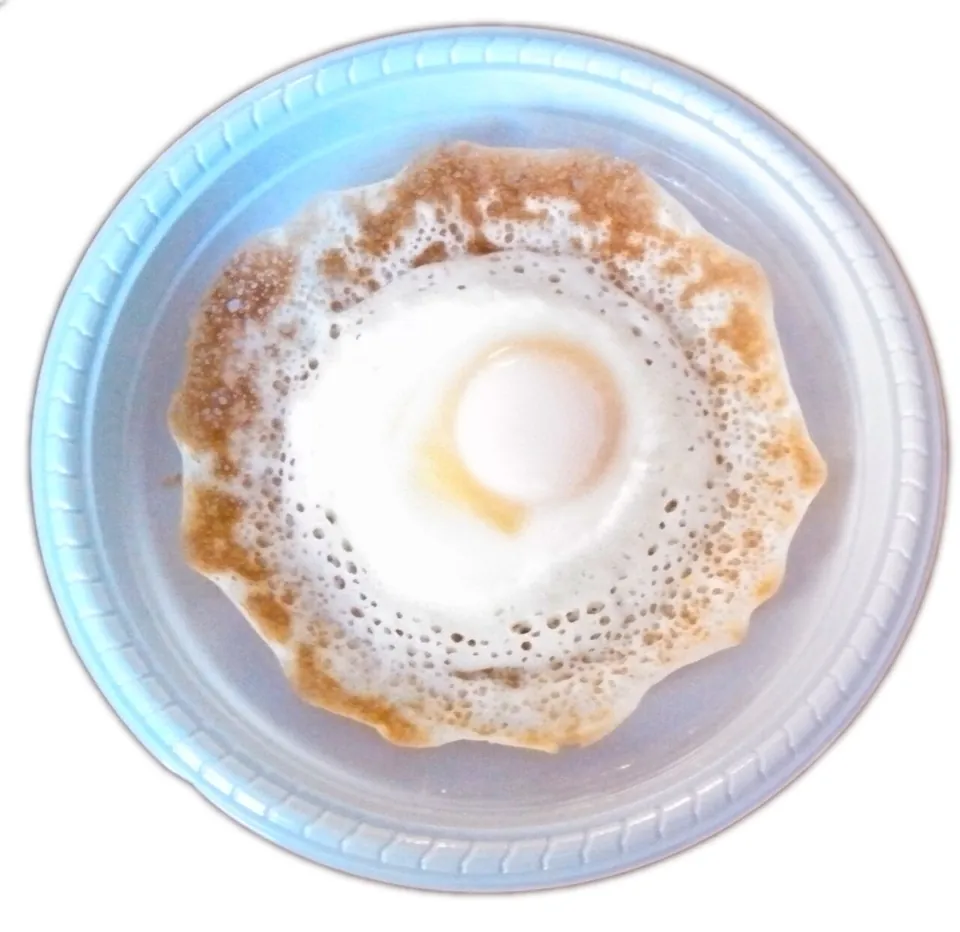
The bowl-shaped āppa (hopper), with its raised rim, is a face of the Sri Lankan breakfast table. But the local pride that calls it a Sri Lankan invention finds no support in the record: its lineage runs back across the sea to a South Indian dish.
Verification highlight popular claim → verdict → evidence
South Indian appam -- established in ancient Tamil country and already appearing in Sangam-era literature -- spread to Sri Lanka via Indian Ocean trade and became localized as the hopper. Claims of an independent Sri Lankan origin are rejected by the sources. Rice and coconut are both native, consistent with the ingredient constraints. The exact founding period of the current hopper form, somewhere between medieval and early modern times, remains debated across multiple theories.
The three gates
- Ingredient-supply gate
- Both rice and coconut are native.
- Cooking-technique gate
- Fermented batter cooked in a bowl-shaped pan.
- Venue gate
- Breakfast and light meals.
Overview
Āppa — hopper in English — is a Sri Lankan snack made by pouring a batter of fermented rice flour and coconut milk into a bowl-shaped pan and cooking it. The rim comes out thin and lacy, the centre thick and soft, and it has long been eaten at breakfast or as a light meal.
Both rice and coconut are old, home-grown ingredients rooted in Sri Lanka, on the everyday table from early on. To them is added the slow preparation of fermentation. Left overnight, the batter takes on a sourness and a rise; then it is poured into the bowl-shaped pan and cooked quickly. When this fermented batter met that distinctive pan, the hopper took its shape: a lacy rim and a plump base.
The English name hopper spread when āppa was anglicised under British rule. Trace the word back and it runs from Tamil āppam to Sinhala āppa and on to English hopper. The chain of names itself tells the road this dish travelled.
How we know
There is a telling that treats the hopper as a Sri Lankan invention all its own and cuts the thread to South India. But no contemporary clue supports such an independent invention.
The dish of pouring fermented rice flour and coconut milk into a bowl-shaped pan was already established in the ancient Tamil country as appam. It is named in Tamil Sangam literature — Perumpāṇāṟṟuppaṭai and others, around the second and third centuries CE — as the food historian K. T. Achaya records in Indian Food: A Historical Companion (1994). From there it crossed the Indian Ocean through trade and the movement of people, reaching Sri Lanka and taking root as the hopper.
The path of the name points the same way. The Oxford English Dictionary gives the etymology of appam as Tamil and Malayalam appam, and treats English hopper as an anglicisation of Sinhala āppa (from Tamil āppam). That English hopper is recorded by at least 1886, in the Anglo-Indian glossary Hobson-Jobson (Yule & Burnell).
The customs themselves — eating fermented rice and using coconut — are old on both shores, and there is no need to deny that age. It is only the view that today's hopper arose from nothing, on its own, that cannot stand against the record of the texts and the chain of the name. The pride over origins and the fact of a crossing over the sea are best kept apart.
The full set of origin theories and the detailed verification log — traceable all the way to their sources — are available on the Japanese edition.
See the full origin theories and verification log (Japanese) →