All dishes / ラテンアメリカ
Pupusa Period COrigin theory CVerified
Some fields (dish name, region and gates) are shown from the Japanese-edition data.
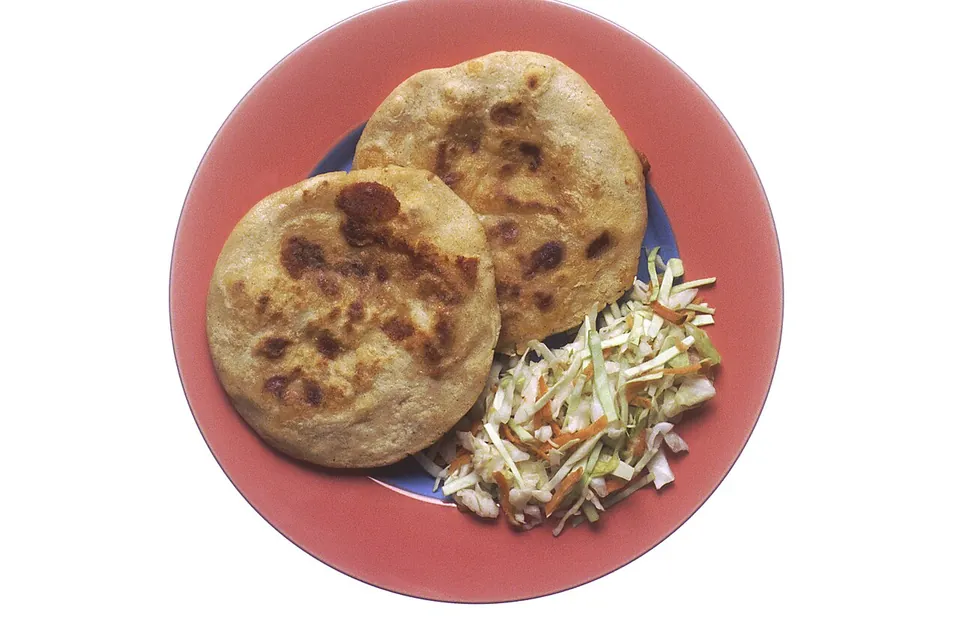
The pupusa, El Salvador's national dish, is a thick tortilla of lime-treated corn dough griddled with a filling sealed inside. It is often told as a one-nation dish the Pipil invented, yet the masa cooking it grows out of is native to Mesoamerica and reaches back to the seventh century at least, and who — or which country — first closed a filling into the disc is still unsettled.
Verification highlight popular claim → verdict → evidence
Pupusas rest on an ancient Mesoamerican base -- griddled corn masa dates back to before Columbus -- but who gets credit for them is still disputed: linguists disagree over whether the name really comes from a Pipil word, and El Salvador and Honduras both claim the dish as their own.
The three gates
- Ingredient-supply gate
- Depends on lime-processed maize (nixtamalized masa). It is native to Mesoamerica and had long been an everyday staple, so it sets no earliest possible date for the dish; maize was domesticated in Central America around 7000 BCE.
- Cooking-technique gate
- Nixtamalization (lime processing) and the comal (griddle). The antiquity of masa processing itself is backed by material remains: at Joya de Ceren, a village buried by the eruption of the Loma Caldera vent around 660 CE, a vessel held maize kernels apparently left to soak, and work areas with grinding stones (metates) were found. But the archaeobotanical study of that site (Farahani et al. 2017) makes no mention of a comal or a tortilla. The antiquity of shaping the dough into a disc and griddling it rests instead on Sahagun's sixteenth-century account and on how widespread masa cookery was across Mesoamerica.
- Venue gate
- home and street stalls (pupuseria) / Social popular/common / market stall / indigenous
Overview
A pupusa is a thick tortilla of lime-treated corn dough — masa — filled with cheese, beans, chicharrón (pork rind) or other stuffings and cooked on a griddle. In El Salvador today it is eaten as the national dish, at home and at street pupuserías.
Corn, the heart of the dish, is an old crop rooted in this land: domesticated in Mesoamerica around 7000 BCE, it was on everyday tables from early on as masa, dough softened and slaked with lime in the process known as nixtamalization. Cooking that masa on a comal, a flat clay griddle, was likewise practiced across the region in pre-Columbian times. The pupusa, a filled disc browned the same way, grew on that old ground.
The archaeology and the written record each carry a part of that antiquity, and they carry different parts. At Joya de Cerén in present-day El Salvador — a Maya village buried under volcanic ash around 660 CE — archaeobotanical and spatial work found corn to be the most abundant plant in the village, alongside processing areas equipped with metates (grinding stones) and a vessel holding kernels that appear to have been left soaking. The cooking those remains point to is pozole and tamales; the work reporting them makes no mention of a comal or a tortilla. So the age of masa foodways is what the buried village demonstrates. The age of the other half — flattening that dough into a disc, folding a filling in and griddling it — rests instead on the written side, where Bernardino de Sahagún recorded in 1570 a Mesoamerican dish that combined dough, beans and meat.
The pupusa is not a courtly invention. It came out of the everyday cooking of Indigenous communities, in kitchens and on the street, and dairy such as cheese joined it from the colonial period onward to give the pupusa its present form. Its standing as a national symbol is recent: a National Pupusa Day was established in 2005, and in 2018 the World Trade Organization recognized El Salvador as the dish's place of origin.
How we know
Two questions tend to run together whenever the pupusa's past comes up, and they answer to different kinds of evidence.
The first is how old the body of the dish is. Joya de Cerén, the Maya village in present-day El Salvador that volcanic ash sealed around 660 CE, is the usual anchor for it, and the line most often repeated runs that comales, grinding stones and masa residue came out of the ruins, physical proof of a pupusa two thousand years old. The archaeobotanical and spatial study of the site published by Farahani and colleagues in Antiquity in 2017 reports something more particular: corn is the most abundant plant in the village, at 189 specimens, and comes with milpa cultivation; Structures 1, 6 and 10 hold processing areas equipped with metates; a vessel in Structure 11 contains kernels that appear to have been left soaking. The cooking inferred from all this is pozole and tamales, and neither the comal nor the tortilla appears anywhere in the paper. What Cerén demonstrates, then, is the antiquity of masa foodways — kernels soaked, dough ground on a stone — and not the antiquity of a filled disc on a griddle. For that second thing the support has to come from the written record, from the dish of dough, beans and meat that Bernardino de Sahagún set down in 1570.
The second question is who — which people, which country — made it. That one is still open. Reading the name pupusa as Nawat, the language of the Pipil, the archaeologist Roberto Ordóñez and others argue for a Pipil origin. The linguist Jorge Lemus doubts the Nawat derivation and points out that the Pipil called this food by a different word, kukumuzin. In Honduras, Héctor Leiva Carías contests the attribution altogether, noting that Nawat was spoken on his side of the border too. And Joya de Cerén was a Maya village rather than a Pipil one; the Pipil reached Central America later.
Nor does the written trail of the word sit only in El Salvador. In Honduras, Alberto Membreño's dictionary of regional speech, Hondureñismos (1895), gives pupusa its own entry, describing a cheese-and-bean pastry cooked on a comal. In English, the Oxford English Dictionary carries pupusa as a headword, dates the earliest use it has found to 1948 in the Denton Journal of Maryland, and traces the etymology to Nawat puxahua, 'swollen.' The name is planted in more than one country of Central America.
One early date is quoted often enough to deserve unpicking: that the word pupusa first appears in 1837, in a letter by José Batres Montúfar. What the letter called 'like a pupusa,' though, was the Nicaraguan rellenas — a comparison, not the debut of the word itself — so it cannot fix the attribution early. The Salvadoran anthropologist Ramón Rivas assigns the pupusa to no single country but to Mesoamerica at large. Read with its timelines kept apart — the etymology, the ethnic claim, the national claim, and the recent turn to national emblem in the Pupusa Day of 2005 and the recognition of 2018 — the origin of the pupusa stays open, while the masa beneath it stays very old.
The full set of origin theories and the detailed verification log — traceable all the way to their sources — are available on the Japanese edition.
See the full origin theories and verification log (Japanese) →
Related dishes
Shares the key ingredient
- UgaliEast Africa (Kenya / Tanzania)C
- Tamale (tamal)MexicoC
- CornbreadSouthern United StatesC
- ArepaColombia / VenezuelaC
- Indigenous maize proto-layer (cornbread precursor: corn pone / ashcake)North America (Indigenous maize-cultivation range)B
- GritsAmerican SouthB
- PozoleMexicoC
- Proto-pozole (pre-pork pre-Columbian ceremonial pozole: ritual meats such as turkey/dog with nixtamalized maize proto-layer)Mesoamerica (pre-Columbian Mexico)C
- Indigenous corn-dough dish (humita family)Araucanía (Chile)B
- Brunswick stewSouthern United StatesC
- NachosPiedras Negras (Northern Mexico)B
- MukimoKenya (Kikuyu country)C
- PanuchoYucatán (Mexico)C
- PapSouth AfricaB
- Mukbil polloYucatán (Mexico)C
- KenkeyGhanaC