All dishes / 東欧
Bigos Period COrigin theory CVerified
Some fields (dish name, region and gates) are shown from the Japanese-edition data.
A medieval legend holds that Poland's slow-simmered bigos began when King Jagiełło served it to his hunting guests in the fourteenth century. But the word "bigos" first appears in writing in the sixteenth century, and what it named then was a different dish entirely, one with no cabbage in it.
Verification highlight popular claim → verdict → evidence
A popular legend credits the 14th-century king Jogaila with inventing bigos for a hunting party, but the word itself is first attested only in 1534, about 150 years too late, and originally meant a plain minced dish with no cabbage at all. The now-familiar cabbage-and-sauerkraut version only spread in the 18th century as "bigos hultajski," as shown by Falimirz's 1534 herbal and Czerniecki's 1682 cookbook.
The three gates
- Ingredient-supply gate
- Cabbage and sauerkraut are long-established Old World crops, so no ingredient sets an earliest possible date for the dish. Some later regional versions add tomato, but it is no part of what bigos essentially is.
- Cooking-technique gate
- Lactic-acid fermentation (sauerkraut) combined with long simmering and repeated reheating, topped up over time like a perpetual stew.
- Venue gate
- Eaten at hunts and banquets by the szlachta, the nobility of the Polish-Lithuanian Commonwealth, it spread no further than the region itself, shared across the Polish-Lithuanian lands.
Overview
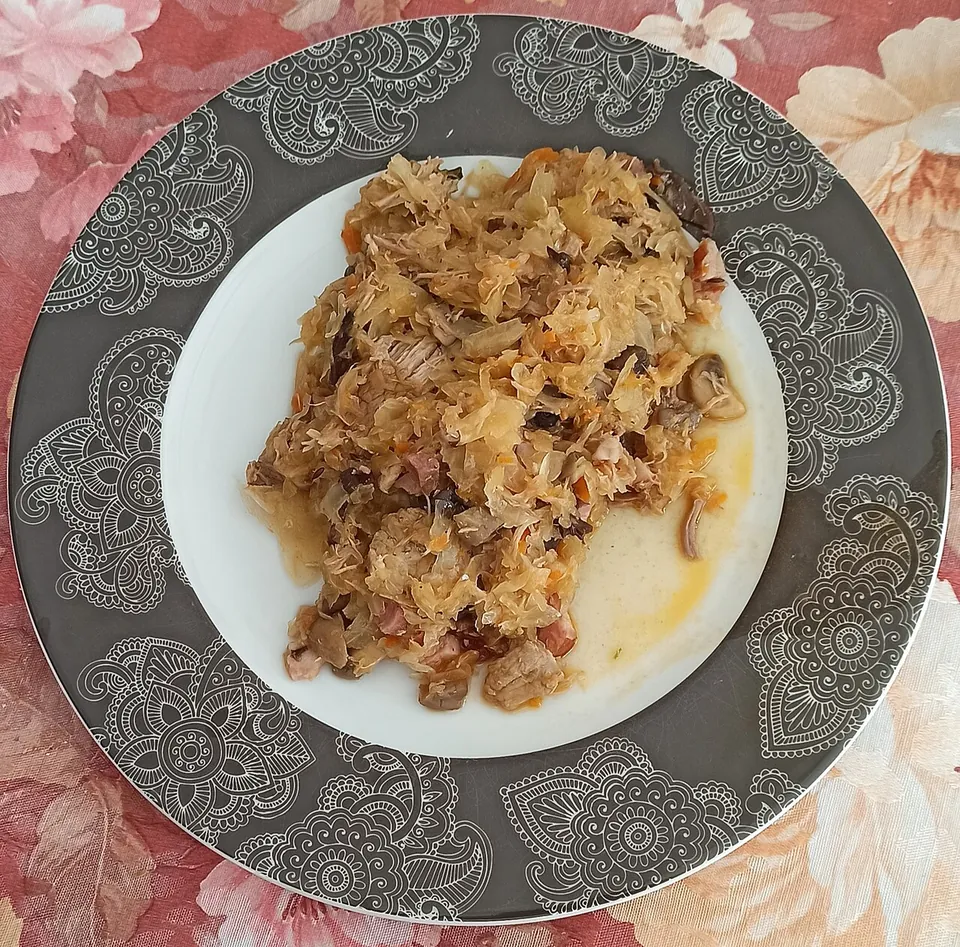
Bigos is a Polish hunter's stew and preserved dish, built up over long hours by adding game, pork, and sausage to cabbage and tangy fermented cabbage (sauerkraut) and simmering it all down. Its present form settled into place in the early modern period, above all in the eighteenth century.
Cabbage and sauerkraut, the leads of the dish, were both long-established Old World foods, rooted early in the Polish table. Regional versions that add tomato appeared in later years, but tomato is no part of what bigos essentially is.
The heart of the method is twofold: the sauerkraut process, which turns cabbage sour through lactic fermentation, and the long simmering, in which ingredients are added and reheated much as in a communal pot. The dish took hold at the hunts and banquets of the szlachta, the nobility of the early modern Polish-Lithuanian Commonwealth. It settled in as a keeping food for the road, and in time spread widely as a preserved dish for the home and the feast.
The word "bigos," however, did not name today's dish from the start. In sixteenth- and seventeenth-century texts, "bigos" meant finely chopped meat or fish dressed with something sour, such as vinegar, lemon, or sorrel, along with spices. The version that draws its sourness from cheap sauerkraut, called bigos hultajski ("scoundrels' bigos"), spread during the reign of Augustus III (1734–1763), and in the nineteenth century this form pushed the others aside to settle as the bigos we know.
How we know
Bigos carries an alluring legend of medieval origin. Jogaila, the Grand Duke of Lithuania who became King of Poland and is known by the name Jagiełło, is said to have served it to his hunting guests at the end of the fourteenth century. But this account has been set aside.
The reason it fails lies with the word itself. "Bigos" first appears in writing about a hundred and fifty years after Jagiełło's accession (1385), in the 1534 herbal of Stefan Falimirz, O ziołach i o mocy ich ("On Herbs and Their Powers"). And what it described there was a medicinal preparation of chopped wolf's lung, with neither cabbage nor any of the meats, nothing like today's bigos. A 1621 dictionary likewise defines "bigos" as a dish of chopped meat, and the oldest surviving Polish cookbook, from 1682, records an early recipe for it. Herbal, sixteenth-century dictionary, seventeenth-century dictionary, and seventeenth-century cookbook cross to point to an original sense of "a chopped dish." The antiquity of the hunter's game stew as such is not in doubt, but there is no ground for pushing the emergence of bigos as a dish back to the fourteenth century.
Where, then, did the image of bigos as a noble hunting dish come from? What burned it into the national memory was the hunting scene in Book IV of Adam Mickiewicz's epic Pan Tadeusz, published in 1834. That poem fixed the image of a noble hunting dish firmly in place. But that is something nineteenth-century literature shaped, not fourteenth-century fact.
Several views stand side by side here: one that sees bigos as a noble hunting dish, and one that sees it as originally a chopped dish. What can be said with confidence is that the bigos we know, made with cabbage and sauerkraut, took shape over the course of the eighteenth century.
The full set of origin theories and the detailed verification log — traceable all the way to their sources — are available on the Japanese edition.
See the full origin theories and verification log (Japanese) →
Related dishes
Shares the key ingredient
- Gołąbki (Polish cabbage rolls)PolandC
- HolubtsiUkraineC
- SarmaBalkans (Ottoman sphere)C
- KåldolmarSwedenC