All dishes / 東欧
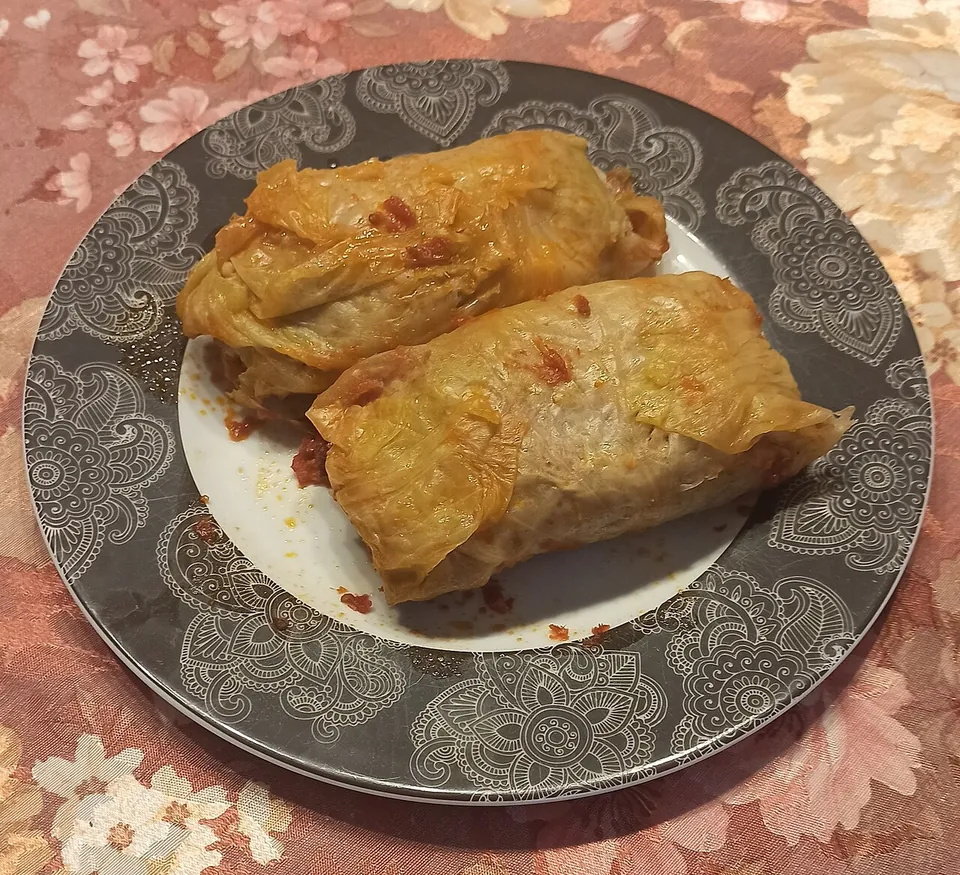
Gołąbki (Polish cabbage rolls) Period COrigin theory CVerified
Some fields (dish name, region and gates) are shown from the Japanese-edition data.
The origin of gołąbki, Poland's stuffed cabbage rolls, does not settle into a single answer. One school holds it a native Slavic dish named for the shape of a dove; another holds it borrowed from the Ottoman dolma. Scholars remain at odds, and any claim that names one of these as the true birthplace does not survive contact with the record.
Verification highlight popular claim → verdict → evidence
A favourite story makes gołąbki a Polish invention of the old noble feast, whole pigeons wrapped in cabbage leaves. The name does mean "little pigeons", and Vasmer derived it from the shape of the roll, but the linguist Marek Stachowski, writing in Przegląd Wschodnioeuropejski in 2016, finds that reading semantically doubtful and proposes a borrowing from Persian kalam and Old Armenian kałamb, "cabbage", later turned into a pigeon by folk etymology. The wrapped-leaf technique belongs to the wide dolma and sarma family, and the Polish word is recorded as taken from Ukrainian hołubci in the nineteenth century. The modern form, white cabbage with minced pork and rice, is in print as kapusta nadziewana in Lucyna Ćwierczakiewiczowa's 365 obiadów za pięć złotych (1860) and under the name gołąbki in Maria Marciszewska's Kucharka szlachecka (1894), where the recipe carries no tomato sauce. The dressings handed down with the dish were linseed oil, mushroom sauce and pork cracklings, the leaves soured rather than fresh, and tomato sauce came in later as a town fashion, po miejsku. Native Slavic invention and eastern borrowing are both still argued, and the origin is not settled.
The three gates
- Ingredient-supply gate
- Cabbage is a European crop, and head cabbage with leaves firm enough to wrap was to be had in Poland by about 1300 at the latest (range 1100-1400; Britannica and others), which is the earliest possible date for the rolls. Rice and meat are Old World foods as well. Only the version sauced with tomato depends on the New World fruit, which settled in Poland around 1850 (range 1800-1900), so that version has a separate and later starting point.
- Cooking-technique gate
- Leaves of head cabbage wrapped round a filling and stewed or baked, in a pot or in the oven.
- Venue gate
- A country home dish that went on to become a fixture at feasts and banquet tables.
Overview
Gołąbki are Polish cabbage rolls: rice and minced meat wrapped in the leaves of a head cabbage and stewed in a pot or oven. The genre of stuffed, wrapped food is old, but the form we know today — filled with rice and minced meat — settled into place in the nineteenth century. By mid-century, Lucyna Ćwierczakiewiczowa's cookbook 365 obiadów za pięć złotych (first edition 1860) records white cabbage stuffed with minced pork and rice, and by the century's end Maria Marciszewska's Kucharka szlachecka (1894) lists cabbage rolls under the name gołąbki. Two cookbooks together show that this form had become a standard of the Polish table by the nineteenth century.
The lead ingredient, cabbage, is a long-established European crop, and the head cabbage with leaves loose enough to wrap was a familiar local vegetable in Poland by the fourteenth century at the latest. Centuries before the dish took its settled form, the leaf to wrap a filling in was already on hand in the kitchen. The rice and minced meat of the filling are both Old World foods, needing no importing from anywhere. What gathered these ready ingredients into a single standard dish was the daily cooking of farming households, and the way that everyday fare climbed in standing toward the festival and banquet table.
The version dressed with tomato sauce is a different matter. The tomato is a New World plant, and it took root on the Polish table only after the nineteenth century began. The tomato version could only come afterward, and the plain basic form of rice and minced meat is the older of the two.
How we know
Two accounts of gołąbki's origin still stand side by side, and that a single one cannot be named as the source is itself the state of the question for this dish.
The native Slavic account sees it arising by itself, as a local dish, after cabbage cultivation spread through Central and Eastern Europe and poor farmers stewed fillings wrapped in leaves. The name gołąbki is the diminutive of gołąb (dove), given because the rolled shape resembles a small dove (so the philologist Vasmer). As noted, nineteenth-century cookbooks record this rice-and-meat form, and it is beyond dispute that the modern standard set in that century.
Directly opposed is the Oriental borrowing account. The linguist Marek Stachowski argued that reading the name as 'dove' is semantically doubtful, and that a borrowing from Eastern words — Persian kalam (cabbage) and kalam pič (cabbage roll), Old Armenian kałamb — was later reshaped, once its foreign sense was lost, into the familiar-sounding 'dove' (Uwagi do etymologii słowiańskiej nazwy potrawy gołąbki, Przegląd Wschodnioeuropejski VII(2), 2016). The family of leaf-wrapped dolma and sarma is held to have spread into Eastern Europe by way of the Ottoman Empire, and similar dishes line up across the Levant and Central Asia. The Swedish kåldolmar, carried home around 1715 in the wake of Charles XII's exile among the Ottomans, is a plain example of the same movement.
Did it arise on its own from the shape of a dove, or was it borrowed from an Eastern wrapped dish? Each account has its supporting argument, and for now neither has won out. What is clear is the single point that the rice-and-meat gołąbki took its standard shape in nineteenth-century Poland; and any telling that, upstream of that, binds the dish to one story as 'the true origin' falls apart before the standoff of the two scholarly accounts behind the record.
The full set of origin theories and the detailed verification log — traceable all the way to their sources — are available on the Japanese edition.
See the full origin theories and verification log (Japanese) →
Related dishes
Cross-links Sister dishes & same-name dishes (separate lineage)
- Sister dish (shared ancestor)SarmaBalkans (Ottoman sphere)C
- Sister dish (shared ancestor)HolubtsiUkraineC
- Sister dish (shared ancestor)KåldolmarSwedenC