All dishes / 東欧
Żurek Period BOrigin theory BVerified
Some fields (dish name, region and gates) are shown from the Japanese-edition data.
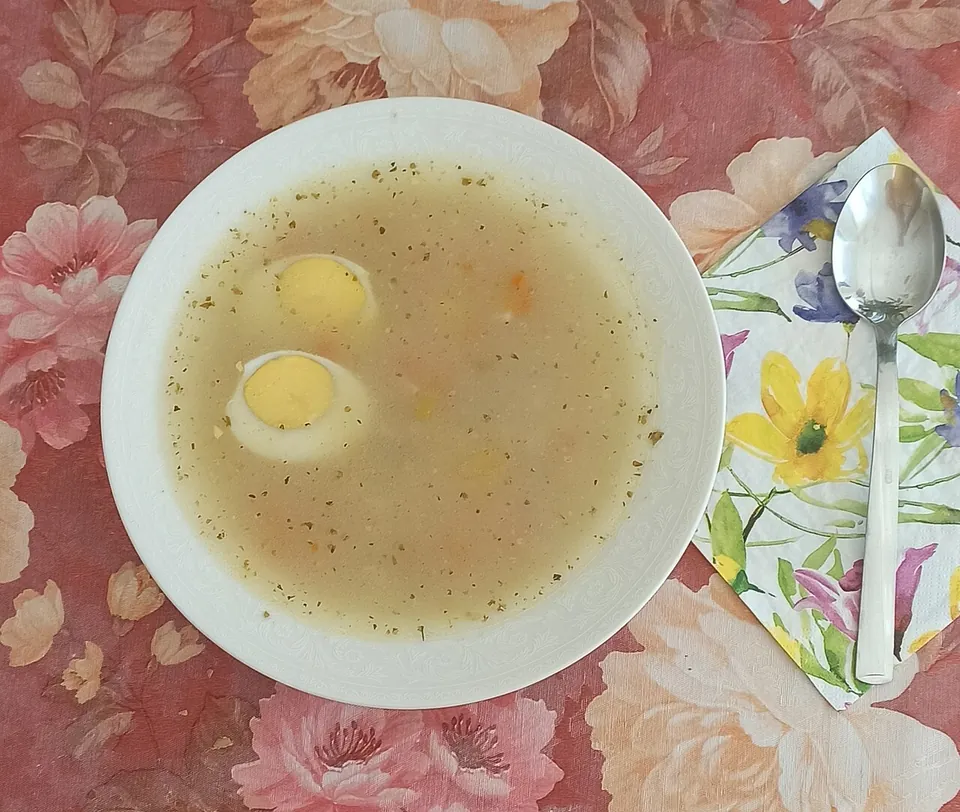
Żurek is a Polish sour soup built on a rye ferment left to turn tart over several days. A cheerful tale credits its birth to a stingy innkeeper's wager, but that is a later invention; its real origin lies in the preserved food of medieval Slavic peasants.
Verification highlight popular claim → verdict → evidence
Popular claim: a Wielkopolska folk legend says a stingy innkeeper invented żurek on a bet with a glutton, using stale sourdough starter and leftover odds and ends, and lost his inn (moving away to Silesia) when he lost the bet. Verdict: refuted as history -- this is a storytelling embellishment unrelated to the dish's real origin as a native Slavic fermented-grain peasant food; the word "żur" traces, per Brückner's etymological dictionary, to medieval Germanic "sür" (sour), spreading across West Slavic languages from the 15th century. Key sources: Brückner, Słownik etymologiczny języka polskiego (1927); Polish Mama Cooks, "Żur (żurek) Sour Rye Soup - its history and legends."
The three gates
- Ingredient-supply gate
- Rye is a native Eastern Slavic grain, always available, so the ingredient itself is not the limiting factor. The dish's backbone is a naturally soured rye starter (zakwas). White sausage, potato, and other garnishes were added later, in the early modern era (potato is a New World crop that arrived in the 18th-19th century, but it is only a garnish, so it does not limit the dish's core formation).
- Cooking-technique gate
- The limiting factor is the fermentation technique: rye flour is left to sour naturally in water for several days to make the starter (zakwas), which is then simmered into a sour soup.
- Venue gate
- an everyday dish of rural farming households. Its place in the religious calendar runs from the meatless Lenten version (żur) to the Easter-morning version with white sausage and boiled egg (żurek wielkanocny / barszcz biały).
Overview
The backbone of żurek is a sour rye starter (zakwas): rye flour stirred into water and left at room temperature for several days until it turns sour. In an age without refrigeration, the peasants of the eastern Slavic lands learned to ferment the rye at hand, both to make the grain keep and to lend a bright acidity to their food. Thinned with water and brought to a boil, this soured liquid is a soup in itself.
The star, rye, was a long-established local grain of the eastern Slavic lands, always within reach of the peasant household. Stirred into water and set in a crock, the liquid begins within a few days to fizz faintly with the work of lactic bacteria and takes on a sharp tartness. It was this cultivated sourness that turned żurek into a soup.
White sausage, boiled egg and potato are later garnishes. The potato reached Poland from the New World and took root there in the eighteenth and nineteenth centuries; the plain sour soup came first, and the trimmings were added over time.
The soup also found a place in the religious calendar. During the meatless fast of Lent it is eaten as a lean fasting soup (żur), and on Easter morning it changes dress into a festive bowl with white sausage and boiled egg (żurek wielkanocny). It began as everyday village fare and in time reached the tables of the court — a soup woven deep into Polish life.
How we know
Żurek has a cheerful local origin story. In a legend from Wielkopolska, a stingy, lazy innkeeper was challenged by a great glutton to make 'the worst soup that won't upset your stomach.' The innkeeper poured broth over the leftover sourdough of a whole-grain loaf and threw in, one after another, old sausage, dried mushrooms, bacon, vegetables and garlic. This, the tale says, was the beginning of żurek. Having lost the wager, the innkeeper is said to have lost his inn and gone off to Silesia.
But the tale has nothing to do with the dish's origin; it is a story fashioned after the fact. Follow the word instead, and żur derives from the Middle High German sür, 'sour.' The Polish etymologist Aleksander Brückner records that the word spread in the fifteenth century into the West Slavic tongues — Polish, Slovak, Czech and Sorbian. And the oldest cookbook written in Polish, the Compendium ferculorum (1682), a book for the court, contains no żur, żurek or barszcz at all — a dish that never reached the courtly page precisely because it was the food of the common people. Long before the innkeeper's anecdote was ever told, the peasants of Eastern Europe were eating sour rye soup every day. The innkeeper's story is best read as a joke stitched onto a dish already long in existence.
The full set of origin theories and the detailed verification log — traceable all the way to their sources — are available on the Japanese edition.
See the full origin theories and verification log (Japanese) →