All dishes / 東欧
Zapiekanka Period BOrigin theory CVerified
Some fields (dish name, region and gates) are shown from the Japanese-edition data.
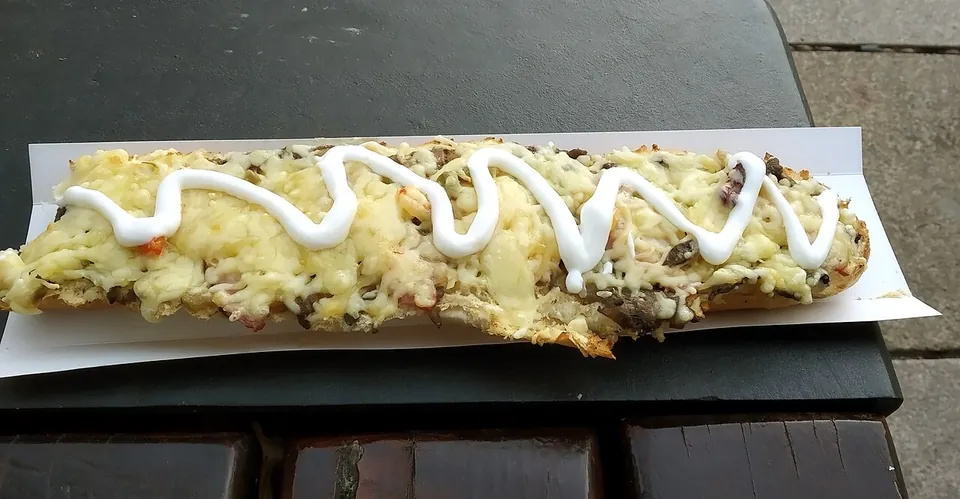
An open-faced street snack from Poland: half a baguette topped with mushrooms and cheese, baked and finished with a stripe of ketchup. It grew out of the food stalls of the lean socialist years and became a dish that stands for that era.
Verification highlight popular claim → verdict → evidence
Myth: zapiekanka is said to have begun when First Secretary Edward Gierek, who spent his youth in France and Belgium, bought a French baguette-manufacturing licence in the 1970s and so put baguettes on Polish counters. Verdict: rejected — no contract, archive record or contemporary report of such a deal, or of Gierek's personal involvement, has yet surfaced, and Polish food-history writers who went looking (Przeszłość od kuchni) found nothing to cite. A Warsaw bar, Murzynek, is also said to have served mushroom-topped sandwiches on hot-dog buns in the 1960s, before baguettes spread; that account rests on a single food-history blog, but if it holds it sits badly with any single-cause origin. What is solid: the half-baguette open sandwich appeared on the streets of the People's Republic in the 1970s, sold by the small private food stalls (mała gastronomia) the state tolerated amid shortages, and multiplied after the 1988 Wilczek Act; the word 'zapiekanka' itself is older, a general term for oven-baked dishes. Key sources: Culture.pl; Słownik języka polskiego PWN (Doroszewski).
The three gates
- Ingredient-supply gate
- Wheat, mushrooms and cheese are native/long-available; the tomato used for the ketchup topping is a New World crop but was already widespread by this period.
- Cooking-technique gate
- Oven-baking, gratin-style.
- Venue gate
- Street food of Poland's People's Republic (PRL) era -- sold from small private stalls and milk bars.
Overview
From the socialist-era street
The zapiekanka is a baguette split lengthwise, topped with mushrooms and cheese, baked, and served with ketchup. Wheat, mushrooms, and cheese had long been on Polish tables, and by the time the snack appeared the tomato ketchup on top was widely available too. Baking toppings together in an oven was a familiar home technique.
The snack reached the street in the 1970s, during the years of the Polish People's Republic. Supplies were often short in this period, and the state permitted small private catering ventures—the mała gastronomia, or small gastronomy. Sold from stalls, food trucks, and milk bars, the zapiekanka spread as a cheap snack you could eat on the spot.
When the 1988 Wilczek Act liberalized private enterprise, these small ventures multiplied, and the zapiekanka became an even more common sight on street corners. Cherished as an affordable dish of a lean time, it came to call to mind socialist-era Poland itself.
How we know
Untangling two backstories
Two separate tales cling to the zapiekanka: one is a misreading of its name, the other a legend about the baguette.
Take the name first. That the dish—the half-baguette snack—dates from the 1970s is one thing; that the word zapiekanka is equally young is another. The Polish word comes from the verb zapiekać, to bake ingredients together until a browned crust forms, and it is an ordinary noun: baked potato and macaroni dishes had long carried the same name. The large PWN Polish dictionary (Doroszewski), compiled from 1958, records both senses side by side—the older, broad one for baked dishes in general, and the newer, narrow one for the street snack on a split baguette. The snack borrowed the name of an existing family of baked dishes; the word was not coined along with it.
The second tale concerns the baguette underneath. Edward Gierek, First Secretary in the 1970s, had spent his youth in France and Belgium. The story goes that Gierek bought a baguette-making licence from France, and that this touched off the spread of the baguette across the country. It circulates widely, repeated almost verbatim from the state cultural institution Culture.pl into English- and Polish-language outlets.
Yet no contemporary record supports this "the licence set it off" account. No contract, no archive, no reporting of the day has been produced—not even by Polish food-history researchers such as those behind Przeszłość od kuchni. That Gierek spent time in France, and that baguettes appeared in 1970s Poland, are each plausible enough on their own. But the causal link between them remains an anecdote no one can trace to a source.
What is firm is the other line: that the zapiekanka appeared and spread on the street in the 1970s People's Republic, as a private small-gastronomy venture allowed amid the shortages. Gierek's baguette legend is best placed as a still-untraceable aside appended to that firmer account.
The full set of origin theories and the detailed verification log — traceable all the way to their sources — are available on the Japanese edition.
See the full origin theories and verification log (Japanese) →