All dishes / 東欧
Holubtsi Period BOrigin theory CVerified
Some fields (dish name, region and gates) are shown from the Japanese-edition data.
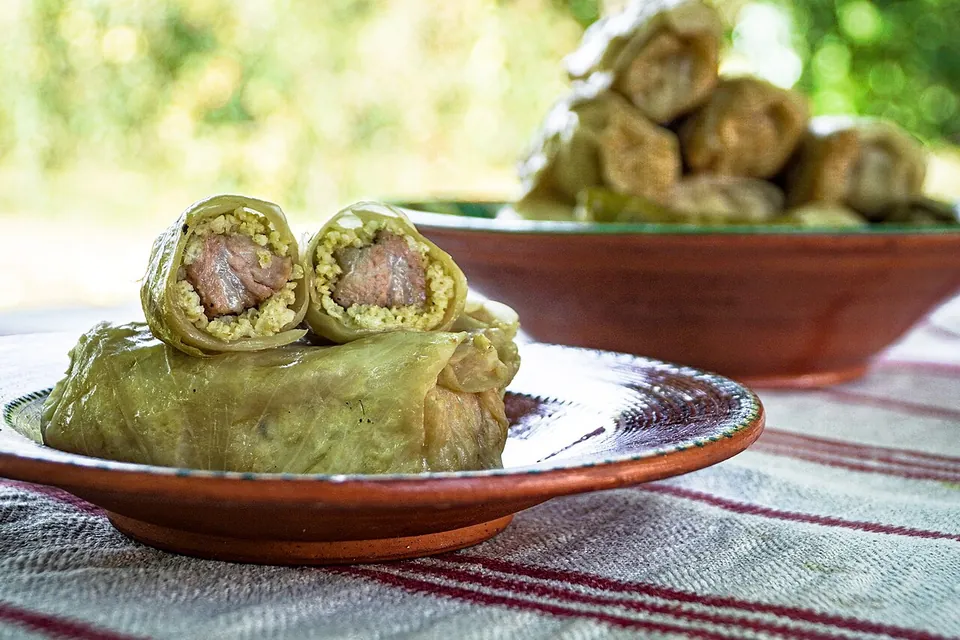
Holubtsi are Ukrainian cabbage rolls: cabbage leaves wrapped around minced meat and rice, then simmered. In Ukrainian the word is голубці, and it means "little doves." Yet why doves, and where the dish was born, still resist a single answer.
Verification highlight popular claim → verdict → evidence
Popular claim: a folk-etymology origin story holds that holubtsi is a purely Ukrainian invention, named for its resemblance to a dove (holub). Verdict: refuted -- stuffed-leaf dishes are a pan-regional phenomenon with a common ancestor in Ottoman dolma/sarma, and no independent source supports a standalone Ukrainian invention; the "dove" etymology is a folk explanation for the name rather than evidence of origin, and doesn't square with the separate leaf-wrapping (dolma) ancestry. National-dish status (UNESCO intangible-heritage listing, 2023) reflects popularization, not origin. Key sources: "Cabbage roll" - Wikipedia; "Dolma" - Wikipedia (13th-century Kitab al-Wuslah).
The three gates
- Ingredient-supply gate
- Cabbage is a native ingredient; the tomato-sauce version postdates the arrival of tomatoes (17th century onward).
- Cooking-technique gate
- Wrapping filling in leaves and simmering.
- Venue gate
- A home dish from village to city, and a festival food.
Overview
The lead player in holubtsi is cabbage, the vegetable kept through the long winter. In the hard cold of Central and Eastern Europe, cabbage could be harvested in autumn and stored, a dependable stand-by. Its leaves were softened in boiling water, filled with minced meat and rice, rolled, and simmered slowly. Wrapping a filling in a leaf and cooking it through called for no special tools and no scarce ingredients; it was work a peasant kitchen could manage with ease.
The familiar version stewed in tomato sauce is a comparatively recent dress. Tomatoes reached Ukraine only from the mid-nineteenth century, and the tomato-stewed version spread through households around the turn of the twentieth, taking the place of the fermented kvas that had until then supplied the sour note. Long before rice and tomato joined it, the plate of cabbage rolled and simmered was already on the table.
The spelling of the name wobbles from place to place. The Ukrainian голубці is romanized as both holubtsi and golubtsi. The waver of the leading consonant between h and g is a trace of the sound shift by which g became h across the East Slavic languages, the same current that leaves the related Polish dish named gołąbki next door.
Holubtsi is at once everyday village fare and a dish for the festive board. Each household has its own proportion of filling and its own broth, and in Ukraine the dish had put down roots as a regional specialty by the eighteenth century.
How we know
The history of holubtsi does not fit into a single story.
One of the more charming accounts is the origin tale that the dish, resembling a holub (dove) in shape, must be a native Ukrainian invention. The link of name and form is appealing, but as proof of origin it is thin. The name "little doves" carries more than the plain reading that the round shape recalls a dove: linguists have argued that a word for "cabbage" in Persian or Armenian (kalam, kalamb) drifted, through a chance resemblance of sound, into the name of the bird, which points rather toward an eastern arrival. Some have even pointed to the influence of a nineteenth-century French court dish of wrapped pigeon. Either way, the explanation "because it looks like a dove" reads a bird into the name after the fact, on the strength of the shape alone, and no independent source singles out Ukraine alone as the place of origin. What a word looks like it comes from is not where the dish comes from.
Wrapped dishes are no Ukrainian monopoly. Ottoman cooking had developed sarma and dolma, fillings wrapped in vine or cabbage leaves. The oldest surviving text for a wrapped-cabbage dish is a sixteenth-century Persian work, Maddet ol-Hayat, cited by the food historian Charles Perry, which records that "cabbage dolma is common in Rum (Turkey) but unknown in Iran." On this reading, what was wrapped in vine leaves around the Mediterranean was replaced with cabbage leaves in Eastern Europe. Polish golabki, Czech and Slovak holubky, South Slavic sarma — dishes of a filling wrapped in a leaf and simmered spread widely from Eastern into Southern Europe, and holubtsi takes its place within that large family as a sister that branched off in Ukraine.
On the other side, the view that it arose as a local dish of the cold country runs deep as well. Cabbage was widely grown as a keeping vegetable across Central and Eastern Europe, and the plain idea of wrapping a filling in a leaf and simmering it might well have occurred separately to poor farmers in many places. The English Wikipedia entry, too, calls the origin "unclear," noting that several groups may have invented it independently around the same time. Several anecdotes that once tied the two lines together have lately been weighed again. The tale that Sweden's cabbage dolma (kaldolmar) was "brought back by Charles XII on his return from Ottoman territory in 1715" is widely known, yet no contemporary record supports it, and the first appearance in print is Cajsa Warg's cookbook of 1765. A Hungarian record of rolled cabbage printed in 1695 has been taken as proof of independent origin, but that very text frames the technique as one "brought in by the Turks as sarma in the sixteenth and seventeenth centuries," and so sits, if anything, in keeping with Ottoman transmission.
In 2023 holubtsi was inscribed on Ukraine's intangible cultural heritage. What that marks is how deeply the dish has taken root in Ukrainian life — a value in its own right, distinct from the tale of origin. Where a technique came from and whose table a dish became are matters one may tell apart. Local emergence in the cold country, and transmission from the Ottoman world: the evidence to settle the matter one way or the other has not yet come together. Holubtsi stands quietly where the two histories cross.
The full set of origin theories and the detailed verification log — traceable all the way to their sources — are available on the Japanese edition.
See the full origin theories and verification log (Japanese) →
Related dishes
Cross-links Sister dishes & same-name dishes (separate lineage)
- Sister dish (shared ancestor)SarmaBalkans (Ottoman sphere)C
- Sister dish (shared ancestor)KåldolmarSwedenC
- Sister dish (shared ancestor)Gołąbki (Polish cabbage rolls)PolandC