All dishes / 東アジア
Peking duck Period BOrigin theory CVerified
Some fields (dish name, region and gates) are shown from the Japanese-edition data.
Peking duck goes back to the Northern and Southern Dynasties, fifteen hundred years ago, so runs a claim that circulates widely in Chinese food writing. But open the old cookbook cited as proof, and the one word that matters is nowhere to be found.
Verification highlight popular claim → verdict → evidence
Popular story: Peking duck goes back some 1,500 years to the Southern and Northern Dynasties, citing a 'roast duck' entry supposedly in the Shizhen Lu. Verdict: refuted -- a direct check of the surviving text of the Shizhen Lu shows no such entry; the earliest confirmed ancestor of the dish is a 'roast duck' recipe in the Yuan-dynasty Yinshan Zhengyao (1330), and the roasting technique that defines today's dish is traceable no earlier than Bianyifang's 1416 founding. Key sources: 飲膳正要 / Yinshan Zhengyao (1330); analysis of the Shizhen Lu text.
The three gates
- Ingredient-supply gate
- Both duck and the wheat wrapper (for the pancakes) were already native to East Asia; no New World ingredient sets a constraint.
- Cooking-technique gate
- The rate-limiter is the technique of separating skin from meat, air-drying, glazing, and high-heat roasting. Two techniques are documented: men lu (closed oven, Bianyifang 1416) and gua lu (open/hanging oven, from the Qing court to Quanjude 1864); both are separately registered as intangible cultural heritage in China.
- Venue gate
- imperial court to specialty restaurants / court and the wealthy to urban citizens / high-end dining / Beijing's Han urban culture
Overview
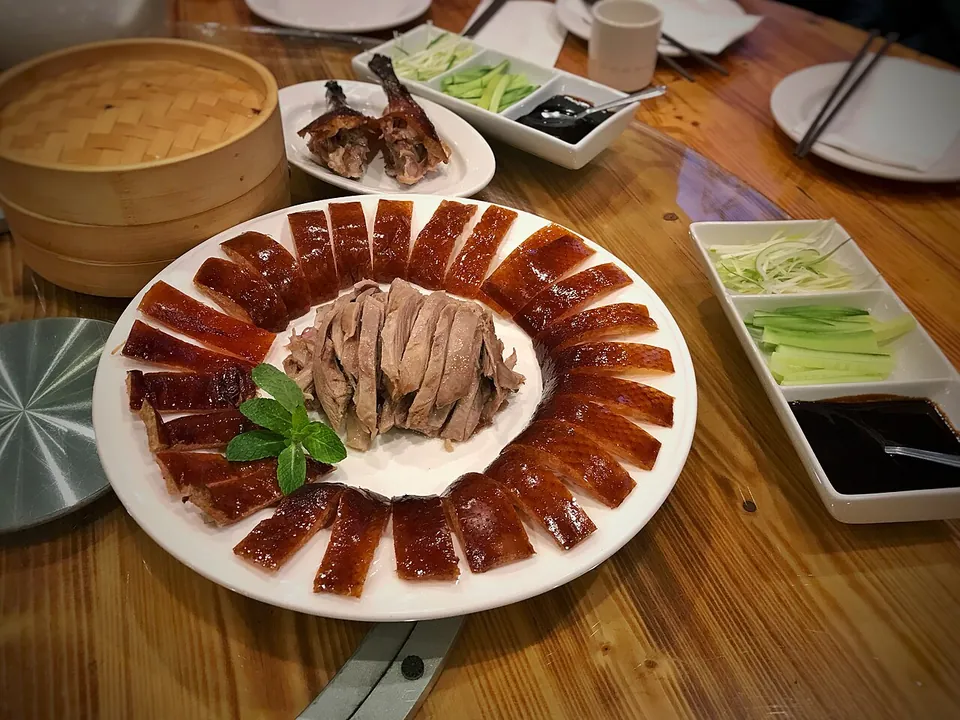
Peking duck (Beijing kaoya) is a whole roasted duck: air is worked in between skin and flesh to shape it, the surface is dried, coated with a sugar glaze, and roasted at high heat in a special oven all at once. It is served with thin wheat pancakes (chunbing) to wrap it in and a side of sweet bean sauce (tianmianjiang). Duck, the wheat pancakes, and the sweet bean sauce are all ingredients long established in East Asia, on the tables of this land from early on.
What gave the dish its final form was the roasting technique. To draw the skin taut, glaze the surface to a sheen with sugar, and drive strong, even heat through the bird, you need a purpose-built oven. That technique grew along two lines. One is the menlu, the closed oven; the oldest bearer traceable in the record is Bianyifang, founded in 1416 in the Yongle era of the Ming. The other is the gualu, the open oven for hanging and roasting, developed in the imperial kitchens of the Qing court; Quanjude, opened in 1864 by Yang Quanren, who invited cooks from the palace, took it up and spread it widely. China's intangible cultural heritage registers the menlu technique and the gualu technique separately. Today's Peking duck combines these two streams.
The beginning is placed in Nanjing (Jinling), early in the Ming. The main account holds that a whole roasted duck born there as "nanluya" (shaoya) was carried, technique and all, to Beijing by court cooks at the time of the Yongle Emperor's move of the capital to Beijing in 1420, and took root there. That the old Beijing house Bianyifang once displayed the words "Jinling kaoya" on its signboard hints at that Nanjing origin.
Where it was eaten also shaped the character of the dish. It began as a dish of the Ming and Qing courts, a plate for the court and the wealthy; by the end of the Qing it opened out, through Beijing's specialist restaurants, into fine dining for the city's people. It is a dish that came down from the court into the streets within the urban culture of Beijing's Han Chinese.
How we know
Peking duck comes with a legend of antiquity that is told again and again. Its beginning, the story goes, reaches back to the Northern and Southern Dynasties, some fifteen hundred years ago, and the cookbook Shizhenlu, written by Yu Cong of the Southern Qi, already carries an entry for "zhiya" (roasted duck). It is a suitably grand pedigree, one that food articles and encyclopedia sites are fond of displaying.
Yet open the surviving Shizhenlu and the two characters for "zhiya" appear nowhere. The text that comes down to us, some two hundred-odd characters gathered into the Ming anthology Shuofu and the Siku Quanshu, lists deer tail, crab roe, and grilled shrimp, but no roasted duck. What is more, foods of the Tang, the Five Dynasties, and the Northern Song are mixed into the surviving text, so it can hardly be called a pure work of the Southern dynasties. The pedigree that runs "there is roasted duck in the Shizhenlu, therefore the dish originated fifteen hundred years ago" is not borne out by the sources.
So how far back can the roasted duck as a dish be traced? The oldest datable written witness appears in the Yinshan Zhengyao, the court dietary manual written by Hu Sihui in 1330, in the entry for "shaoyazi" (roasted duckling). Roasted duck was already sold in the streets of Southern Song Hangzhou, it is said. In other words, the genre of roasted duck is genuinely old. But that antiquity does not push back the beginning of the Peking duck we know today. The "shaoyazi" of 1330 is the oldest record of the genre, and it is a different story from the dish as it now stands, born in early-Ming Nanjing, moved to Beijing with the capital, and branching into the two lines of the menlu and the gualu.
Reading those old records has another catch, and it lies in the name. Under the Qing, "shaoya" (roasted duck) meant, first of all, this Beijing dish. The Qingbai Leichao, compiled in the early years of the Republic, writes in the "foods of the capital" entry of its volume 105 that tianya, the method of fattening ducks by force-feeding, was not passed on in the south, and that among the ways of cooking such a bird "shaoya is the finest of all"; it goes on to record even the carving, the skin cut with a sharp blade into pieces the size of a coin, with no flesh left clinging to them. That is Peking duck to the letter. No shop, however, is named in that entry.
The names of the shops come in a separate entry of the same volume. Setting down the dishes that pleased officials at banquets in the capital in the years 1889 and 1890, it lists the red-braised fish head of Zhimeizhai, the shaoya of Bianyifang, and the mutton of a certain Muslim restaurant as all being good to the taste. By the close of the Qing, then, the dish was spoken of together with the house that roasted it, a famous plate of the city's restaurants. Bianyifang did not stand above the rest for its duck, though. The same book turns to that house's tongzi ji, the barrel chicken sold in Jinling and in Beijing's Mishi Hutong, and remarks that while the name is spoken in one breath with shaoya, its duck falls short of the other houses and only its chicken excels. Several establishments in Beijing were roasting ducks, and their work was being weighed against one another.
Guangdong, though, has a shaoya of its own: a whole duck hung and roasted over charcoal in the siu laap roast-meat shops, its skin glazed amber with a maltose wash, and it belongs to a line of its own, apart from the force-fed duck of Beijing. The two share a family of techniques, hanging the bird and drawing the skin taut, yet no source showing either as an offshoot of the other has come to light. Because the same two characters named two dishes, a "shaoya" in a Ming or Qing text is not necessarily a record of the Cantonese roast.
Who roasted the first bird, in the end, no one knows. The view that it was carried from Nanjing and the view that the two schools of the menlu and the gualu grew up side by side stand together, neither one discarded. The history of Peking duck can at last be drawn in firm lines only once the legend of fifteen hundred years has been set aside.
The full set of origin theories and the detailed verification log — traceable all the way to their sources — are available on the Japanese edition.
See the full origin theories and verification log (Japanese) →