All dishes / ラテンアメリカ
Chimichurri Period BOrigin theory CVerified
Some fields (dish name, region and gates) are shown from the Japanese-edition data.
An Irish immigrant named Jimmy McCurry supposedly left his name on it: the English-flavored tales of how chimichurri got its name are many, and all of them are later inventions with no contemporary record behind them. The green sauce itself grew up in the charcoal-grill culture of 19th-century Argentina.
Verification highlight popular claim → verdict → evidence
Folk etymologies tracing the name to English (an Irish immigrant named Jimmy McCurry, or 'gimme curry') are refuted as fabricated, with no contemporary documentation. The most linguistically credible theory derives the name from Basque, though the Real Academia Espanola still lists the origin as uncertain. Key sources: Wiktionary, the RAE dictionary, and 19th/early 20th-century Argentine dictionaries that lack any chimichurri entry.
The three gates
- Ingredient-supply gate
- Parsley, oregano, garlic, and vinegar were all locally available; chili, though a New World crop, was already local to its region of origin. The real constraint on the dish's emergence was the spread of asado (charcoal-grilled beef) culture.
- Cooking-technique gate
- An uncooked sauce made by mixing chopped fresh herbs with oil and vinegar.
- Venue gate
- Took hold alongside gaucho and asado culture on the pampas.
Overview
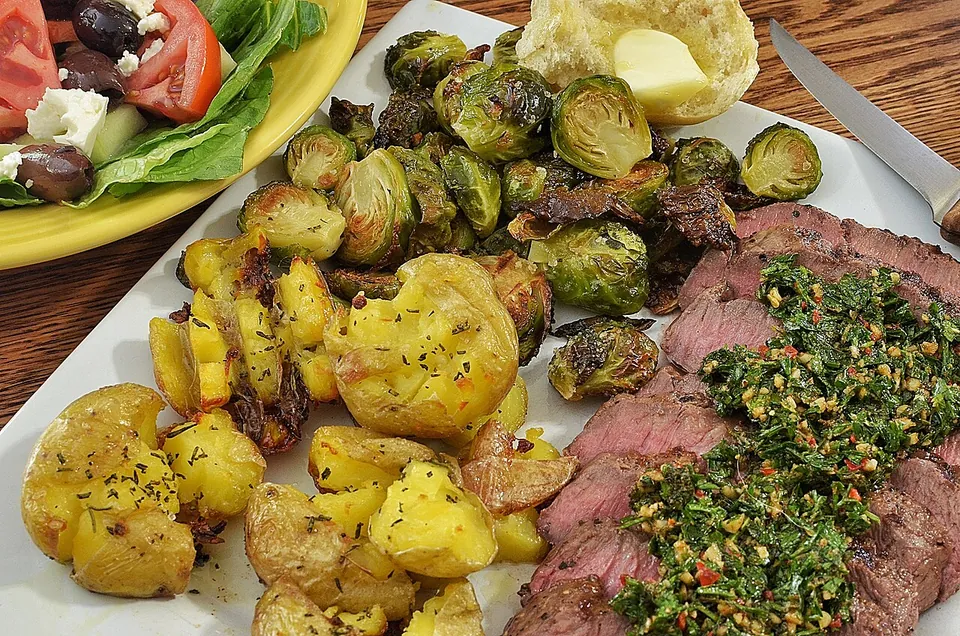
Chimichurri is an uncooked green sauce built on chopped parsley, mixed with oregano, garlic, red wine vinegar, oil, and chili flakes. In the Río de la Plata region of Argentina it is inseparable from the asado, the meal of beef grilled over charcoal.
Its ingredients were all long-established local staples. Parsley, oregano, garlic, and vinegar were on the everyday tables of 19th-century Argentina. Chili, though a New World crop, was native to the Americas and equally close at hand here. Chopping fresh herbs and dressing them with oil and vinegar calls for no special equipment and no heat.
The sauce took root alongside the spread of the asado, the ritual of putting beef to the coals. Over the 19th century, as the gauchos of the cattle-raising Pampas made charcoal-grilled beef a way of life, chimichurri settled in as the relish set beside the grilled meat. It is a comparatively recent sauce that moved in step with the growth of modern Argentine ranching and its culture of beef.
How we know
When it comes to the name, chimichurri comes wrapped in several amusing tales with an English accent. An Irish immigrant, Jimmy McCurry, is said to have devised it in the late 19th century, his name slurred into chimichurri. Or it came from 'Jimmy's curry.' Or from 'give me curry,' the phrase British prisoners supposedly used to beg for a curry. Each is a story that sticks in the ear.
Yet no contemporary document supports any of these tales. The names and the phrases alike are folk etymologies pinned on afterward. The 'give me curry' version invokes the British invasions of the Río de la Plata in 1806-07, which fall before the sauce appears in the record, so the dates do not line up either.
The reading favored on linguistic grounds looks to Basque. One account derives the word directly from the Basque tximitxurri, a name for a similar sauce of chopped garlic and parsley (roughly 'a jumble'); another routes it through the Basque zurrumurru ('murmur, commotion') by way of the Spanish chirriburri ('disorder, uproar'). Both fit the history of heavy Basque immigration to Argentina and Uruguay in the 19th century. The dictionary of the Royal Spanish Academy (RAE) records the origin as 'uncertain' while naming a Basque source as the most likely. Entertaining as the naming tales are, the green sauce itself is best watched apart from them.
The full set of origin theories and the detailed verification log — traceable all the way to their sources — are available on the Japanese edition.
See the full origin theories and verification log (Japanese) →
Related dishes
Shares the key ingredient
- TabboulehLevant (Syria / Lebanon)C
- Herb-and-bulgur layer (pre-tomato tabbouleh)Levant (Syria/Lebanon highlands; Bekaa Valley)C