All dishes / ラテンアメリカ
Dulce de leche Period COrigin theory CVerified
Some fields (dish name, region and gates) are shown from the Japanese-edition data.
Dulce de leche carries a sweet legend that a maid made it by accident during an 1829 peace parley, but it was in fact a milk sweet that spread across Latin America in the Spanish colonial era and grew up in many places, with no single birthplace to be found.
Verification highlight popular claim → verdict → evidence
The popular tale of a maid accidentally leaving milk and sugar on the fire during an 1829 truce meeting is a legend without historical support: independent documents from 1814-1817 and even earlier Chilean manjar trade records predate it, and constant stirring is required to avoid burning, so 'created by neglect' is not plausible. The true origin remains an unresolved regional dispute among Argentina, Uruguay, and Chile, most likely tracing back to Spanish colonial confiture de lait.
The three gates
- Ingredient-supply gate
- Both milk and sugar are Old World foods; in Latin America they became available only after cattle and sugarcane arrived with colonization. The bottleneck is a stable milk supply.
- Cooking-technique gate
- Simmering sugared milk for a long time until it caramelizes (Maillard/caramelization).
- Venue gate
- A preserve made by ranching households in the Río de la Plata region, later a staple spread across the whole area.
Overview
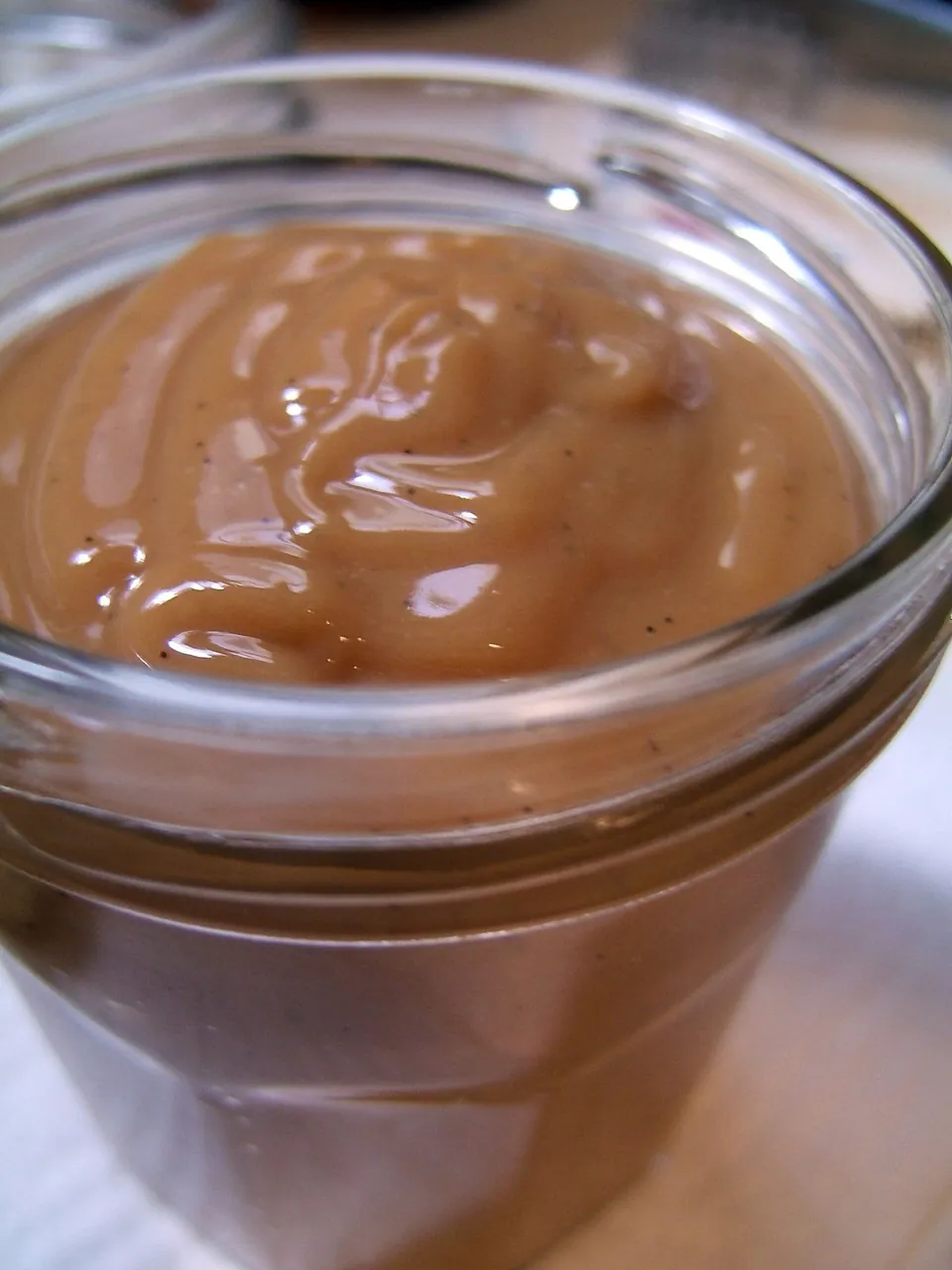
Dulce de leche is a milk sweet made by simmering sweetened milk over low heat for a long time, reducing it until it turns caramel-colored. The ingredients are only milk and sugar. Both came from the Old World, and in Latin America they became available only after cattle and sugarcane were introduced in the colonial period. It was only once a settled herding life supplied milk steadily that this could become an everyday preserve made at home.
The setting is the herding farms and homes of the Río de la Plata region, the area centered on present-day Argentina. Sweetened milk, stirred constantly and reduced patiently, reacts as its sugar and milk proteins combine into a brown, sweet paste. The thick spread that results keeps well, and in time it became an indispensable staple across the region, spread on bread and worked into sweets. Within the herding culture of the 19th century, this sweet spread outward from the home kitchen.
How we know
There is a birth story often told in Argentina. In 1829, during a peace parley between the generals Rosas and Lavalle at Cañuelas near Buenos Aires, a maid supposedly left milk and sugar on the fire and by accident produced this caramel. But no contemporary record supports the anecdote as fact. The Argentine historian Daniel Balmaceda, in "La comida en la historia argentina" (2016), sets out documents that predate 1829. In 1814 there was a letter requesting that dulce de leche be sent from Buenos Aires to Córdoba, and a record survives of it being served to Lavalle's troops at a banquet in 1817. More than a decade before the parley, this sweet was already in people's hands. Records of similar milk sweets reach back further still in various places: doce de leite in Minas Gerais, Brazil, in 1773, and records of manjar imported from Chile to Mendoza in 1693 and 1712. On top of this, dulce de leche must be stirred constantly to keep it from scorching, so the storyline of a sweet made by "leaving it alone" does not fit the reality of the kitchen. The story of 1829 was an ornament added afterward to a sweet already made.
Set the anecdote aside and look at the reality, and what remains is a dispute over ownership. Argentina, Uruguay, and Chile have each claimed the origin. When Argentina tried in 2003 to have it designated as cultural heritage, neighboring countries objected at once. So where is the true source? From here on, the question remains unresolved. One view holds that Spain's confiture de lait, a sweet of reduced milk and sugar, spread across Latin America in the colonial period and took root in many places; Normandy and Savoy in France have sweets of the same type, and one can see a path by which Europe's reduced-milk sweets crossed the Atlantic. Balmaceda draws an entirely different route: a sweet born in Southeast Asia (Indonesia) passed through Spanish Manila and was carried by galleon crews to Acapulco in Mexico, and from there across the continent. On the Chilean side there is a further claim that manjar, recorded from the colonial period, reached the Río de la Plata by way of San Martín's Andean army in 1817. Every one of these routes agrees in rejecting the 1829 tale, but a single birthplace and year of origin remain undetermined to this day.
The full set of origin theories and the detailed verification log — traceable all the way to their sources — are available on the Japanese edition.
See the full origin theories and verification log (Japanese) →