All dishes / 中東・北アフリカ
Tabbouleh Period COrigin theory CVerified
Some fields (dish name, region and gates) are shown from the Japanese-edition data.
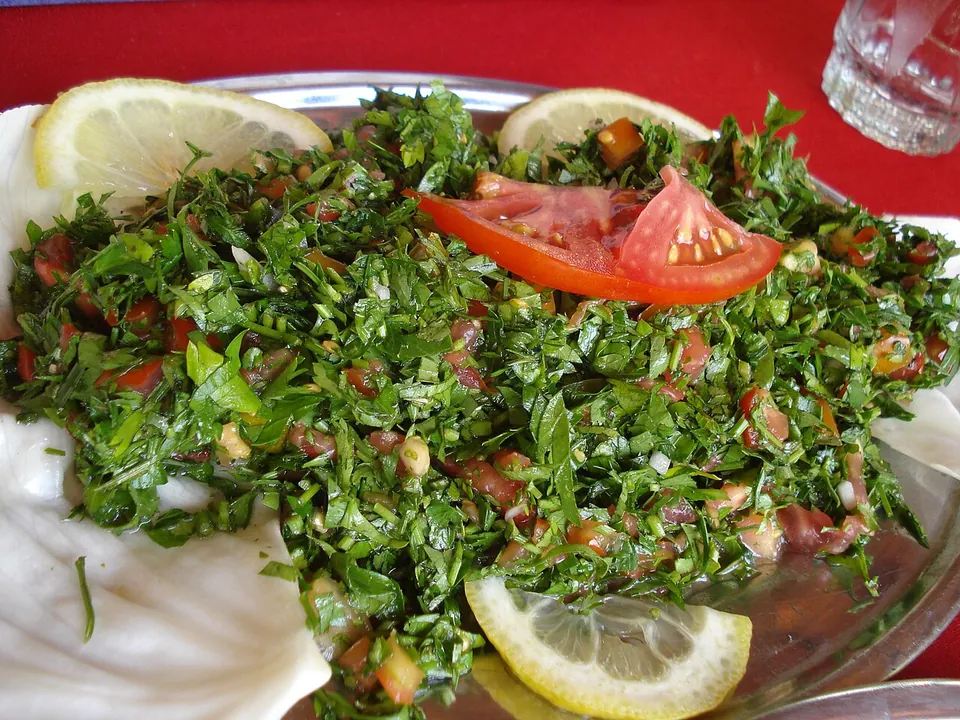
A Levantine salad of parsley and bulgur, dressed with lemon and olive oil. It is sometimes called "an ancient dish eaten for thousands of years," but today's version, with tomato in it, is a more recent, modern standard.
Verification highlight popular claim → verdict → evidence
Popular articles like to say that the people of the ancient Levant ate this salad three to five thousand years ago. The kind of dish is indeed old: villagers in the Lebanese and Syrian mountains tossed edible herbs, qadb, with bulgur in the Middle Ages, and the parsley salad of today grew out of that. The bowl we picture, flecked with red, is another matter. Tomato is a New World crop, and the earliest record of it in the Levant is 1756, when Alexander Russell, physician to the English factory at Aleppo, listed love apples among the plants of the town's little gardens and added that few local people, apart from the Jews, ate them; the revised edition of 1794 has them grown in the fields and carried to the bazaars under the name Frank badinjan, the foreigners' eggplant. Three thousand years ago there was no such fruit in a Levantine garden to chop into the bowl. The fruit became an everyday vegetable in local kitchens only in the nineteenth century, a century after it first reached the region.
The three gates
- Ingredient-supply gate
- Parsley, mint and bulgur wheat have long been at home in the Levant. The one ingredient that came from elsewhere is the tomato, a New World crop first recorded in the Levant in 1756, when an English physician at Aleppo listed it among the plants of the town's little gardens and noted that few local people, apart from the Jews, ate it. In the revised edition of 1794 the same book has tomatoes grown in the fields and carried to the bazaars. Being present in the country and being eaten every day were two different things, the second arriving only in the nineteenth century. The tomato-flecked tabbouleh of today can be no older than the fruit itself, whose arrival on the earliest reckoning reaches back to 1694.
- Cooking-technique gate
- Preparing bulgur (wheat parboiled and cracked) and chopping raw herbs and vegetables to toss together.
- Venue gate
- A home dish served as mezze, everyday food in ordinary Levantine households.
Overview
From a mountain herb dish to a table starter
Tabbouleh is a salad from the Levant—Lebanon and Syria—built mainly on finely chopped parsley, tossed with bulgur (cracked wheat), mint, and tomato, and dressed with lemon and olive oil. It comes to the table as a starter (mezze) and is cherished in Lebanon as a national dish.
Its older layer reaches back to the mountains of Lebanon and Syria, and to the Bekaa highlands in particular. In the Middle Ages, Arab villagers ate an edible herb called qaḍb tossed with bulgur. From that plain rural herb dish, over the centuries, grew the parsley-forward salad of today. The name tabbouleh is thought to derive from a root meaning "to season" or "to steep," traceable back to Aramaic.
Parsley and bulgur, the mainstays, are long-established Levantine ingredients that were on everyday tables from early on. Tomato came from the New World. In Aleppo of the mid-eighteenth century it was already recorded growing in the little gardens of the town, though few local people ate it at the time; by the end of that century it was being grown in the fields and carried to the bazaars, and it became an everyday vegetable in home kitchens in the nineteenth. The tabbouleh we know, flecked with red, seems to have spread only once that red fruit had become a standing item in the mountain kitchens.
How we know
Tabbouleh attracts a claim, seen in popular articles, that "the people of the ancient Levant ate this salad three or five thousand years ago." It is a tempting story, the kind that reaches for authority in age.
But it turns on a mix-up of two different kinds of antiquity. The food category itself—herbs tossed with bulgur—can indeed be traced to the Middle Ages, and perhaps earlier; that antiquity stands. The tomato-laced tabbouleh we picture today is another matter. Tomato is a New World crop, and on the earliest reckoning it reached the Levant only at the close of the seventeenth century. Three thousand years ago there was no such fruit in a Levantine field or market to chop into the bowl. Reading "the age of the category" as "the age of the present dish" is where the ancient-origin claim frays.
The gap between when the red fruit appeared in this land and when the people here began to eat it complicates the story further. The natural history written by an English physician stationed at Aleppo notes, already in its first edition of 1756, that tomatoes grew in the little gardens of the town—while adding that the natives, apart from the Jews, hardly ate them. In the second edition of 1794 that entry is revised: tomatoes, once raised in pots like any other flower, were lately grown in the fields and brought to the bazaars, and the local name for them was Frank badinjan, the Franks' eggplant, the eggplant of the foreigners. Being present as an ingredient and settling into daily meals were two different events.
The path we can trace runs like this. The medieval herb dish of the Bekaa highlands was carried down in an unbroken line, and once tomato had taken root as a vegetable of the land, the parsley-forward, tomato-added form appears to have spread in the nineteenth century. By the early twentieth, roadside cafés in the Bekaa valley were serving it as a mezze, and it settled in as a dish Lebanon claims as its own. The older layer reaches to the Middle Ages while the present form settles in the modern era—tabbouleh's history cannot be told without this difference of stage.
Which proportions count as "original" also varies by region. Traditional Levantine versions lean heavily on parsley and other herbs, while the version carried by Syrian communities uses more bulgur. The latter traveled to the West in the later twentieth century, and the bulgur-heavy form is the one that spread there.
The argument over what counts as "original" is not confined to proportions. Since 2001 Lebanon has kept the first Saturday of July as a national tabbouleh day, holding the dish up as a face of the country. The same pairing of herbs and bulgur has long been eaten in the villages of Syria across the mountains, and Jordan and its neighbours name it among their own dishes too. On one view it is a shared inheritance of the whole Levant, with no one country's sole origin provable from the sources; whose dish it is and where the dish took shape are two different questions.
The full set of origin theories and the detailed verification log — traceable all the way to their sources — are available on the Japanese edition.
See the full origin theories and verification log (Japanese) →