All dishes / 東欧
Halászlé Period BOrigin theory AVerified
Some fields (dish name, region and gates) are shown from the Japanese-edition data.
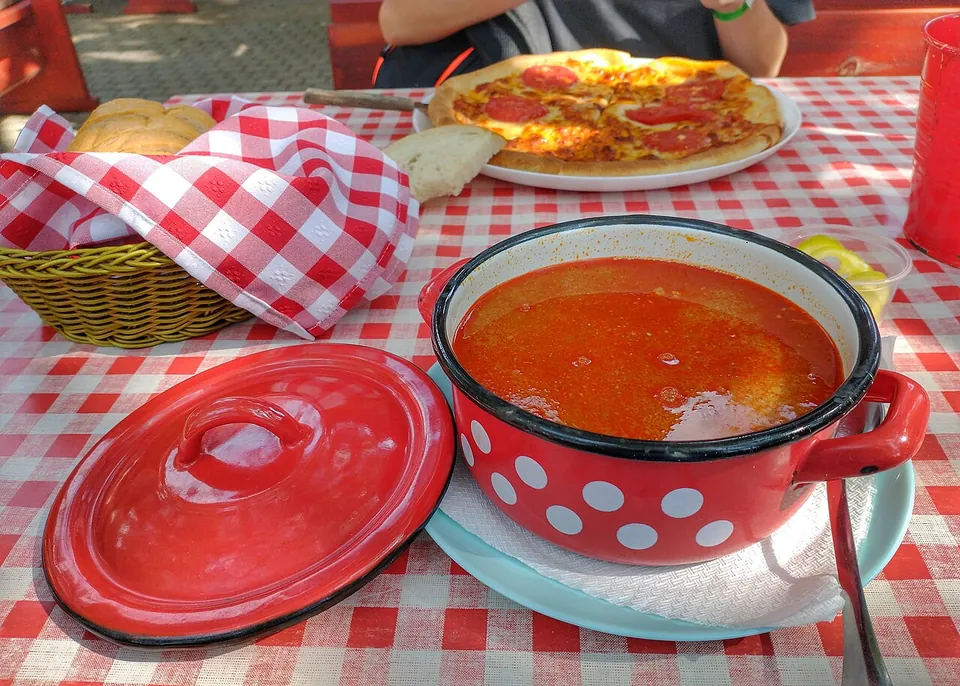
Halászlé, the deep-red river-fish soup of Hungary. Its red comes from paprika, a spice out of the New World, and the recipe for the red bowl reached print in 1864, in a household manual published in Pest.
Verification highlight popular claim → verdict → evidence
The dish's current red, paprika-seasoned form could not have formed until paprika, a New World crop, became a common ingredient in Hungary in the 18th-19th century. The earliest printed record of the paprika version is a recipe titled 'Bográcsos hal, halászosan' in Medve Imre's 1864 cookbook; an 1887 ethnographic account by Herman Ottó describes fishermen along the Danube and Tisza cooking it in a kettle over open fire as everyday practice. An earlier 17th-century fish-soup tradition made without paprika is a distinct ancestral stage, not the same dish.
The three gates
- Ingredient-supply gate
- Freshwater fish were native to the Danube-Tisza basin; paprika, a New World crop, reached Hungary via the Ottomans in the 16th century and only became a common food ingredient in the 18th-19th century, which is what limits when the current red version could form.
- Cooking-technique gate
- Cooking the mixed river fish in a large kettle (bogrács) over an open fire.
- Venue gate
- Riverside cooking by fishermen, later adopted as urban fare.
Overview
Halászlé is a river-fish stew born along the Danube and the Tisza in Hungary. Freshwater fish such as carp are cooked in a bogrács, a cauldron set over an open fire. It began as a working dish of fishermen who, with no kitchen equipment on the riverbank, cooked the day's catch on the spot with nothing but a cauldron and a fire, and later spread to the tables of townspeople. No single cook devised it; it rose in the same way at many points along the rivers, out of a life lived beside the water.
The freshwater fish at its center were native to these river courses from the start. A plain soup of carp and other river fish simmered in a cauldron over a fire belonged to riverbank life from early times.
The paprika-red halászlé we know today is younger than that. Paprika comes from the New World, and when it first reached Hungary by way of the Ottoman Empire in the sixteenth century, it was only an ornamental plant. Its passage from the garden to the kitchen, and its rise into a national spice, came over the eighteenth and nineteenth centuries. Into Hungarian cauldron cooking, seasoned until then with onion and black pepper, the red powder made its way. In step with that, the red halászlé took its shape. The oldest known record of how the red bowl was made dates to 1864, in a household manual published in Pest by Imre Medve, Magyar gazdasszony teendői ("The Duties of the Hungarian Housewife"). Its entry "Bográcsos hal, halászosan" ("cauldron fish, fisherman's style") sets out the method in full: mixed river fish chopped into the cauldron, onion and whole or ground paprika added, simmered in red wine and water, never stirred but only shaken, and brought to the table cauldron and all.
The same river dish is cooked on the other side of today's borders as well. Fiš paprikaš in the Slavonia and Baranja country of Croatia and riblja čorba in Serbian Vojvodina are sisters of halászlé, sharing an ancestor with it: the freshwater fish soup that river fishermen of the Pannonian plain — along the Danube, the Tisza and the Drava — cooked before paprika spread. Once paprika reached everyday tables in the eighteenth and nineteenth centuries, each community gave its own name to the red version. No source tells which of them came first and which branched off. They are one river's dish, divided only by the names on either side of a border.
How we know
With halászlé, the antiquity of the "fisherman's fish soup" as a genre and the making of the red soup we know today are often told as one continuous story.
It is true that seventeenth-century Hungary already had a fish soup made with pale freshwater fish. But that was a dish of an earlier stage, one without paprika. It belonged to a time when the paprika that reddens the dish had not yet spread to the table, and it stands at a different stage of formation from the red halászlé cooked in cauldrons now.
The recipe for the red bowl reaches paper in the nineteenth century. The earliest known record dates to 1864: Imre Medve's household manual Magyar gazdasszony teendői, published in Pest, carries "Bográcsos hal, halászosan," already a complete method — mixed river fish into the cauldron, onion and paprika, simmered in red wine and water. In 1887, the ethnographer Ottó Herman recorded actual visits to fishermen in A magyar halászat könyve ("The Book of Hungarian Fishing"). A fisherman carried from home only bread, onion, salt and paprika; the cauldron was never missing; and river towns and villages each claimed their own bowl to be the world's best. By this point halászlé was already an everyday practice among fishermen.
The year a dish reaches print, however, is not the year it was born. What 1864 gives is an upper limit — the dish existed by then — while its formation sits in the looser span of the eighteenth and nineteenth centuries, when paprika was spreading to Hungarian tables. That gap is confirmed by the eighth edition of István Czifray's Magyar nemzeti szakácskönyve ("Hungarian National Cookbook"), published in 1888. Despite holding 1,649 recipes, 108 of them fish dishes, this urban, canon-setting cookbook has no entry for halászlé at all. A dish already settled into fishermen's and rural tables had not yet entered the separate lineage of the urban cookbook canon. First appearance in print is not the same as spread — riverbank practice and the urban codebook kept different clocks.
That the genre of fish soup is old is beyond doubt. But the vivid red bowl came after paprika took root in Hungary. Read the old pale-fish soup and the present red bowl as one unbroken line, and the dish's real history is lost. The brilliant red is the mark of a halászlé that took its shape after Hungary's encounter with the New World.
The full set of origin theories and the detailed verification log — traceable all the way to their sources — are available on the Japanese edition.
See the full origin theories and verification log (Japanese) →