All dishes / 東欧
Goulash Period AOrigin theory BVerified
Some fields (dish name, region and gates) are shown from the Japanese-edition data.
Goulash the stewed-meat dish is old. But the deep red, paprika-stained goulash we know today is a much younger creation: it appeared only after a New World relative of the chili pepper took root as food and, amid war and epidemic, was chosen as the seasoning that would stand in for black pepper.
Verification highlight popular claim → verdict → evidence
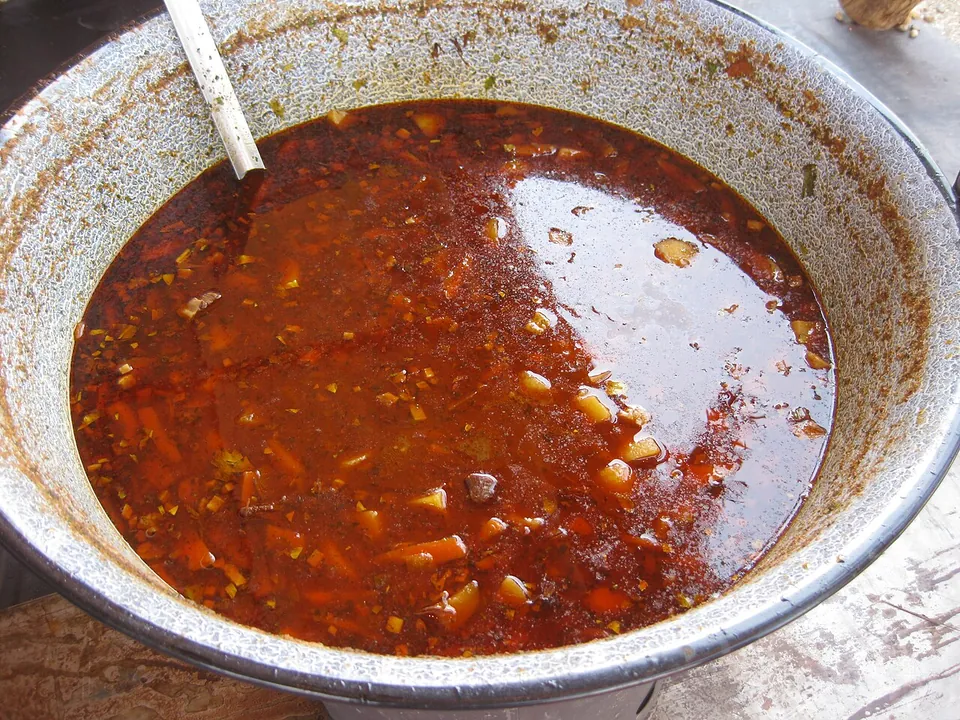
Goulash (gulyas, 'herdsman') descends from the portable meat stew cooked by herdsmen on the Hungarian plain. The stew itself is medieval in origin, but the paprika that defines the modern dish is a New World chili pepper that reached Hungary via the Ottomans around 1526 -- at first grown only as an ornamental, then adopted as food by herdsmen and peasants, and finally established as the dominant spice by the 19th century. Under Romantic nationalism, this humble herdsman's dish was elevated into an urban, elite, and eventually national dish. The stew genre is old, but the modern paprika-based dish is bounded by paprika's culinary adoption.
The three gates
- Ingredient-supply gate
- The limiting factor was the culinary adoption of paprika (a New World chili pepper). It arrived via the Ottomans around 1526, at first as an ornamental plant, was taken up as food by herdsmen and peasants, and became the dominant spice by the 19th century; 19th-century urban distribution (restaurants in Vienna and elsewhere) carried the modern paprika-based form into wider circulation
- Cooking-technique gate
- Paprika-grinding technology (hand-milling from the 18th century, industrial milling from the mid-19th century, steam rollers in the 1880s); its adoption as a national dish under Romantic nationalism is social context, not a technical gate
- Venue gate
- From herdsmen's fare to national dish
Overview
Goulash begins with the meat stews of the herdsmen who drove their cattle across the Hungarian plain, the Puszta. The idea of a stew simmered slowly in a great kettle is genuinely old, reaching back to the Middle Ages. But the bright red paprika stew we picture when we hear the word took shape much later, roughly across the 18th and 19th centuries.
What gave the dish this newer form was paprika. Paprika is a New World relative of the chili pepper; it reached Hungary in the first half of the 16th century by way of the Ottoman Empire. At first it was grown only as an ornamental in the flower bed and never went into the pot. It was herdsmen and peasants who first began picking it as food.
The turning point that pushed paprika to the fore as a seasoning came at the start of the 19th century. In 1806, when Napoleon's Continental Blockade drove up the price of imported black pepper, the cheap paprika that people could grow in their own fields began to take the place of pepper in the hands of peasants and herdsmen. During the cholera outbreak of 1831 paprika was even rumored to have medicinal virtue, which lent its reputation a further push. So the plant that had been a mere ornamental in the 16th century had, by the early 19th, become a seasoning that stood for Hungarian cooking itself.
The recipe for red goulash first appears in writing at just this moment. A cookbook printed in 1826, the Közönséges és legújabb Nemzeti Szakács Könyv, sets down a method almost identical to today's: onions and meat simmered in their own juices, seasoned with salt and paprika, and thickened with a little flour. The national cookbook compiled by István Czifray, court chef to Archduke Joseph, had likewise carried paprika dishes to the tables of the city and the court by 1830. The edition available to read in full today, though, is a later one — the eighth, printed in 1888, where the dish appears as No. 593, "Gulyásos és pörkölt hús." The taste of the herdsmen's kettle thus settled into fixed form on the page.
And what raised the herdsmen's plain kettle into a national dish was the mood of the age. In the 19th century, as a Romantic nationalism sought its bearings in the traditions of the people, the food of the Puszta herdsmen was welcomed onto the tables of urban nobles and elites. The origin in a herdsman's traveling ration met the era's fervor to imagine the nation as one, and goulash became the face of Hungary.
How we know
With goulash, the recurring question is how to count its age. The view that it descends from the herdsmen's traveling ration is well settled in scholarship and does not waver. That the very form of the stew reaches back to the Middle Ages is disputed by no one, and the name gulyás, meaning cowherd, speaks its origin plainly enough.
The care needed is not to fold that antiquity into the age of goulash as it exists now. Simmering meat is indeed old. But the red paprika that makes today's goulash what it is came across the sea only in the 16th century and after. Even if one could call the pre-paprika stew goulash, it would be a different dish, neither red nor hot.
The traces left on paper mark the same line. The recipe for paprika goulash appears in a cookbook in 1826, and no record can be traced earlier than that. The word goulash surfaces in English writing later still, in 1866. But this is no proof that the dish was born there; it is only a marker of the Hungarian herdsmen's kettle spreading, word and all, beyond the border.
So goulash is a dish whose present form is dated firmly by when the ingredient that decides its taste took its place at the table, even though the name stayed the same. The older a dish's roots, the easier it is to mistake the antiquity of its lineage for the antiquity of its present shape. Goulash quietly warns against that confusion.
The full set of origin theories and the detailed verification log — traceable all the way to their sources — are available on the Japanese edition.
See the full origin theories and verification log (Japanese) →