All dishes / 西欧
Pesto alla genovese Period COrigin theory CVerified
Some fields (dish name, region and gates) are shown from the Japanese-edition data.
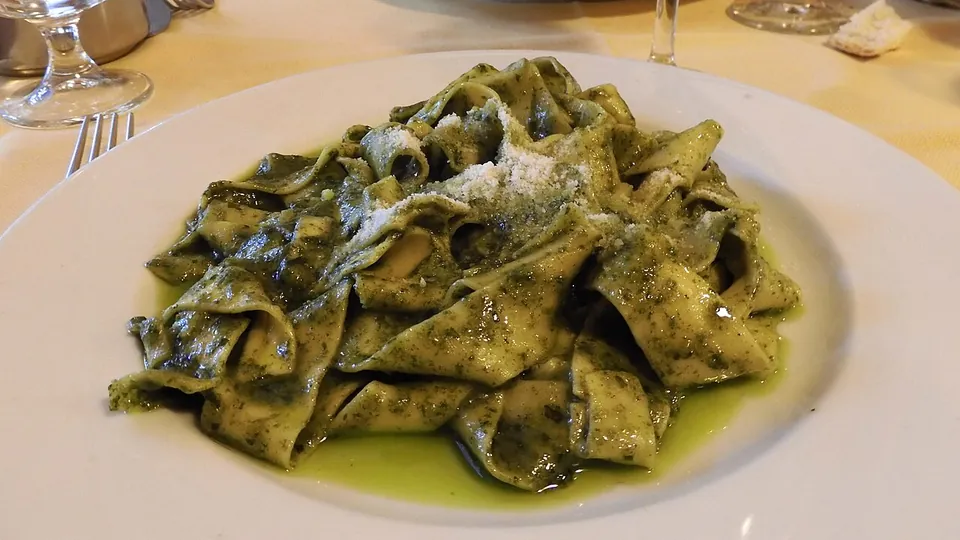
The vivid green sauce of pounded pine nuts and basil comes with a grand origin story that traces it to ancient Rome. But pesto with basil at its center is only recorded in mid-19th-century Genoa, and no source supports a direct line of descent reaching back two thousand years.
Verification highlight popular claim → verdict → evidence
The basil-based pesto known today first appears in print in the mid-19th century, in Genoese cookbooks by G.B. Ratto (1863) and Emanuele Rossi (1865). The practice of pounding herbs, garlic, and cheese in a mortar is far older, but the line between that older tradition and today's basil pesto is a gradual one, not a single moment of invention.
The three gates
- Ingredient-supply gate
- Basil, pine nuts, garlic, and olive oil are all native to the Mediterranean
- Cooking-technique gate
- Pounding in a mortar (mortaio); an uncooked sauce
- Venue gate
- Home cooking and port-town food of Liguria
Overview
Pesto alla genovese is an uncooked sauce in which basil, pine nuts, garlic, pecorino, and olive oil are pounded together in a mortar (mortaio). The name pesto comes from a word meaning "to pound," and it takes its name from the very technique of crushing and mixing without any heat.
The ingredients have all been part of the Mediterranean for a very long time. Basil, the lead, is an old herb rooted in this soil, and pine nuts, garlic, and olive oil were all standing ready in the kitchens of the Ligurian port of Genoa. The materials were at hand; what remained was for them to be brought together into one sauce.
The technique of pounding herbs and garlic in a mortar into a paste was itself old and widespread across the Mediterranean. The pounded cheese-and-herb pastes of ancient Rome, the medieval Genoese agliata of pounded garlic and walnuts: the genre of pounded sauces ran on unbroken. Within that genre, the version with basil as its main ingredient appears in the written record from the mid-19th century. No lower bound for when this basil-centered form took shape can be drawn from the sources; the earliest firm record is G. B. Ratto's La Cuciniera Genovese (1863). As a home dish of the port city of Genoa, this green sauce had taken on its present outline by the mid-19th century at the latest.
How we know
This dish is trailed by an appealing origin story: that it is a direct descendant of the ancient Roman moretum. The Moretum attributed to Virgil (Appendix Vergiliana) describes a paste of cheese, herbs, garlic, and oil pounded in a mortar, and this, the story goes, is the ancestor of pesto.
But the paste of the Moretum contains no basil. All the two share is the technique of pounding in a mortar, and there is no source showing a chain of transmission that carried that technique, main herb and all, down to today's pesto. The moretum was a Roman condiment complete in itself, and no thread of two thousand years of direct descent from it survives in the sources we can now check. That the genre of pounded sauces is old, and that this basil-based dish is old, are two different matters.
Source criticism turns up a still more entertaining episode. In the debate over pesto's first appearance, the 1852 edition of Emanuele Rossi's La Vera Cuciniera Genovese has often been cited, as evidence earlier than and older than Ratto's 1863. Yet this 1852 edition is a phantom that never existed. According to the study by the Museo della Cucina, Rossi's book actually came out in 1865, two years after Ratto, and the date 1852 was an error that grew as books copied one another. The wish for an older first appearance conjured up an edition that was never there.
What remains, then, is Ratto of 1863 as the firm first text. Yet a first text is still not a birth. The year a dish appears in writing marks only the latest point at which it could have existed; the single moment when a green sauce first began to be pounded in a Genoese kitchen dissolves into a continuous tradition and cannot be pinned down. Onto an old technique of pounded sauces, basil was set as the lead in the mid-19th century, and today's pesto alla genovese crystallized. That is as far as the sources can speak.
The full set of origin theories and the detailed verification log — traceable all the way to their sources — are available on the Japanese edition.
See the full origin theories and verification log (Japanese) →