All dishes / 北米
Reuben sandwich Period BOrigin theory CVerified
Some fields (dish name, region and gates) are shown from the Japanese-edition data.
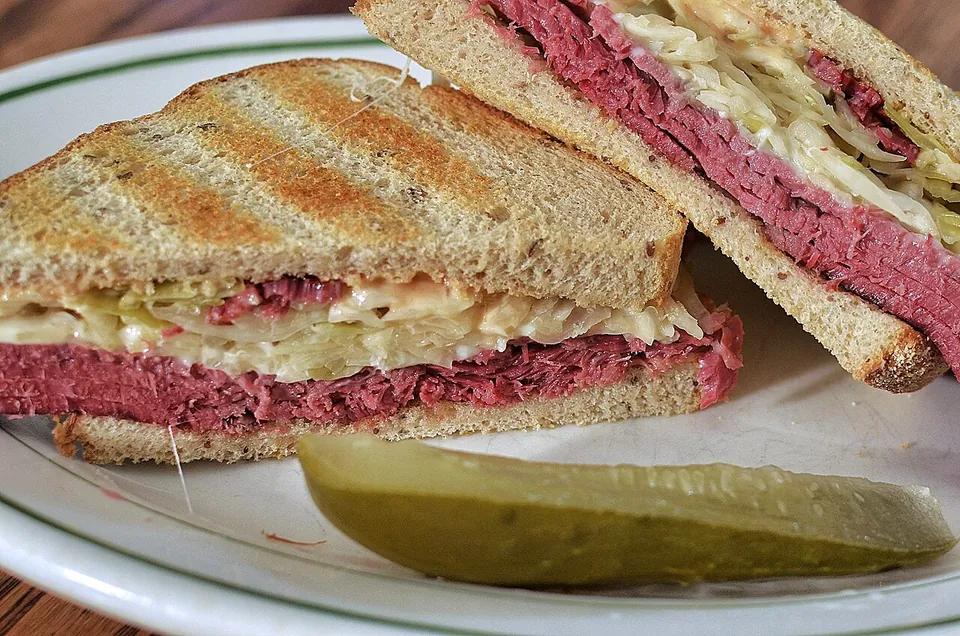
The Reuben sandwich layers corned beef, sauerkraut, and Swiss cheese on rye and grills them together. New York and Omaha have both claimed it as their own, and following the paper trail shows that the New York claimant was a sandwich of the same name but a different thing.
Verification highlight popular claim → verdict → evidence
Two rival origin stories compete: Omaha (invented at a poker game at the Blackstone Hotel, credited to Reuben Kulakofsky and the Schimmel family) versus New York (Arnold Reuben's delicatessen). Verdict: the earliest known menu matching the current form (corned beef, sauerkraut, Swiss cheese, rye) is an October 9, 1937 menu from the Cornhusker Hotel in Lincoln, Nebraska, supporting the Omaha attribution. Arnold Reuben's own original 'Reuben Special' was a different sandwich (roast beef or turkey with coleslaw and Russian dressing), so the New York story describes a same-named but different sandwich rather than a direct ancestor of today's Reuben.
The three gates
- Ingredient-supply gate
- Rye, cabbage (as sauerkraut), and beef (as corned beef) are all Old World foods already established in the US; no ingredient was a bottleneck.
- Cooking-technique gate
- Grilled or pressed as a hot sandwich.
- Venue gate
- Delicatessens and hotels (the exact founding site is disputed).
Overview
The Reuben is a hot, pressed sandwich of corned beef (salt-cured beef), sauerkraut (fermented cabbage), and melting Swiss cheese layered on rye bread and griddled under pressure. A thin spread of dressing and a crisp-browned surface let the sour, the salty, and the rich melt together in a single slice.
The rye, the cured beef, and the pickled cabbage were all long-established ingredients brought over from the Old World, on the shelves of ordinary grocery stores and delicatessens in early-twentieth-century American cities. The dish began with what was already at hand.
Rather than stacking these fillings cold, they are layered between rye and pressed on the griddle. The cheese melts, the bread browns, and a warm slice carrying acidity and salt comes off the plate. Its setting, too, was the city delicatessen and the hotel restaurant where immigrant food cultures crossed, kitchens that handled corned beef and sauerkraut every day. Its emergence is generally placed in the 1910s to 1920s.
How we know
Two places have long claimed the Reuben's birth: Omaha, Nebraska, and New York. The one long celebrated was the glamorous New York version, that Arnold Reuben, owner of Reuben's Delicatessen in Manhattan, created it in the early twentieth century. The food historian Andrew Smith once argued, on the strength of a 1941 cookbook, that it was a New York invention.
Yet trace the earliest document to show the sandwich in its present form, corned beef and sauerkraut grilled together, and it leads not to New York but to Nebraska. The oldest menu found by Jim Rader, an etymology editor for Merriam-Webster, is dated October 9, 1937, from the coffee shop of the Cornhusker Hotel in Lincoln: 'corned beef, Sauer Kraut, Swiss cheese on Russian Rye.' That hotel was then owned by the Schimmel family, who had been griddling the sandwich at the Blackstone Hotel in Omaha. In 1956 a Blackstone waitress won a national sandwich contest, and the Nebraska State Historical Society holds the dish to be born in the state.
On the New York side, no menu bearing that present form turns up. Arnold Reuben's original 'Reuben Special' was a cold sandwich of roast beef, ham, or turkey with cheese and coleslaw in Russian dressing, quite unlike the grilled corned-beef-and-sauerkraut version eaten today. Smith himself later acknowledged the two were different dishes. The New York Reuben was another sandwich that merely shared the name.
So has the inventor been settled? That remains in the fog. In Omaha, the grocer Reuben Kulakofsky is said to have asked for it at a poker gathering, and the Schimmels are said to have assembled it, but no contemporary record carries the story, which rests on a grandson's testimony. The first appearance in the documents is in Nebraska. Whose hands made the first slice, though, still cannot be said outright.
The full set of origin theories and the detailed verification log — traceable all the way to their sources — are available on the Japanese edition.
See the full origin theories and verification log (Japanese) →