All dishes / 南アジア
Paya Period COrigin theory DVerified
Some fields (dish name, region and gates) are shown from the Japanese-edition data.
The story that a Mughal court cook invented Paya is a tale borrowed from royal prestige. This slow-simmered trotter stew is the South Asian branch of a far older and wider tradition.
Verification highlight popular claim → verdict → evidence
A popular story credits the Mughal court with inventing trotter stew as a way to use every part of the animal. The sources don't support this: a Persian-Indian cookbook from before the Mughal era (1495-1510) already records slow-simmered meat dishes, and paya fits into a much older West and Central Asian tradition of head-and-trotter soups. Muslim court cooks across Delhi, Lucknow, Hyderabad, and Lahore likely refined today's spiced version under Mughal rule, but the dish itself predates them.
The three gates
- Ingredient-supply gate
- Animal trotters (sheep, cattle, goat) are all locally available parts of livestock.
- Cooking-technique gate
- Long, slow simmering that renders the connective tissue into gelatin.
- Venue gate
- A breakfast stew, eaten alongside nihari.
Overview
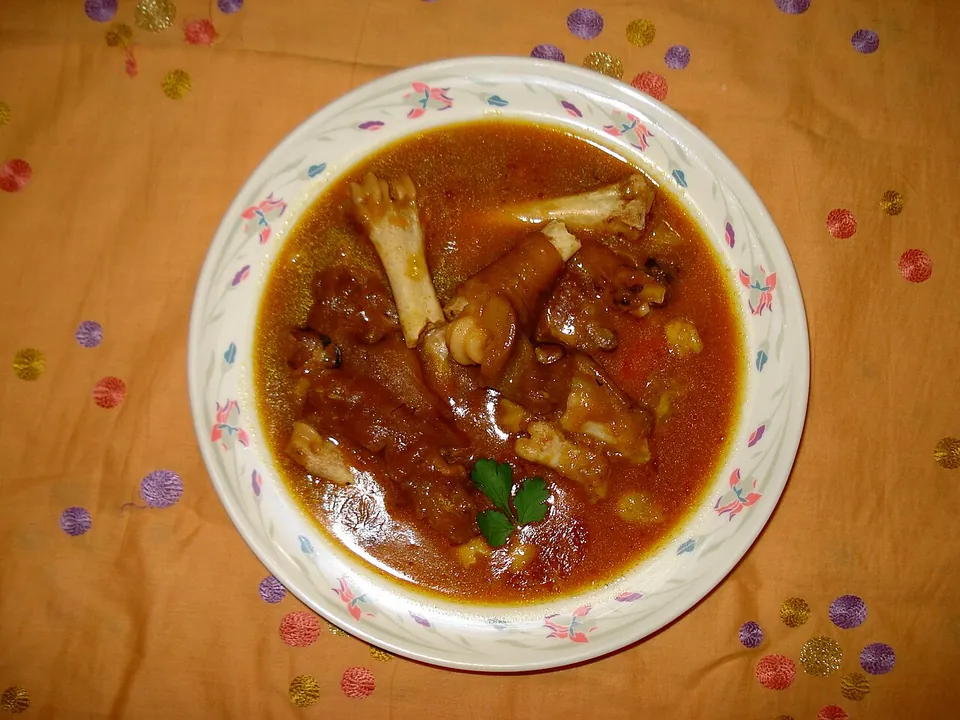
Paya is a stew of the feet of goats, sheep, or cattle, simmered for hours until the gelatin drawn from bone and sinew turns the broth thick and glossy. In Lahore and across the Muslim cities of South Asia, it has long been eaten at breakfast.
Livestock trotters were a familiar, close-at-hand food in this region from early times. The dish took its present shape when one particular technique settled into place: keeping tough feet at a low simmer for many hours to coax out the gelatin around the bone and turn it into a rich, viscous bowl. This patient, long-cooked craft is what defines Paya.
Where it is served has shaped the dish as much as how it is cooked. At dawn, steaming pots of trotters at markets and eating houses became the breakfast of people starting their day. These simmered dishes, called nihari and paya, are part of the morning life of urban Muslim society.
How we know
Paya often comes with a colorful origin story attached. A Mughal court cook, it is said, first devised a dish of feet as a way to 'use every part of the animal,' and it was a favorite of Emperor Akbar.
But this account has no contemporary record showing when, where, or by whom it was supposedly created. It reaches for a royal pedigree to raise the dish's standing, an after-the-fact narrative that does not hold up as history.
Soups made by simmering feet with the bone still in are older here than the Mughals. The Ni'matnama, a cookbook compiled in the late fifteenth century in Mandu, in what is now central India, already records meat and pulses stewed slowly with spices in a soup style. This slow-simmering craft was rooted in South Asia long before the Mughal court arose. Reach back further, and soups of heads and feet run as an old tradition from West Asia across Central Asia. The Persian kalle-pache, 'head and feet,' and pache, 'feet' — the very name paya belongs to this line.
Paya is this old tradition of trotter soups, carried into South Asia under Persian influence and brought to its present spicing by cooks in cities like Delhi, Lucknow, and Lahore. Rather than searching for a single moment of court invention, it makes far better sense to see it as the South Asian form of a bowl that had been simmered across many lands long before.
The full set of origin theories and the detailed verification log — traceable all the way to their sources — are available on the Japanese edition.
See the full origin theories and verification log (Japanese) →