All dishes / 南アジア
Kachori Period COrigin theory CVerified
Some fields (dish name, region and gates) are shown from the Japanese-edition data.
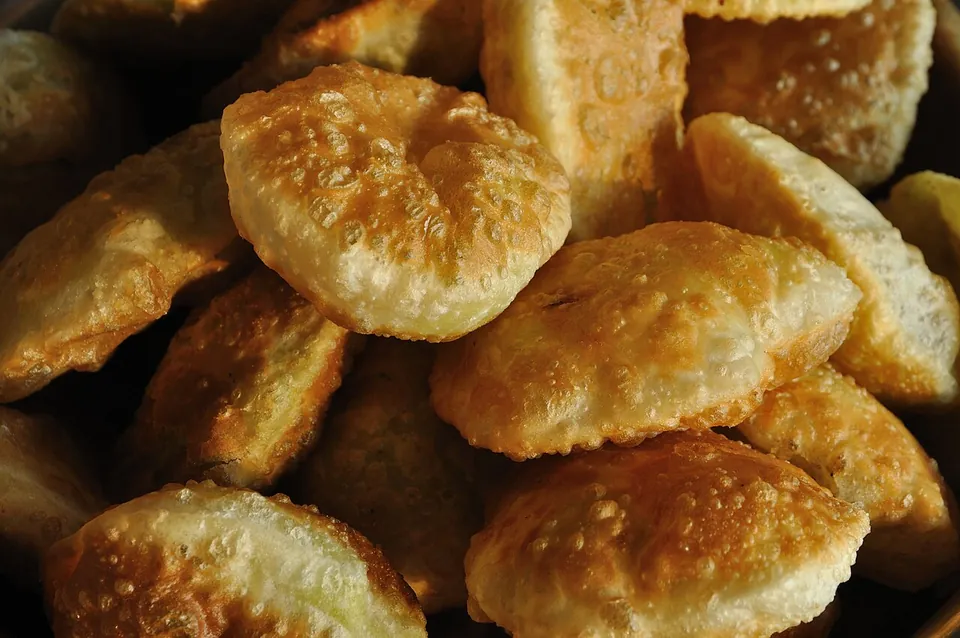
A north Indian snack of spiced lentil filling wrapped in a wheat shell and deep-fried. It is often said to appear in a seventh-century Jain text, but that reference cannot be traced to any source, and the word itself does not surface until the seventeenth century.
Verification highlight popular claim → verdict → evidence
A popular claim that a 7th-century Jain text mentions a fried pastry called 'Kacchari' cannot be verified -- every source citing it (Wikipedia, blogs) fails to name the actual text or passage, so it circulates without an independent source. What's solid: the word 'kachori' is securely attested in Banarasidas's Ardhakathanaka (composed 1641), whose verses 337-343 record him buying kachori on credit from a street vendor and living on it for months; the surrounding verses (257, dating Akbar's death to Samvat 1662 = 1605/06, and 438, Samvat 1671 = 1614/15) place the episode around 1605-1614, so the name was in real-world use in early 17th-century North India. Two origin accounts persist unresolved: that Marwari merchants of Rajasthan devised it as portable trade food, or that it continues an older lineage of fried legume-filled snacks traceable to medieval India (e.g. Manasollasa, 1127-1138 CE).
The three gates
- Ingredient-supply gate
- Wheat and lentils/beans are native; the potato-filled version postdates the New World potato's arrival.
- Cooking-technique gate
- A spiced lentil filling wrapped in dough and deep-fried.
- Venue gate
- Market and street snack (chaat) fare.
Overview
From the caravan routes of the desert
Kachori is a snack of spiced lentil filling wrapped in a wheat shell and fried. The shell is made from wheat flour (maida), the filling from moong or urad lentils. All of these were long-established Indian foods, on the everyday table from early on.
The origin most widely told places it in the Marwar region of western Rajasthan. In that dry country, the Marwari merchants who carried the trade are said to have devised it as a food for long journeys. Frying gave the snack keeping quality, well suited to an arid climate and the long distances of the caravan trade. Riding the merchants' networks, kachori is said to have spread through northern and eastern India across the eighteenth and nineteenth centuries.
Today it is a fixture of the chaat (savory snacks) sold in markets and on the street, enjoyed across many regions. In being wrapped and fried it resembles the samosa, but the filling and the shape of the shell are different: it belongs to a separate line of snacks.
How we know
A story often told of kachori is that a seventh-century Jain text mentions a fried pastry called kacchari. If that were so, kachori would carry a history of well over a thousand years. But the claim appears only in encyclopedia entries and a handful of blogs, none of which names the text or cites the passage in question. The sources merely copy one another and never reach an original. A story that leads to no primary source cannot be treated as a firm first attestation.
What is certain is that the lineage itself, a fried wheat shell around a spiced lentil filling, can be traced quite far back in India. Colleen Taylor Sen's Feasts and Fasts: A History of Food in India (2015) reports that the twelfth-century encyclopedia Manasollasa (1127-1138) records purika, a fried disc-shaped sweet, and dumplings of urad lentil; K. T. Achaya's Indian Food: A Historical Companion (1994) likewise records fried sweets of the same kind.
The word kachori itself does surface in the seventeenth century. The merchant Banarasidas, who finished his autobiography Ardhakathanaka in 1641, describes buying kachori on credit from a street seller and eating it for months on end. The episode falls somewhere around 1605-1614: in Mughal north India, the snack was already being hawked and bought in the street.
Still, it would be hasty to take the age of the fried-lentil lineage as the age of the present-day Rajasthani kachori. There is no proof that the fried sweets described in older times are the same thing we see today. That the genre is old, and when the current form came into being, remain separate questions.
One note: aloo kachori, in which the filling is replaced with potato, is a variant that arose after the potato spread from the New World, and the circumstances of its making differ from those of this lentil kachori.
The full set of origin theories and the detailed verification log — traceable all the way to their sources — are available on the Japanese edition.
See the full origin theories and verification log (Japanese) →