All dishes / 西欧
Moussaka Period BOrigin theory BVerified
Some fields (dish name, region and gates) are shown from the Japanese-edition data.
Layers of eggplant and minced meat covered with a smooth white sauce and baked—moussaka, one of Greece's signature dishes. The story that its white béchamel was born in the opulence of the Ottoman court fell apart when a food historian withdrew a theory she herself had long believed.
Verification highlight popular claim → verdict → evidence
The current bechamel-topped Greek moussaka was created by Nikolaos Tselementes, a chef trained in French cuisine, in the 1920s, first appearing in print in his 1932 cookbook Odigos Mageirikis. Its prototype, a layered eggplant dish called maghmuma, is documented in a 13th-century Baghdad cookbook translated by Charles Perry, a primary source. The popular claim that it originated at the Ottoman court (Topkapi Palace) is rejected by the sources -- food historian Aglaia Kremezi retracted her own earlier version of that claim.
The three gates
- Ingredient-supply gate
- Eggplant arrived in the medieval period; tomato arrived from the New World from the 17th century on; the bechamel relies on dairy and wheat.
- Cooking-technique gate
- Frying eggplant, layering it, and baking it topped with bechamel sauce.
- Venue gate
- Urban restaurants and home kitchens.
Overview
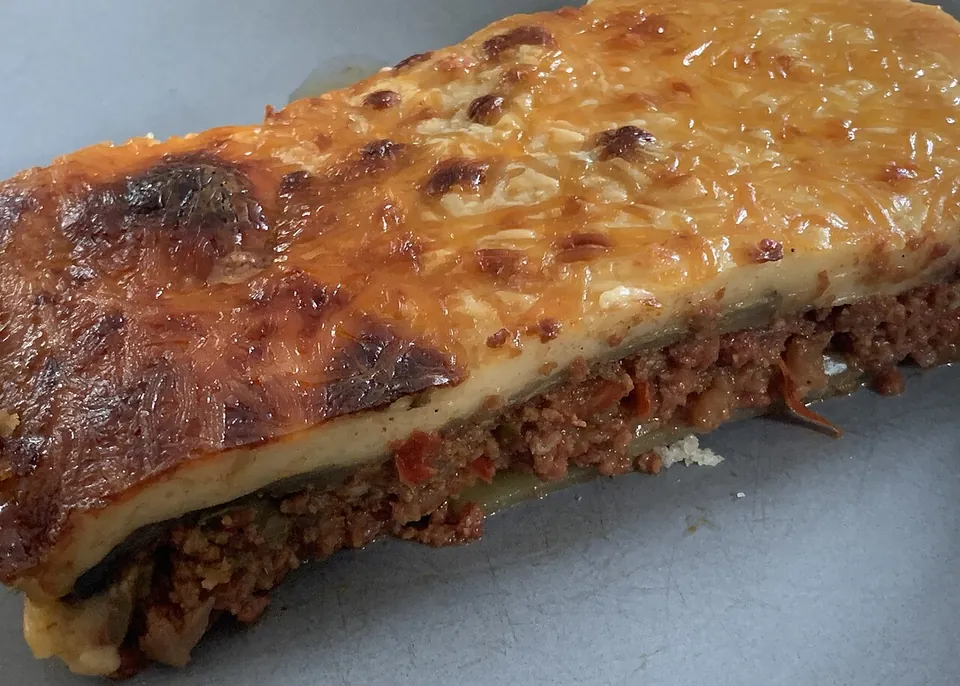
Moussaka is a dish loved in Greek homes and restaurants, built from layers of fried eggplant and tomato-seasoned minced meat, topped with a white béchamel sauce and baked. Beneath the browned surface, the layers of eggplant, meat, and sauce fold together.
The ingredients that make up the dish reached the Mediterranean in different eras. Eggplant arrived in the region during the medieval period; the tomato that flavors the minced meat came out of the New World and spread from the seventeenth century onward; and the béchamel that covers the top is a comparatively recent layer made from milk and flour.
Frying the eggplant, layering it, covering it with a white sauce, and baking—this sequence of handwork gave the dish its present three-layer form of eggplant, tomato-seasoned meat, and béchamel. This three-layer moussaka settled onto Greek tables in the first half of the twentieth century.
How we know
The name moussaka comes from the Arabic musaqqâ, "moistened." The thirteenth-century Baghdad Cookery Book records a dish called maghmuma, in which minced meat with eggplant, onion, and spices is built up in layers, and the genre itself—layered eggplant dishes—reaches back to the medieval Arab world. Through the Ottoman period this type, without a white sauce, spread across the Turkish and Arab lands and was carried to Greece as well.
What has long been told is that today's moussaka too, crowned with its white sauce, was born at the height of the Ottoman Empire, probably in the kitchens of the Topkapı Palace in Istanbul. The eastern ring of the word moussaka joined with the opulence of the court, and it sounded thoroughly plausible. The food historian Aglaia Kremezi herself believed in this courtly origin at first.
But as she looked further, it turned out that the present béchamel-topped moussaka appears nowhere before the early twentieth century. There is no independent source going back to the court period, and the Topkapı kitchen documents record no white-sauce moussaka. The béchamel version first appears in writing in 1932, in Odigos Mageirikis (Cookery Guide) by Nikolaos Tselementes, a Greek chef trained in French cooking. The white sauce is a recent addition owing to his French leanings, and before it moussaka was only fried eggplant layered with tomato-seasoned minced meat. Kremezi withdrew the courtly-origin theory she had believed and concluded that it was Tselementes's creation.
Two timelines thus come into view. The skeleton—layered eggplant dishes—is an old one reaching back to the medieval period, but the form we know and call "Greek moussaka," that dish under its smooth béchamel, is a new tradition born in the twentieth century. The steam rising from a palace kitchen was an aroma added to the story only afterward.
The full set of origin theories and the detailed verification log — traceable all the way to their sources — are available on the Japanese edition.
See the full origin theories and verification log (Japanese) →