All dishes / 中東・北アフリカ
Baba ghanoush Period BOrigin theory CVerified
Some fields (dish name, region and gates) are shown from the Japanese-edition data.
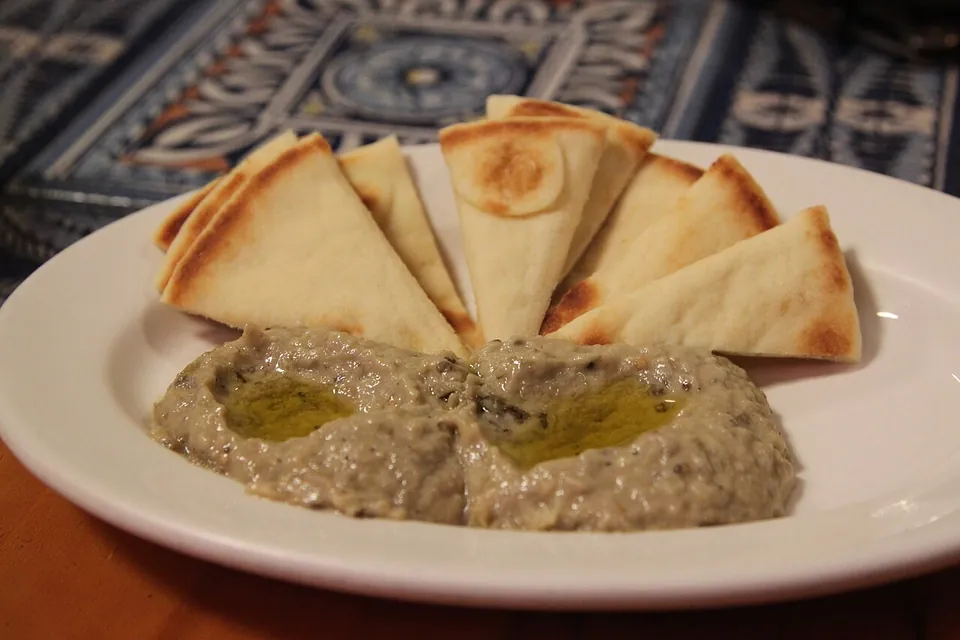
A Levantine meze of grilled eggplant dressed with tahini and lemon. The many origin tales that trace its name to a harem woman or a doting jester are later inventions, none of them backed by an independent source.
Verification highlight popular claim → verdict → evidence
Several folk tales trace the name baba ghanoush (roughly 'spoiled father') to specific stories — a harem cook, a toothless old man, and so on. None hold up under scrutiny; even the Oxford English Dictionary calls the harem story merely 'supposed.' The dish likely took its familiar form as one style of grilled-eggplant meze sometime in the modern era, though no pre-modern source names this specific preparation, and the word's earliest recorded English use dates only to 1938.
The three gates
- Ingredient-supply gate
- Eggplant, originally native to India, became established in the Levant through Islamic-era trade.
- Cooking-technique gate
- Eggplant roasted or charred directly over an open flame.
- Venue gate
- A home dish within the region's meze (appetizer) tradition.
Overview
Baba ghanoush is a cold appetizer of eggplant, grilled or smoked, then mashed and dressed with tahini (sesame paste), lemon, and garlic. It belongs to the home cooking and the meze table of the Levant, the eastern Mediterranean coast centered on Syria and Lebanon.
Its main ingredient, the eggplant, came originally from India and settled across the Islamic world, including the Levant, the wider Middle East, and North Africa, by around the eighth century. Medieval Arabic manuscripts record an early taste for dishes built on it. With the eggplant rooted in local kitchens, cooks could char it over open flame until the flesh softened through to the skin, then scoop it out. The smoky note that the flame leaves on the surface is what gives the dish its outline. Onto that go the richness of tahini, the acidity of lemon, and the bite of garlic.
Though it shares the Levantine meze table with hummus, that is a separate dish built on a different main ingredient, the chickpea. Read against the sources, baba ghanoush is best understood as one style of dressed grilled eggplant that settled into a dish of its own within the modern record.
How we know
Several tales have circulated to explain the name. Reading the Arabic babba ghannouj as pampered father or jester, one story has a harem woman present the dish to a sultan; another has a daughter mashing eggplant for a toothless old father; another says the dish was so easy a child could make it, hence pampering the father; another still glosses the eggplant as the big daddy of vegetables.
None of these rests on an independent source. They are later folk etymologies, explanations attached after the fact. The Oxford English Dictionary goes no further than noting the harem story as supposed, and does not treat it as fact. The more charming the tale, the more it travels on its own; but no contemporary record backs it up.
So when was the dish born? The eggplant settled in the Levant around the eighth century, but the word babba ghannouj itself is first recorded in English only in 1938, in the OED. That is a date by which the dish existed at the latest, not the year it was created. No pre-modern source shows when this particular meze took shape as a dish in its own right, and even the quarrel over whether it began in Lebanon or Syria is not settled by the record. Set aside the colorful tales about the name, and what remains is a plainer but firmer picture: a grilled-eggplant meze that settled in during the era of written record.
The full set of origin theories and the detailed verification log — traceable all the way to their sources — are available on the Japanese edition.
See the full origin theories and verification log (Japanese) →