All dishes / 東南アジア
Amok Period COrigin theory CVerified
Some fields (dish name, region and gates) are shown from the Japanese-edition data.
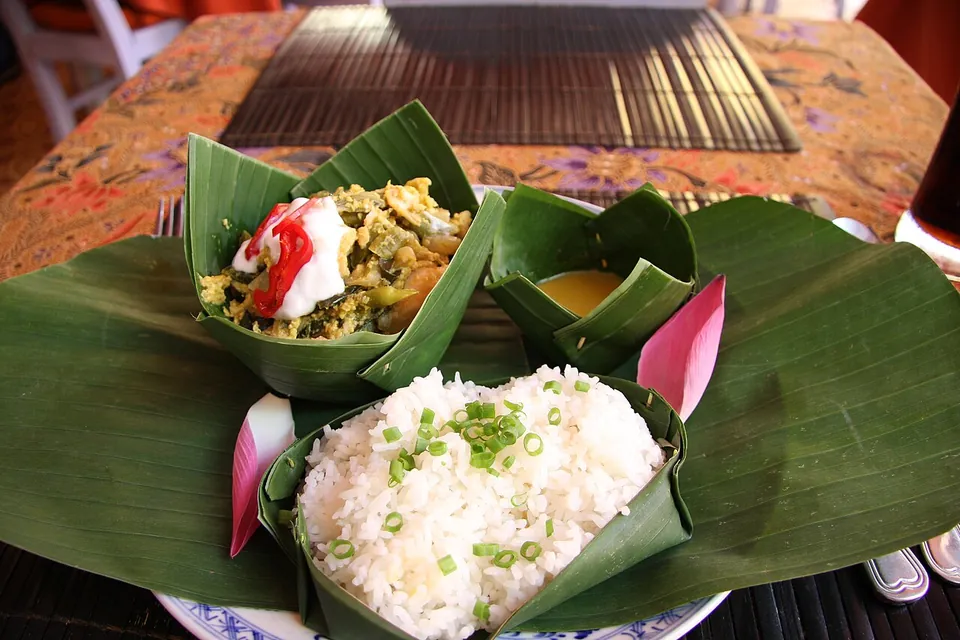
A fish custard steamed in banana leaves, one of Cambodia's defining dishes. It is often said to have been born in the kitchens of the Khmer court, yet that royal origin cannot be followed in the sources, and both the derivation of its name and the direction of its travel remain in dispute.
Verification highlight popular claim → verdict → evidence
The claim of an Angkor-era royal court origin rests on oral tradition with no contemporary documentation -- even the writer who is the source of the Portuguese-etymology theory has admitted that the claim of historical authenticity going back more than a couple of generations is untenable. Meanwhile, the Khmer word 'haa mok' looks like a loanword from Thai 'ho mok', and Ayutthaya-era Thai court law and epic poetry already record steamed curry dishes, so the textual record favors Thailand. Fish, coconut, and herbs are all native, so no imported ingredient limits the dish's origin.
The three gates
- Ingredient-supply gate
- Fish, coconut, and herbs are all native ingredients; there is no imported ingredient constraining the dish's origin.
- Cooking-technique gate
- Steaming a custard-like mixture wrapped in banana leaf.
- Venue gate
- From royal court cuisine to a festival and tourist dish.
Overview
When and where it took shape
Amok is white fish folded with coconut milk and kroeung, an aromatic paste built on lemongrass and other herbs, then wrapped in banana leaves and steamed. As it cooks it sets softly, like a custard, with a mild, rounded texture. It stands as one of the emblematic dishes of Khmer cuisine, served at festivals and set before visitors.
The white fish at its heart, the coconut, and the lemongrass and other herbs were all old ingredients rooted in Cambodia's landscape, on everyday tables from early on. This is a dish assembled from what lay close at hand, tied to its own soil.
The face of the dish is its wrapping and steaming in banana leaves. Rather than an open flame or a pot, the leaf parcel lets steam bring the mixture slowly up to heat, so that the coconut milk and fish do not separate but gather into a smooth custard. This wrap-and-steam is what sets amok apart from a plain steamed fish.
Where it was served has shifted from the court toward everyday life. Once told of as a dish of the royal household, it is now enjoyed as festival food and, through tourism, as one of the faces of Cambodia.
How we know
The origin of amok is contested by several accounts at once.
The most widely repeated is the tradition that it was a royal dish born in the palace kitchens of the Khmer Empire of the Angkorian period (802 to 1431). The food writers Alford and Duguid regard both the name and the technique as Khmer in origin. Yet no contemporary text records this palace origin; the story rests on oral tradition alone. Fittingly, the very writer who first proposed a Portuguese derivation for the name, Phil Lees, admits that Khmer cuisine can be traced back only about two generations, and that claiming a deep historical pedigree for it is absurd. That the genre of the dish is old is not denied, but there is at present no source to corroborate the idea that today's amok took shape in an Angkorian court.
The account that reverses the direction of travel has textual support. On this view the Khmer word haa mok is a loan from the Thai ho mok, and the dish itself passed from the Ayutthaya kingdom (1351 to 1767) into Cambodia. On the Thai side, the Palace Law that codified the court's ceremonial calendar lists ho mok among the foods offered to monks in the royal monthly rites, and the Ayutthaya-era epic Khun Chang Khun Phaen describes a curry wrapped in leaves and steamed. In matters of language too, the scholarly Cambodian-English dictionary compiled by Headley and others (1977) enters haa mok, and the Cambodian monk Chuon Nath, in his Khmer dictionary of 1967, held the Thai-derived form to be correct and cautioned against the spelling amok.
A dish native to the Khmer court, or one that came over from Thailand? A name from Khmer, from Thai, or from Portuguese? Even as older textual clues accumulate on the Thai side, the history of amok stands with these several accounts side by side, still not settled into one.
The full set of origin theories and the detailed verification log — traceable all the way to their sources — are available on the Japanese edition.
See the full origin theories and verification log (Japanese) →