All dishes / 東南アジア
Kuy teav Period BOrigin theory BVerified
Some fields (dish name, region and gates) are shown from the Japanese-edition data.
Kuyteav, the rice-noodle soup that carries Phnom Penh through the morning, looks at a glance like a purely Cambodian dish. In fact it is a border-crossing noodle story—a Teochew Chinese noodle culture that dissolved into local ingredients and local taste.
Verification highlight popular claim → verdict → evidence
No competing folk story to weigh against. The account the sources agree on traces Kuy teav to Cambodia's Teochew Chinese community, whose migration began in the 1860s and grew into the largest Chinese group in Phnom Penh by the 1920s-30s, corroborated by independent lines of evidence (Willmott-era demographic history, linguistics, food history).
The three gates
- Ingredient-supply gate
- Rice and pork were already available locally; the limiting factor was the arrival of Teochew Chinese noodle culture (trade and technique).
- Cooking-technique gate
- Assembling rice noodles with a clear broth, shaped by Teochew noodle technique.
- Venue gate
- A street-stall breakfast noodle dish.
Overview
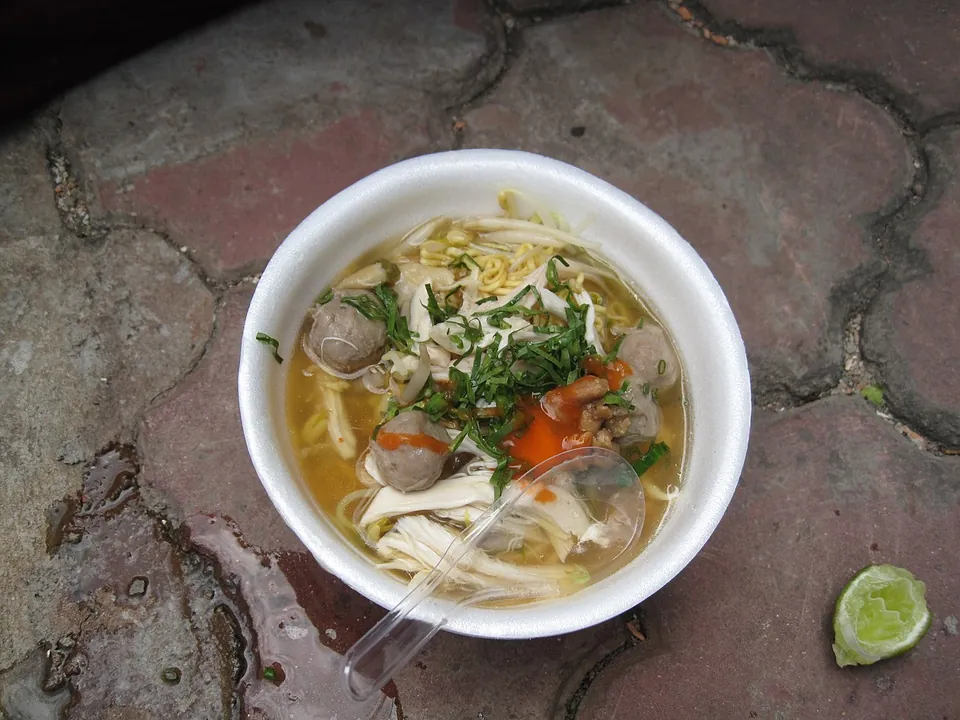
Kuyteav is a rice-noodle soup that took its present form in and around Cambodia's capital, Phnom Penh, from the later nineteenth into the earlier twentieth century. Rice noodles rest in a clear pork-bone broth, garnished with pork, and it is eaten in the morning.
Rice and pork are both native to Cambodia—long-established foods that had been on the everyday table from early times. Kuyteav came into being when Teochew people from southern China brought a new way of eating with them as they migrated. Their way of drawing noodles from rice and matching them to a clear broth was worked over to suit local Khmer ingredients and taste, and it became an everyday dish of the streets. Teochew migration gathered force in the 1860s, after French protectorate rule encouraged arrivals from southern China, and by the 1920s and 1930s these migrants had grown into the largest group among Phnom Penh's Chinese. Kuyteav settled in step with this wave of migration.
The setting, too, shapes the dish. Kuyteav took root as a quick noodle dish served at street stalls in the morning. The noodles are blanched to order on the spot, hot broth is poured over, and it is handed across. Fitted to this street-corner breakfast, the style of a light, clear bowl was refined.
How we know
Start with the name, and it already speaks to the dish's origin. The word goes back to the Teochew guê-diao (粿條, rice noodle), carried along with the dish itself by migrants. The same word branches out across Southeast Asia—into Khmer kuyteav, Thai kuai tiao (ก๋วยเตี๋ยว), and Vietnamese hủ tiếu.
On the origin of this dish there is no real quarrel among the sources. Scholarship on the population history of Teochew migration, the linguistics tracing the chain of words, and the food history of street eating all point the same way: Teochew people resettled in Phnom Penh's Chinatown from the later nineteenth century, brought Chinese noodle technique with them, and it fused with local ingredients and taste to become kuyteav. There is, notably, no origin tale claiming kuyteav as an indigenous Khmer dish, and it has been confirmed to have no connection with the similarly named Kuy people.
What makes it interesting is that dishes of the same descent line up across borders. Vietnam in particular has a family of hủ tiếu called hủ tiếu Nam Vang—'Phnom Penh noodles'—held to be the Cambodian-born kuyteav carried to Saigon in the earlier twentieth century. Seen this way, it is closer to the truth to read kuyteav not as something Cambodia alone possesses, but as one form in which Teochew noodle culture took root across Southeast Asia, wearing the flavour of each land.
The full set of origin theories and the detailed verification log — traceable all the way to their sources — are available on the Japanese edition.
See the full origin theories and verification log (Japanese) →