All dishes / 東アジア
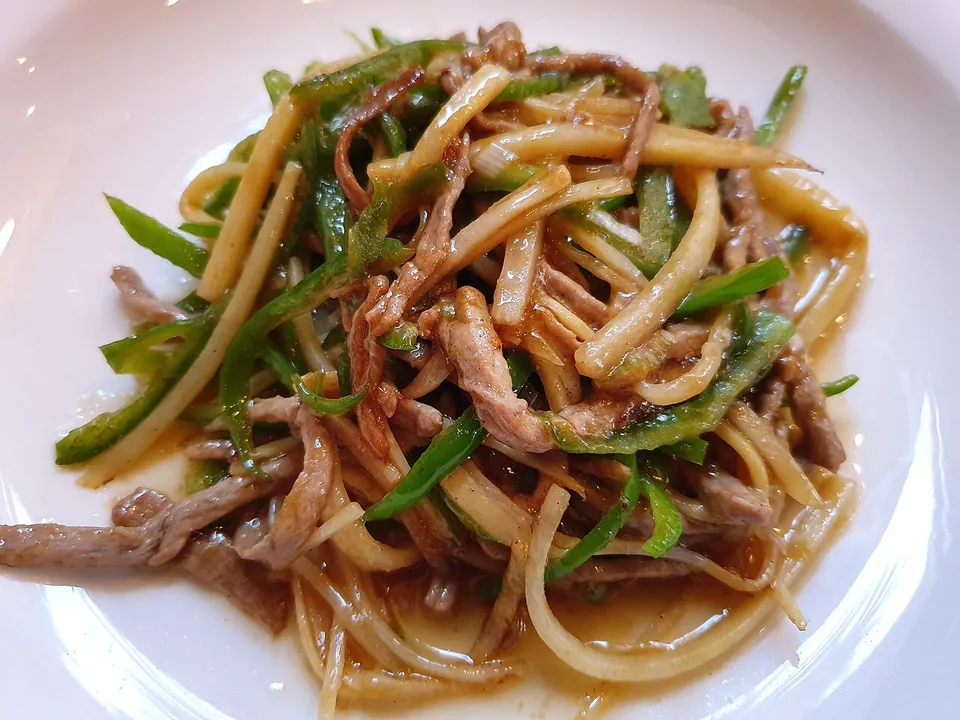
Qingjiao rousi (pepper and pork stir-fry) Period BOrigin theory CVerified
Some fields (dish name, region and gates) are shown from the Japanese-edition data.
Slivers of green pepper and pork tossed together over a roaring wok flame: a staple of Chinese cooking so familiar that its home province still cannot be agreed upon, claimed at once by Sichuan, Guangdong, and Fujian.
Verification highlight popular claim → verdict → evidence
Claims variously trace the dish to Fujian or to Sichuan/Cantonese cuisine. Verdict: regional attribution remains unsettled across all sources -- the bell pepper (a non-spicy Capsicum annuum cultivar, distinct from chili peppers) reached China by the 1570s, and Tang Lu-sun's essays record it as a chef's-exam dish among wealthy Republican-era households, confirming an early-modern date even though no primary source fixes the region (Brian R. Dott, The Chile Pepper in China).
The three gates
- Ingredient-supply gate
- The bell pepper (sweet capsicum) is a New World nightshade; its arrival in China no earlier than the late Ming sets the earliest possible date. Limiting ingredient.
- Cooking-technique gate
- Fine-sliced pork and pepper stir-fried over high heat in a wok (chao).
- Venue gate
- A household and everyday-restaurant staple that spread widely.
Overview
When and where it took shape
Qingjiao rousi is green pepper (qingjiao) and pork, both cut into thin slivers and stir-fried fast over a hard wok flame. It spread as an everyday home and canteen dish, and today it is one of the standards of Chinese cooking.
The star of the plate is the sweet bell pepper, which carries no heat. It belongs to the pepper family but is a different line from the fiery chile (lajiao): a mild, gentle-fleshed cultivated variety known as tianjiao or caijiao. Its home is Central and South America, and the fruit that Europeans carried eastward reached China in the second half of the sixteenth century; by 1591 it appears in the writings of Gao Lian. Some hold that the large sweet peppers were only grown in earnest from the nineteenth century onward, but either way, a stir-fry built around the green pepper could take form only once the fruit had settled onto Chinese tables.
The other deciding element is the wok technique of chao: setting the pan over a fierce flame and tossing the slivered ingredients through it in moments. This high, brief heat gives the dish its crisp bite and its toasted fragrance. The bright green of the pepper and the savor of the pork bound together in that fierce heat, and the shape of today's qingjiao rousi was set. By the late Qing it had reached the everyday tables of the court and the wealthy; the food essayist Tang Lusun recorded that a stir-fried qingjiao rousi was set as a test dish when households hired a cook, a way to judge command of the high wok flame.
How we know
Which region qingjiao rousi belongs to is, in truth, unsettled.
It is often taken for a Sichuan dish, yet the mainstream form today is closer to the Cantonese style, leaning on savory depth over heat with oyster sauce and the like. Beyond that, some trace it to a Fujian dish of slivered stir-fried pork. The Fujian-origin claim is often repeated in Japanese-language sources, but no contemporary primary record stands behind it. The regional attribution sits this way, several accounts side by side, none of them settled.
The era of its making, by contrast, is clearly drawn. The green pepper is a fruit of Central and South America, and it came to China in the later sixteenth century, showing up in writing by 1591. Brian R. Dott's study, The Chile Pepper in China, follows in careful detail how peppers took root in Chinese food culture. And by the first half of the twentieth century, a stir-fried qingjiao rousi had become a test dish for judging a cook's hand: the scene Tang Lusun set down tells us this dish was a settled everyday staple by the modern era at the latest.
The regional lineage remains a matter of several accounts, yet the era of its making is lit clearly enough. A modern story turning on a single fruit carried over from the Americas: that is the parentage of the plate called qingjiao rousi.
The full set of origin theories and the detailed verification log — traceable all the way to their sources — are available on the Japanese edition.
See the full origin theories and verification log (Japanese) →