All dishes / 南アジア
Luchi Period BOrigin theory BVerified
Some fields (dish name, region and gates) are shown from the Japanese-edition data.
The Portuguese brought white wheat flour and so gave rise to luchi, the Bengali fried bread, a widely told origin story that cannot hold, because fried wheat bread was already rooted in the land long before.
Verification highlight popular claim → verdict → evidence
A popular claim credits Portuguese traders with introducing refined wheat flour (maida) and thereby creating luchi, but the fried-wheat-bread technique itself is already described in the 11th-century physician Chakrapani Datta's Dravyaguna -- some 500 years before Portuguese contact -- under the Pala-dynasty term shaskuli, so the Portuguese story substitutes a later refinement for the dish's much older actual origin.
The three gates
- Ingredient-supply gate
- Refined wheat flour and ghee were both native to the Indian subcontinent, so no ingredient acted as a bottleneck.
- Cooking-technique gate
- A technique of kneading refined wheat flour, rolling it thin, and deep-frying it in oil until it puffs.
- Venue gate
- Popular as a fried bread for Bengali festivals, breakfasts, and hospitality.
Overview
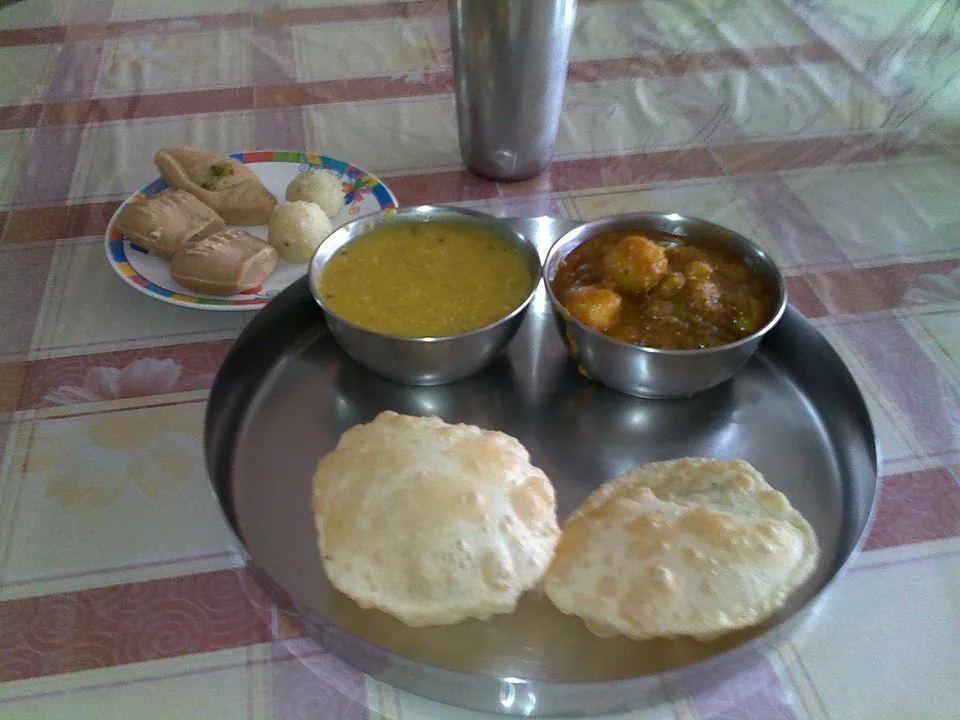
Luchi is a Bengali fried bread of refined wheat flour, kneaded and rolled thin into a round, then fried in hot ghee until it puffs up light. It appears at festivals, at breakfast, and at tables set to honor guests, a festive food that took hold across Bengal over the early modern and modern eras.
The ingredients that carry this dish were all long present on the Indian subcontinent. Wheat, the main ingredient, has been grown here as a native crop since the Harappan period, and both the refined wheat flour and the ghee for frying were long-established local materials, on hand from early on.
What gave luchi its form was the craft of working those materials. Knead wheat flour with ghee, roll it thin, drop it into hot oil and let it swell: luchi became luchi when this craft of making a fried wheat bread found its place as a festive dish on the Bengali table. In Bengal under the Pala dynasty (eighth to twelfth centuries) there was already a fried wheat bread called shaskuli, with a distinction between the kind kneaded with fat and the kind without. The fat-kneaded line grew into the luchi of Bengal, and the fatless line into the puri of North India; the two are sister dishes sprung from a single source. The name luchi itself appears in early modern texts, and from there it is drawn into tales and plays as the finest of light dishes.
How we know
Luchi has another well-known origin story. The Portuguese who came to India in the sixteenth century, it is said, brought the milling of refined wheat flour (maida), and that gave rise to Bengal's luchi. The pairing of white flour with foreign trade sounds suitably distinguished, and it has spread through popular food media.
But there is a decisive gap in time. The craft and form of fried wheat bread, wheat flour kneaded with ghee, rolled thin, fried until it puffs, was already present in Pala-dynasty Bengal, some five hundred years before the Portuguese crossed the seas. Fried bread itself was in the land far earlier, so sixteenth-century trade cannot have given rise to it. Refined wheat flour, too, was long known in South Asia and needed no Portuguese arrival.
This origin story, then, substitutes a single improvement, refined flour, for the birth of the dish itself. The Portuguese did not give rise to luchi. The genre of luchi is far older, rooted in this land. What must not be mistaken here is that none of this denies the age of the fried-bread line. What the tale is stripped of is the plot of a Portuguese origin; that luchi is an old Bengali food only grows the surer for the refutation.
The full set of origin theories and the detailed verification log — traceable all the way to their sources — are available on the Japanese edition.
See the full origin theories and verification log (Japanese) →