All dishes / 南アジア
Rasam Period COrigin theory CVerified
Some fields (dish name, region and gates) are shown from the Japanese-edition data.
A South Indian cook is said to have saved a sick prince with a single bowl of soup, the celebrated origin of rasam. No old record supports the tale. The real heart of this sour-and-spicy soup lies not in legend but in the tamarind and black pepper long rooted in South Indian soil.
Verification highlight popular claim → verdict → evidence
One story has a Madurai cook named Karunas invent a restorative soup for a king's sick son and win a reward for it, which explains neatly why rasam is still given to the ill; no independent record behind the tale has been found, and it belongs to folklore rather than to the history of the dish. A second and soberer account places the beginning in sixteenth-century Madurai, where Saurashtra families who settled there after the fall of Vijayanagara are said to have made a sour broth from the tamarind and pepper around them. It fits the shape of rasam, but the act of invention in that century is not confirmed by any contemporary source, and it stands as one account among several. When rasam itself began is not known, and a starting year taken from that century would rest on the story rather than on a record. What is firm lies further back and is simpler. Tamarind and black pepper are both South Indian, and the name says so: milagu thanni, pepper water in Tamil, which crossed into English as mulligatawny, first evidenced in the Oxford English Dictionary in 1784, the date of the loanword in print and not of the dish. Niccolao Manucci, in India from 1653, wrote in Storia do Mogor (c.1700) that South Indians drink water boiled with pepper, so the sour peppery broth was there by the end of the seventeenth century. K. T. Achaya's Indian Food: A Historical Companion (1994) treats tamarind and pepper as the base and tomato, curry leaf and lime as later additions; the red tomato rasam is one version among many, and the plain milagu rasam is the older shape.
The three gates
- Ingredient-supply gate
- The dish turns on tamarind and black pepper, and both are long-established South Indian crops: black pepper is native to the Western Ghats and was in use by about 1000 BCE, tamarind in the south from about 500 BCE. Both were there for the taking locally, and no imported ingredient fixes a date on rasam, which is accordingly older than the tomato in South India. Tomato is a modern and optional addition, thakkali rasam being one variant among many rather than the dish itself, and chilli is optional in the same way; the classic form, milagu rasam, is made with black pepper alone. The tomato came to South India late, recorded in Winslow's Tamil dictionary of 1862 and placed somewhere between 1600 and 1862, but that has no bearing on when rasam began.
- Cooking-technique gate
- Spices simmered in tamarind water to make a sour, peppery broth.
- Venue gate
- Everyday cooking in ordinary Tamil homes.
Overview
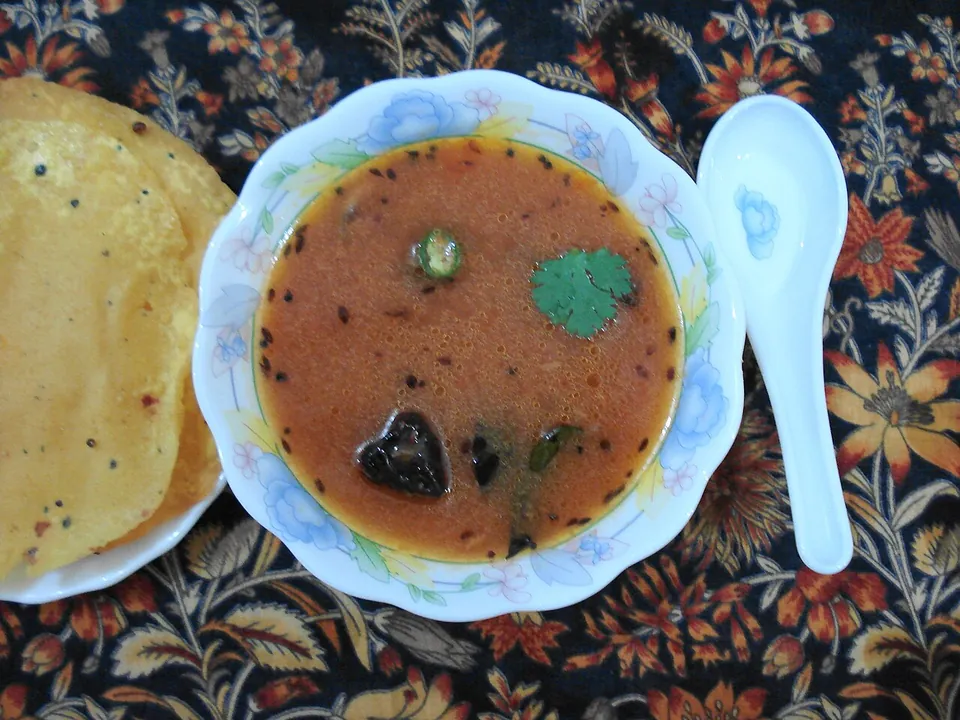
Rasam is a sour, peppery soup of the Tamil country in South India, made by boiling black pepper into water sharpened with tamarind pulp. Tart and tingling at once, it is ladled over rice or sipped on its own, a warming bowl that returns to the table day after day.
The two pillars of that flavor, the sourness and the heat, are both ingredients long rooted in the South Indian land. The tamarind tree grows here, and its tart pulp has long been a ready souring agent. Black pepper, too, made this coast famous the world over as its source, a heat close at hand in everyday life. The idea of dissolving something sour and something sharp into water and sipping it comes naturally in a land where both lie within reach.
The name itself states the dish's core. In Tamil, the word for pepper joins the word for water into a name meaning pepper-water, reflecting the old form of rasam, and that name crossed the seas to become the English soup name mulligatawny. As the name says, the original dish is complete with the sourness of tamarind and the heat of black pepper alone.
The red rasam thickened with tomato, common today, is a later addition. Only after the tomato crossed the ocean and took root in South India did that color and sweet-sour note enter these kitchens. Curry leaf and lime are likewise later touches; strip them away, and rasam still stands as rasam so long as there is tamarind and black pepper. The tomato is no lead player but a guest received afterward.
How we know
Two stories have been handed down about the origin of rasam: one a lovely invention, the other a lineage said to have been carried by migrants.
The best known is the anecdote of Karunas, a cook of Madurai. For a prince who had lost his appetite and fallen ill, he is said to have made a nourishing soup that restored him and won a reward, and that, the tale goes, was the beginning of rasam. The story vividly explains why rasam is still valued as food for the sick and the recovering. But no contemporary record supports the anecdote. It is a folk tale that took its shape in the retelling, and it cannot be treated as history of where the dish actually came from. More likely the soup's familiarity as a food of recovery drew the fine tale to it afterward.
The other, more grounded account runs thus. When the kingdom of Vijayanagara fell in the sixteenth century, a Saurashtra community that resettled in Madurai made a sour soup from the tamarind and black pepper abundant in the region, and that, it is said, was the beginning of rasam. The word they used for sourness is spoken of alongside the dish. This account sits well with a rasam built on tamarind and black pepper, and food history holds that these two were the base while tomato and curry leaf came later.
Only the single point that it was invented in the sixteenth century lacks an old record to confirm it. So this account, though told as a plausible common view, is not asserted but remains one of several. What is certain is not the year of invention but the core of the dish itself. The pairing of tamarind and black pepper, the sourness and heat long present in South India, is rooted deep in this soil whoever first named it and whenever. What truly holds rasam up is neither the legend of the rescued prince nor any tale of a single invention, but those two ingredients.
The full set of origin theories and the detailed verification log — traceable all the way to their sources — are available on the Japanese edition.
See the full origin theories and verification log (Japanese) →